AI Tools for Workflow Analysis & Process Mapping 2026

Artificial Intelligence
September 12, 2026
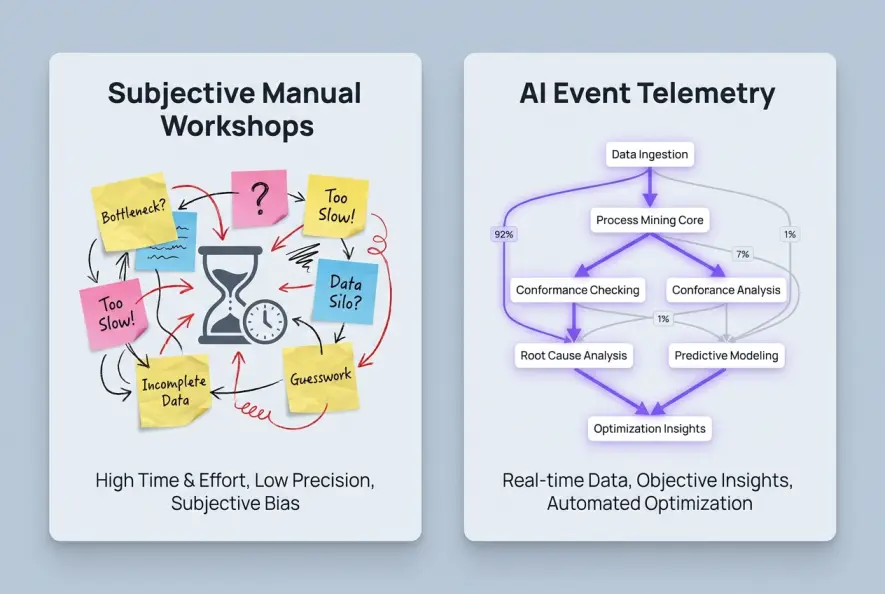
According to enterprise operational research from Gartner, over 68% of corporate process documentation becomes obsolete within sixty days of being finalized. This breakdown occurs because traditional documentation captures work-as-imagined by managers rather than work-as-done by front-line teams. In practice, operational workflows diverge into hundreds of unrecorded workarounds across spreadsheets, email threads, and instant messaging channels within weeks of any strategic rollout.

Deploying modern AI tools for business workflow analysis process mapping 2026 solves this systemic blindness by replacing subjective interviews with real-time digital telemetry, computer vision task mining, and causal graph reconstruction. Instead of static swimlane flowcharts that gather dust in internal wikis, these platforms ingest raw event logs from enterprise software to build living digital twins of your operations. These systems automatically surface hidden bottlenecks, calculate the exact financial cost of rework, and highlight where manual handoffs throttle company velocity.
Understanding how these platforms operate—and how to separate true algorithmic discovery from rebranded workflow diagramming software—is essential for any organization seeking operational efficiency.
The Breakdown of Traditional Process Mapping
For decades, business process analysis followed an expensive, disruption-heavy script. Leadership hired external consultants who spent months interviewing department heads, observing employee screens, and facilitating whiteboard workshops.
This manual approach suffers from three structural flaws that make it unusable for fast-moving businesses:
- The Hawthorne Effect: When workers know consultants are observing them, they adhere strictly to formal operating procedures. Once observation ends, they immediately return to the informal shortcuts required to meet daily deadlines.
- Cognitive Recall Bias: Even during transparent interviews, employees recall how a task is supposed to flow rather than the micro-exceptions, system crashes, and manual data re-entries that happen daily.
- Point-in-Time Stagnation: A manual process map represents a frozen snapshot. The moment your engineering team updates an API, your sales team adopts a new CRM field, or your billing vendor changes its invoicing layout, that static map becomes misleading fiction.
When leadership makes capital allocation or automation decisions based on obsolete process maps, the consequences are expensive. Teams automate the wrong tasks, purchase software that conflicts with existing protocols, and unintentionally cement broken workflows into code.
Stop asking team leads how their departments complete tasks. Instead, look directly at event logs and transactional timestamps. Systems never experience memory fatigue, and audit trails do not lie about handoff delays.
The Engine Room: How AI Discovers Real Workflows
Contemporary workflow analysis platforms do not ask your staff what they do; they mathematically reconstruct what happened by analyzing digital exhaust. This intelligence operates across three distinct capture layers.
1. System Event Log Ingestion
Every modern software application generates digital breadcrumbs. When a support agent updates a ticket, an accountant reconciles a line item, or a logistics coordinator approves a bill of lading, the underlying database records an immutable event log.
An event log requires three fundamental data points:
- A unique identifier (Case ID, such as Invoice #9821)
- An activity name (such as "Credit Check Approved")
- A verified timestamp (such as
2026-09-08T09:14:22Z)
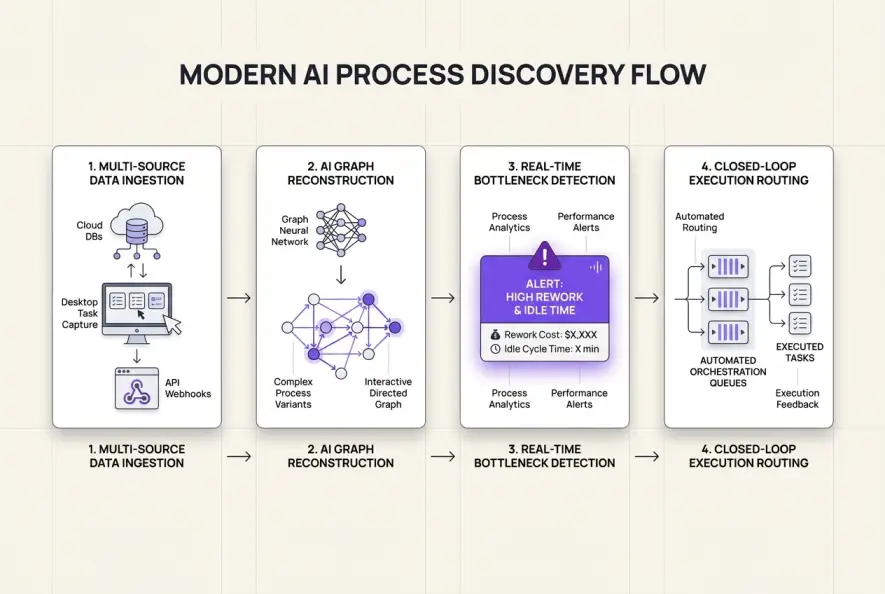
Advanced algorithmic engines ingest millions of these event rows across disconnected databases—Salesforce, SAP, Zendesk, Snowflake, and custom internal tools. By stitching together shared transaction keys, the software maps the complete, unvarnished journey of a transaction from inception to completion.
2. Desktop Task Mining via Computer Vision
Event logs are exceptional for tracking actions that occur inside enterprise databases. However, they are blind to the friction that occurs between systems—such as an employee copying customer tax IDs from an email attachment, verifying them in a legacy desktop tool, and pasting them into a web form.
To bridge this visibility gap, modern task-mining tools utilize lightweight background agents equipped with optical character recognition (OCR) and computer vision. These agents capture user interactions, categorize mouse clicks and keyboard commands into semantic activities, and feed those interaction clusters directly into the broader process graph.
Privacy engineering is paramount here. Reliable platforms perform local, on-device sanitization to strip personally identifiable information (PII), client passwords, and non-work applications before transmitting telemetry upstream.
3. Natural Language Processing for Unstructured Context
Operational friction leaves an audit trail in human language. Modern platforms parse internal support tickets, project management comments, and vendor emails using fine-tuned language models.
By matching sentiment shifts and contextual complaints ("waiting on manager approval for third time") to specific transactional timestamps, AI tools link quantitative latency metrics directly to qualitative workplace frustrations.
The Four Generations of Workflow Intelligence
Understanding where modern technology stands requires evaluating how business process management evolved over the past two decades. We have transitioned from manual graphic design exercises to autonomous, self-healing operational loops.
| Generation | Methodology | Primary Data Source | Update Cadence | Key Weakness |
|---|---|---|---|---|
| Gen 1: Static Diagrams | Manual Visio/BPMN flowcharts | Employee interviews & workshops | Annual or quarterly | Decoupled from operational reality |
| Gen 2: Classic Mining | Rule-based event log mining | Relational databases & ERPs | Batch imports (weekly/monthly) | Blind to desktop tasks; rigid schemas |
| Gen 3: Unified AI Mining | Task mining + log correlation | Multi-system telemetry + OCR | Near real-time streaming | High data storage & compute costs |
| Gen 4: Causal Digital Twins | Causal graph models + agents | Full operational telemetry + NLP | Continuous real-time | Requires strict governance & data maturity |
Evaluating enterprise-grade AI tools for business workflow analysis process mapping 2026 requires looking past flashy UI dashboards into how systems extract event logs. Static flowcharts (Generation 1) and classic mining scripts (Generation 2) fail because they view processes as clean, linear sequences. In real organizations, work resembles an asynchronous web of dependencies, interruptions, and edge-case workarounds.
This reality led to the rise of Object-Centric Process Mining (OCPM). Traditional process tools forced analysts to view workflows through a single lens—such as tracking an Order through fulfillment. However, a single order might link to three distinct invoices, four warehouse shipments, and two customer service cases. Traditional tools distorted this complexity into artificial loops.
Modern platforms model operations as multi-object graphs, reflecting the complex, many-to-many relationships that run contemporary commerce.
Do not confuse desktop task mining with employee surveillance software. If your team thinks you are monitoring their bathroom breaks or keystroke counts, they will actively sabotage the initiative. Position task mining strictly as an automated friction-hunter that identifies repetitive manual data entry, and implement strict local PII masking.
Critical Capabilities of Modern Analysis Platforms
When evaluating workflow discovery and mapping software in 2026, prioritize tools that deliver measurable operational intelligence over simple visualization. Look for these four non-negotiable capabilities.
Automated Variant Clustering and Edge Detection
If your organization processes 50,000 transactions per month, you do not have one standard operating procedure—you likely have over 800 execution variants.
In a standard purchase-to-pay workflow, the "happy path" (order placed, approved, invoiced, paid) often accounts for less than 35% of total volume. The remaining 65% fragments into variants involving price mismatches, missing vendor tax codes, and manual escalation loops.
AI engines automatically cluster these hundreds of variants into primary categories using unsupervised graph algorithms. They immediately answer: Which three variants consume 80% of our team's overtime hours?
Causal Root Cause Attribution
Traditional business intelligence identifies correlation: "Orders from Region B take 40% longer to process." However, correlation does not explain why.
Modern workflow AI applies causal inference models to isolate true root causes. The system can determine whether the delay in Region B is caused by regional shipping carriers, local regulatory checks, or a specific customer service manager failing to approve credit exceptions before 5:00 PM. By isolating true variables, companies avoid spending millions fixing symptoms while leaving root causes untouched.
Real-Time Drift and Conformance Checking
Operational drift happens quietly. A department updates a routine spreadsheet template, and within weeks, three downstream teams must manually reformat data without leadership ever knowing.
Modern engines compare live execution graphs against documented compliance baselines. The moment a transaction skips a mandatory security verification step or deviates from an approved procurement threshold, the system flags the variance, quantifies the compliance risk, and alerts operations leaders before an audit failure occurs.
Predictive Simulation and Operational Digital Twins
Before altering an existing workflow, operations teams need to test the ripple effects in a sandbox. Leading platforms now construct dynamic digital twins of your operations.
By feeding historical transaction distributions through predictive machine learning models, these engines run counterfactual simulations: "If we automate invoice matching for purchases under $1,000, what happens to downstream accounting headcount, exception resolution queues, and vendor discount capture?"
This capability allows leadership to de-risk operational restructurings before moving a single employee or writing a line of code.
Leading AI Workflow Analysis and Process Mapping Tools
Selecting the right software depends heavily on your data infrastructure, organization size, and whether your operational friction lives in enterprise database systems or desktop manual labor.
1. Celonis (Enterprise Process Intelligence)
As an early pioneer in process mining, Celonis remains a benchmark for massive enterprise deployments. Its platform shines in complex ERP environments like SAP and Oracle.
- Core Strength: Celonis leads the industry in Object-Centric Process Mining (OCPM), allowing multinational organizations to map interconnected supply chain, procurement, and billing operations simultaneously.
- Best Fit: Fortune 500 enterprises with dedicated data engineering teams and massive transactional volumes in standardized relational databases.
- Watch Out For: High implementation costs, multi-month deployment runways, and limited out-of-the-box visibility into unstructured desktop tasks.
2. IBM Process Mining
Integrated deeply into enterprise automation architectures, IBM provides robust process discovery linked directly to robotic process automation (RPA) and operational rule engines.
- Core Strength: Exceptional algorithmic root-cause analysis and seamless simulation modeling. It allows analysts to calculate the cost-per-hour impact of workflow changes with precision.
- Best Fit: Mid-market to enterprise companies looking to consolidate process discovery with legacy system modernization and governance.
- Watch Out For: Complex administrative interfaces that require specialized training for business analysts.
3. Soroco Scout (The Work Graph Platform)
Soroco approaches workflow intelligence from the user experience inward, focusing heavily on what it terms the "Work Graph."
- Core Strength: Industry-leading task mining. Soroco captures interactions across hundreds of desktop applications—email, browsers, internal tools, spreadsheets—without requiring costly backend system integrations.
- Best Fit: Financial services, insurance, and shared-services organizations where hundreds of knowledge workers perform complex, repetitive computer-based operations.
- Watch Out For: Requires thoughtful employee communication to address workplace privacy concerns regarding desktop activity tracking.
4. Mimica
Mimica uses specialized machine learning models to analyze desktop user recordings and automatically generate standardized process definition documents (PDDs).
- Core Strength: Speed to value for automation discovery. Mimica monitors how teams perform tasks and identifies the exact sub-routines most suitable for software automation.
- Best Fit: Operations and continuous improvement teams running automation sprints that need to build workflow documentation quickly.
- Watch Out For: Less comprehensive than full-scale event-mining platforms when tracking multi-month, cross-department enterprise transactions.
Strategic Implementation: A 4-Step Deployment Blueprint
When teams deploy dedicated AI tools for business workflow analysis process mapping 2026, the goal is not to document bureaucracy but to eradicate invisible throughput bottlenecks. Deploying these platforms successfully requires a structured engineering approach.
[System Event Logs] + [Desktop Task Capture]
       │
       ▼
[Data Ingestion & PII Sanitization Engine]
       │
       ▼
[Graph Reconstruction & Variant Discovery (OCPM)]
       │
       ▼
[Causal Bottleneck Attribution & Cost Quantification]
       │
       ▼
[Closed-Loop Orchestration / Workflow Automation]
Phase 1: Ingestion Scoping and PII Sanitization
Resist the temptation to connect every enterprise database on day one. Select one high-stakes operational workflow with clear financial boundaries—such as customer onboarding or order-to-cash.
Establish strict extraction rules: map unique transaction IDs, standardize timestamp formats to UTC, and deploy local filtering agents to redact customer names, credit card details, and internal credentials before logs touch your analysis lake.
Phase 2: Graph Reconstruction and Variance Auditing
Allow the discovery engine to ingest data across at least two complete billing or operational cycles (typically 30 to 60 days).
Review the generated directed acyclic graph (DAG) alongside your department leads. Pay close attention to the gap between your documented standard operating procedures and the top five most common execution paths identified by the algorithm.
Phase 3: Quantifying Friction and Cost of Rework
Rank process variances by business impact rather than sheer volume. A variant that occurs only 2% of the time may account for 45% of customer escalations and manual refund processing costs.
Quantify friction using three core metrics:
- Cycle Time Variance: How much longer do abnormal paths take compared to standard operations?
- Touch Rate: How many different employees handle a transaction before it reaches completion?
- Rework Ratio: How often does a file, ticket, or contract loop backward to an earlier stage for corrections?
Phase 4: Closed-Loop Automation and Continuous Calibration
Process analysis creates zero economic value if it ends in a slide deck. The true return on investment arrives when you connect discovery engines to operational execution layers.
When an AI engine identifies a recurring bottleneck—such as contracts stalling for four days waiting for legal review on standard non-disclosure terms—it should trigger automated workflows directly in your orchestration layer.
Organizations scaling modern operations treat workflow mapping as an ongoing feedback loop rather than a static project. For instance, in automated digital publishing, platforms like Qoreta structure complex content discovery, validation, and multi-channel publishing into distinct programmatic stages. Instead of relying on manual oversight at every step, automated workflows execute the pipeline while flagging anomalies only when human intervention is required.
This continuous orchestration mindset is identical to how high-performing companies tackle scaling organic revenue with lean operational workflows, proving that automated task coordination consistently outperforms manual management oversight.
The Real-World Friction: Why Deployments Fail
While the technology behind algorithmic workflow discovery is mature, enterprise implementations frequently stumble over preventable organizational hurdles.
The Data Hygiene Debt
AI analysis engines require accurate, reliable data. If your legacy ERP records timestamps in system local time while your cloud CRM records in UTC, your process discovery engine will flag millions of phantom "backward time travel" anomalies where invoices appear to be paid before they are created.
Cleaning timestamps, resolving fragmented customer IDs, and establishing unified data schemas is non-glamorous work, but it accounts for 70% of deployment success.
The "Dashboard Trap"
Many operations teams treat the purchase of a process mining platform as the finish line. They spend six months admiring interactive, illuminated process graphs on high-resolution screens without making operational changes.
Unless leadership assigns direct operational owners to resolve specific bottlenecks surfaced by the platform, the tool becomes another expensive, passive business intelligence monitor.
- Traditional manual workflow interviews capture idealized perceptions, whereas AI process mining surfaces actual execution realities.
- Object-Centric Process Mining (OCPM) is vital for mapping multi-object enterprise workflows without creating artificial loops.
- Privacy-first architectures with local PII scrubbing are non-negotiable when deploying desktop task mining.
- Process discovery must connect directly to automated execution pipelines to deliver measurable operational return on investment.
Executive Metrics: Measuring the Business Return
To justify investment in AI process discovery software, executive sponsors must track metrics that reflect operational balance-sheet health rather than abstract data science vanity metrics.
1. Process Velocity Ratio (PVR)
Calculate the proportion of total cycle time spent on active, value-adding work versus idle wait states:
In inefficient manual workflows, PVR often hovers below 5%—meaning a contract that takes ten days to finalize spent less than four total hours being reviewed, edited, or approved. The remaining 236 hours were spent waiting in unmonitored email inboxes.
2. Process Debt Index (PDI)
Quantify the operational tax your organization pays to navigate around its own broken systems. Track the monthly cost of rework loops, manual data cross-referencing, and exception handling per full-time employee (FTE).
When deployed properly, automated discovery tools routinely compress process debt by 30% to 50% within the first six months of active optimization.
The Future: Toward Self-Healing Operations
As we look through 2026 and beyond, business process mapping is transitioning from a diagnostic tool into an autonomous control plane.
Early process mining merely alerted managers that a bridge was broken. Second-generation tools showed where the structural cracks originated. Next-generation systems actively reroute traffic, dynamically reallocate workloads to available staff or AI agents, and suggest code-level patches to API connectors before outages impact customer delivery.
Organizations that master this operational telemetry will operate with structural cost advantages that manual competitors cannot match. By illuminating hidden bottlenecks and replacing static diagrams with live operational models, companies turn workflow efficiency from an annual corporate chore into an automated competitive engine.
Artificial Intelligence
Intelligence without limits.
We believe great content deserves honest authorship—even when it's AI.
Frequently Asked Questions
Leading platforms deploy privacy-by-design architectures that sanitize data locally on the host device before telemetry leaves the corporate boundary. Keystroke recorders ignore password inputs and personal banking fields, while optical character recognition engines automatically blur or hash PII, payment card details, and health information.
While simple linear flows can show preliminary patterns with a few hundred transactions, enterprise algorithms generally require at least 5,000 to 10,000 completed transaction cases across two operational cycles to reliably separate meaningful workflow variants from statistical noise.
Yes. As long as your internal tools record basic database transaction logs containing a unique Case ID, an Activity Name, and a valid timestamp, process mining engines can ingest that data via CSV dumps, direct SQL connections, or REST APIs.
Classic process mining forces all data into a single case identifier (such as tracking an invoice), which distorts complex realities where one sales order links to multiple shipments and payments. OCPM models operations as multi-relational graphs, capturing real-world many-to-many business relationships accurately.
Most enterprises achieve initial diagnostic visibility within four to six weeks of establishing log connectors. Measurable cost reduction and cycle-time compression typically materialize within three to six months once operational bottlenecks are remediated or automated.
The platform compares live event streams against a formal conformance model or approved governance baseline. When deviations occur, the system flags them as compliance exceptions unless an authorized admin permanently updates the reference model to adopt the new path.