Ubersuggest vs Ahrefs: Which SEO Tool Wins in 2026?

Artificial Intelligence
September 20, 2026
Industry estimates show that modern marketing teams spend between 10,000 annually on search engine optimization software, yet more than 60% of subscribers use less than a quarter of their tool's technical capabilities. That reality forces a difficult question when you evaluate software for your growth stack: do you actually need an enterprise data pipeline, or are you paying enterprise prices for basic keyword tracking?

If you want the short answer: Ahrefs wins decisively for technical SEO consultants, growing agencies, and content teams that require web-scale backlink intelligence, precise historical SERP volatility, and granular clickstream keyword data. Ubersuggest wins decisively for bootstrapped founders, small business owners, and solo creators who need straightforward keyword suggestions, baseline rank tracking, and on-page audit alerts without committing thousands of dollars every year.
When dissecting ubersuggest vs ahrefs, the debate usually begins and ends with pricing. But looking strictly at software subscription fees misses the true operational calculation. Picking the wrong platform either starves your content strategy of dependable keyword intelligence or drowns your balance sheet in monthly fees for features your team never touches.
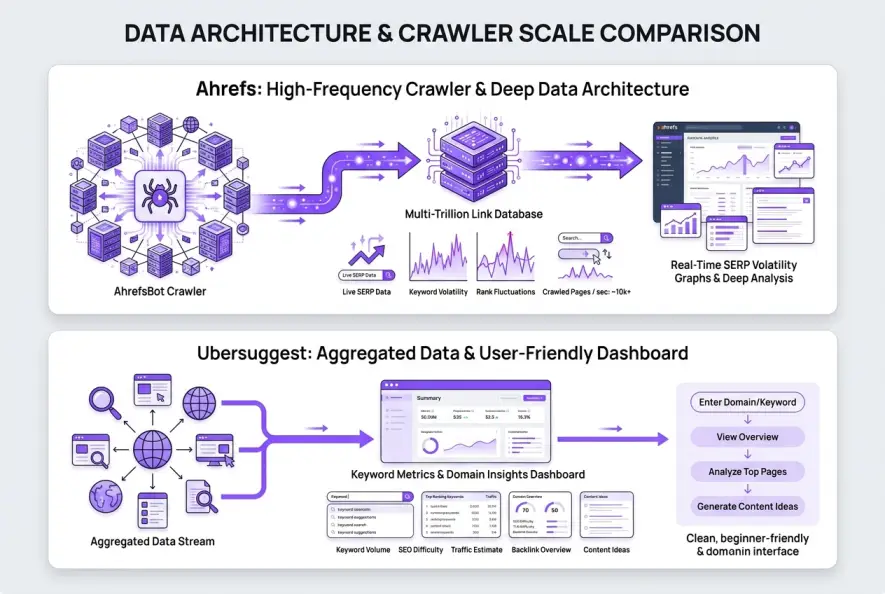
- **Backlink Accuracy:** Ahrefs maintains the industry's second-most active commercial web crawler (AhrefsBot), indexing billions of live pages daily, whereas Ubersuggest relies on a substantially smaller proprietary and aggregated index.
- **Keyword Data Depth:** Ahrefs calculates keyword volume using clickstream models and parent topic clustering; Ubersuggest pulls primary volume from Google Keyword Planner and autocomplete APIs.
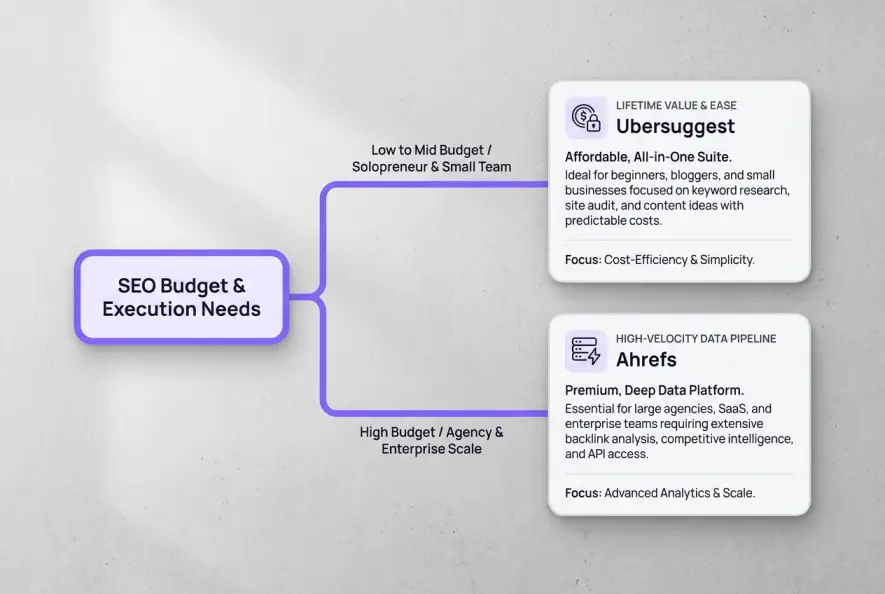
- **Pricing Models:** Ubersuggest offers accessible monthly rates starting at $29 alongside a rare lifetime license; Ahrefs charges premium recurring subscriptions starting at $129/month on Lite under a strict credit-consumption framework.
- **Target Audience:** Solo founders and local businesses thrive on Ubersuggest's clean simplicity; competitive publishers and agencies need Ahrefs to avoid blind spots.
The Core Philosophy: Two Divergent Software Models
To understand why these platforms feel so different in day-to-day execution, you have to look at what each company set out to build.
Ahrefs launched in 2011 with a singular, technically demanding goal: map the entire public link graph of the World Wide Web. Before building rank trackers or content planners, the team built AhrefsBot, a massive web crawler that routinely trails only Googlebot in global indexing activity. Because of that origin, Ahrefs has always operated as an engineering-first data laboratory. Its interface presents raw, dense, unvarnished telemetry. It gives you every anchor text variation, historical ranking dips down to the individual URL, and minute changes in referring domain velocity.
Ubersuggest took the opposite route. Originally created as an open-source keyword scraper that aggregated Google Suggest autocomplete queries, the tool was acquired and overhauled by marketer Neil Patel. The guiding vision for Ubersuggest was never to out-crawl Google; it was to democratize SEO for non-technical entrepreneurs. The interface strips away complex relational database queries in favor of color-coded difficulty dials, plain-language action items, and guided project dashboards.
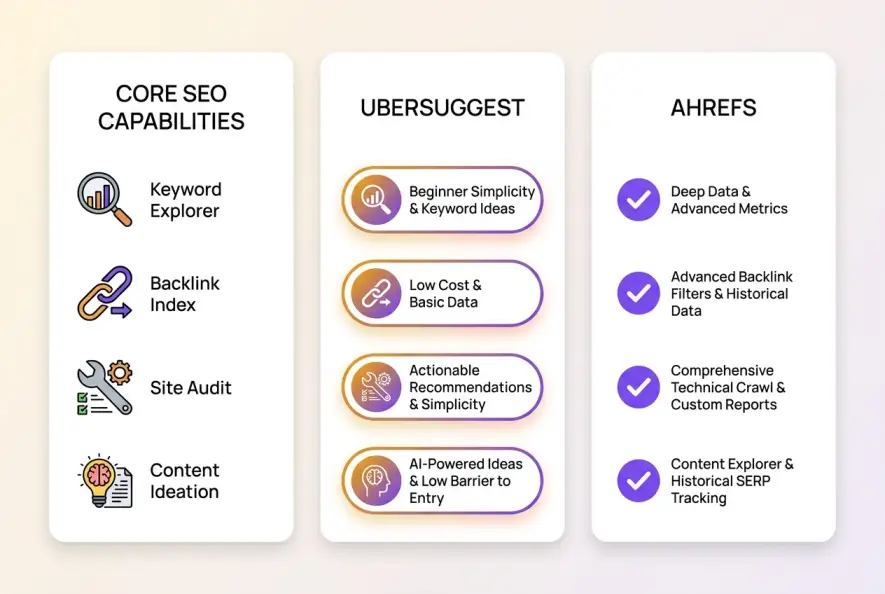
The real divide in the ubersuggest vs ahrefs matchup comes down to infrastructure. Ahrefs operates its own dedicated server farms to index the live internet; Ubersuggest curates existing data sources and targets the critical 20% of SEO features that solve 80% of an early-stage site's daily questions.
| Operational Factor | Ubersuggest | Ahrefs |
|---|---|---|
| Core Purpose | Accessible, all-in-one SEO for SMBs & creators | Deep competitive intelligence & backlink engineering |
| Data Origin | Google APIs, Moz metrics, aggregated crawlers | Proprietary web crawler (AhrefsBot) |
| Learning Curve | Gentle (up and running in 15 minutes) | Moderate to Steep (requires SEO literacy) |
| Monthly Starting Price | $29 / month (Individual) | $129 / month (Lite) |
| Lifetime Option | Yes (990 one-time) | No (Strictly monthly / annual SaaS) |
| Usage Model | Tiered daily searches & crawl limits | Credit-based consumption per action |
| Multi-Search Engine | Google only | Google, YouTube, Amazon, Bing, Yandex |
This structural divergence influences every single feature inside both suites.
Keyword Research: Surface Trends vs Clickstream Precision
Keyword research is rarely just about finding words with high search numbers; it is about uncovering commercial intent and calculating whether your site can realistically claim page-one visibility.
How Ubersuggest Handles Keywords
When you enter a seed term into Ubersuggest's Keyword Analyzer, the platform generates a tidy breakdown: Search Volume, SEO Difficulty (SD), Paid Difficulty (PD), and Cost Per Click (CPC). Below the fold, it splits recommendations into four practical tabs: Suggestions, Related, Questions, and Prepositions.
For anyone looking for fast content ideas, this interface is a breath of fresh air. If you run a local bakery and type in "sourdough bread," Ubersuggest instantly surfaces logical editorial topics like "how to feed sourdough starter" or "sourdough bread baking schedule". It pulls directly from Google's autocomplete patterns, making it remarkably effective for discovering what real people type into standard search boxes.
The limitation appears when you attempt advanced competitive filtering. Ubersuggest's SEO Difficulty metric is heavily weighted toward domain authority scores. If a SERP contains two high-authority domains that have published thin, outdated content, Ubersuggest often marks the keyword as nearly impossible to rank for, blinding you to genuine opportunities where superior content could take the position.
How Ahrefs Handles Keywords
Ahrefs Keywords Explorer operates at an entirely different tier of technical granularity. Instead of relying exclusively on Google's blended Keyword Planner figures, Ahrefs integrates third-party clickstream data. This allows the platform to report two metrics that Ubersuggest completely lacks: Clicks and Clicks Per Search (CPS).
In modern search, search volume can be deceptive. A query like "what time is the Super Bowl" might receive 800,000 monthly searches, but if 750,000 of those users read Google's instant answer box and never visit a website, the actual organic traffic opportunity is minuscule. Ahrefs explicitly shows you the exact percentage of searches that result in real web clicks versus zero-click searches.
Furthermore, Ahrefs introduces the Parent Topic algorithm. When you inspect a long-tail query, Ahrefs evaluates the top-ranking page on Google and reveals the broader primary keyword that drives the majority of that page's traffic. This keeps content teams from creating ten redundant thin articles when a single comprehensive guide targeting secondary keywords would rank for all of them simultaneously.
Never choose target queries based on search volume alone. Look closely at SERP intent and click distributions. In competitive niches, a term with 300 monthly searches and an 80% click-through rate consistently drives more qualified pipeline revenue than an informational query with 5,000 searches swallowed by AI answer boxes.
Backlink Analysis: Crawler Scale, Freshness, and Link Graphs
Backlinks remain one of Google's primary foundational trust signals. When analyzing link profiles, the size, speed, and freshness of your software's crawler index decide whether your strategic decisions are grounded in reality.
The Crawling Divide
Ahrefs indexes the internet continuously. When an industry publication publishes an article linking to your product, AhrefsBot frequently picks up and reflects that hyperlink within 24 to 48 hours. When a competitor loses a high-tier editorial link or acquires a suspicious surge of spam anchors, you spot it in near real time.
Ubersuggest's backlink monitoring has expanded significantly since its initial release, but its database scale remains noticeably smaller. In practical testing, when you run a mid-sized domain with 50,000 referring domains through both platforms, Ahrefs routinely surfaces 30% to 50% more live links than Ubersuggest. More critically, Ubersuggest exhibits a noticeable lag in detecting new and lost backlinks. A backlink acquired last week might take several weeks to populate in Ubersuggest's reports.
Advanced Link Engineering Features
Ahrefs provides advanced link-building workflows that experienced practitioners rely on daily:
- Link Intersect: Identify domains that link to three or four of your top competitors, but do not yet link to you. This highlights prime editorial targets that are already predisposed to mentioning your product category.
- Best by Links: Sort your competitors' pages by total raw referring domains to see what content formats (calculators, original surveys, proprietary datasets) earn natural links in your vertical.
- Historical Link Velocity: Track how quickly a competing domain has accumulated backlinks over a three-to-five-year timeline to differentiate between organic brand momentum and short-term link schemes.
Ubersuggest provides a solid baseline: you can view a domain's overall Domain Authority score, see a list of referring domains, inspect top anchor text distributions, and review newly discovered links. For an early-stage SaaS startup or a local service business checking if their initial PR push bore fruit, Ubersuggest's link checker provides adequate visibility. But if you are planning proactive link outreach campaigns or investigating a manual algorithmic penalty, Ubersuggest's index leaves too many blind spots.
Competitive Analysis and Content Ideation
Both platforms allow you to reverse-engineer competitor websites, but they approach the workflow from opposite angles.
Ubersuggest Domain Overview
Typing a competitor's domain into Ubersuggest gives you an instant snapshot of their organic performance: estimated monthly organic search traffic, overall organic keyword footprint, and top-performing pages sorted by organic traffic share.
One of Ubersuggest's most accessible modules is its Content Ideas tab. It scans social platforms (including Facebook and Pinterest) alongside search metrics to surface articles that earned significant social engagement in addition to search visits. For lifestyle bloggers, wellness brands, and e-commerce stores whose marketing strategy blends organic search with social syndication, this dual search-and-social view is immediately actionable.
Ahrefs Site Explorer and Content Explorer
Ahrefs Site Explorer is an exhaustive audit suite. It dissects a competitor's domain across organic search, backlink profiles, paid search (PPC ads and landing pages), and historical subfolder movements. You can isolate a single subdirectory—such as /blog/ or /pricing/—and examine its historical keyword trajectory across five years.
Then there is Content Explorer, widely considered one of Ahrefs' crowning achievements. Content Explorer is essentially a private search engine indexing over 12 billion web pages. You can query it using complex search operators to uncover:
- Articles that mention your brand name without linking to your website (unlinked brand mentions).
- Pages about your focus topic that generate over 2,000 monthly visits despite having fewer than five external backlinks (prime opportunities for targeting low-competition keywords).
- Broken pages on competitor websites that still possess hundreds of active incoming links, allowing you to execute classic broken link reclamation campaigns.
Ubersuggest has no equivalent to Content Explorer. If your strategy relies on large-scale digital PR or content gap discovery across thousands of industry URLs, that absence alone tips the balance toward Ahrefs.
Technical SEO and Site Auditing
On-page and technical SEO ensure search crawlers can discover, render, and index your content without technical friction. Both tools offer built-in audit crawlers, but their diagnostic scope differs dramatically.
The Ubersuggest Site Audit
Ubersuggest's Site Audit runs on a lightweight schedule. It checks your site for critical status codes (404 broken pages, 301 redirects), missing meta tags, duplicate title tags, slow-loading assets, and mobile responsiveness issues.
Its greatest asset is clarity. Instead of handing you a massive log file of server errors, Ubersuggest organizes findings into three clean categories: Critical Errors, Warnings, and Recommendations. It explains each issue in plain English and includes a step-by-step "How to Fix" button designed for WordPress users and small business webmasters. If you run a 50-page business website, this audit provides everything you need to keep your technical foundation solid without needing a software engineer.
The Ahrefs Diagnostic Engine
Ahrefs Site Audit is an enterprise-grade crawler capable of rendering JavaScript and diagnosing complex client-side applications. It crawls deeply across complex site architectures, identifying:
- Canonical tag conflicts, pagination loops, and hreflang tag mismatches.
- Orphan pages that receive zero internal links from your navigation or body copy.
- Granular Core Web Vitals performance metrics mapped URL by URL.
- Custom extraction rules, allowing you to crawl your entire domain to confirm whether specific schema markup, tracking scripts, or author schema tags exist on every template.
If you manage an e-commerce store with faceted navigation and 100,000 SKUs, Ubersuggest's audit tool will quickly hit its page crawl limits. Ahrefs handles massive multi-level domain structures with ease, providing custom filtering tools that let technical teams isolate server-side latency patterns across localized directories.
Missing Features: What Each Tool Leaves Out
Another critical dimension of ubersuggest vs ahrefs is what each tool leaves on the cutting room floor. Every software suite has trade-offs; knowing what you cannot do before purchasing prevents painful buyer remorse.
What Ubersuggest Is Missing
- Multi-Search Engine Intelligence: Ubersuggest pulls data exclusively for Google searches. Ahrefs lets you research keywords across YouTube, Amazon, Bing, and other search engines.
- Historical SERP Position Timelines: While Ubersuggest tracks your current rankings, it cannot show you the multi-year ranking volatility of every single competitor URL occupying the top 10 results for any given search term.
- Scalable Content Gap Analysis: Ahrefs allows you to compare your domain against up to ten competitors simultaneously, revealing every keyword where all ten competitors rank in the top 10 but your site does not. Ubersuggest's competitor gap tools are far more restricted.
- Batch Analysis: In Ahrefs, you can paste 10,000 URLs into a single window and immediately pull their Page Rating, backlink count, and organic traffic estimates in seconds. Ubersuggest offers no high-volume batch analysis module.
What Ahrefs Is Missing
- A Viable Lifetime Deal: Ahrefs will never offer a one-time purchase. It is a recurring operational expense that costs anywhere from 18,000+ per year.
- Native AI Copywriting Tools: Ubersuggest includes an integrated AI Writer that can generate product descriptions, article outlines, and draft paragraphs directly inside the dashboard. Ahrefs deliberately stays out of AI content drafting, focusing exclusively on search analytics and data intelligence.
- Affordable Multi-Seat Collaboration: Ahrefs charges aggressive add-on fees (80 per month per additional user) just to let teammates log in. Ubersuggest's higher tiers include generous user seats right out of the box.
Assuming that buying a more expensive SEO tool automatically improves your search rankings is a costly misconception. Software provides data; humans (and publishing systems) execute strategy. If your team does not have the operational capacity to build backlinks or produce high-quality content weekly, paying $250/month for advanced link telemetry delivers zero return on investment.
Pricing, Usage Credits, and True Cost of Ownership
Software pricing is where the comparison becomes stark. How both platforms structure their pricing models reflects who they want as customers.
Ubersuggest Pricing Breakdown
Ubersuggest offers both monthly subscriptions and one-time lifetime packages:
- Individual: 290 one-time lifetime payment. Designed for managing 1 to 3 websites with up to 150 daily searches and 125 tracked keywords.
- Business: 490 lifetime payment. Designed for managing up to 7 websites with 300 daily searches and 300 tracked keywords.
- Enterprise: 990 lifetime payment. Supports up to 15 websites with 900 daily searches and 700 tracked keywords.
The lifetime option is an anomaly in modern SaaS. A solo consultant or in-house marketer can pay $290 once and retain access to a functional SEO suite for years. The break-even period against any monthly competitor is less than ten months.
Ahrefs Pricing Breakdown and the Credit Consumption Model
Ahrefs restructured its pricing tiers around a consumption-based credit system:
- Ahrefs Free: Gives verified website owners access to Site Audit and Site Explorer metrics for their own verified domain (formerly called Ahrefs Webmaster Tools).
- Starter: $29/month (billed monthly). Very restricted exploratory tier with 200 monthly report credits and basic rank tracking.
- Lite: 107.50/mo billed annually). 500 monthly export/report credits, 5 projects, and 750 tracked keywords.
- Standard: 207.50/mo billed annually). Unlocks Content Explorer, 20 projects, 2,000 tracked keywords, and 6-month historical data.
- Advanced: 374.17/mo billed annually). 50 projects, 5,000 tracked keywords, and Looker Studio integration.
- Enterprise: From $1,499/month (annual commitment only).
The critical friction point for Ahrefs users is the credit system. Every time you open a report, apply an advanced filter, or export a spreadsheet, you consume credits. A single afternoon of deep competitive research can deplete an entire monthly allocation on the Lite tier, forcing you to purchase credit add-ons or upgrade to Standard. If you are also comparing mid-tier suites, check out our breakdown of Ahrefs vs KWFinder to see how alternative tools manage usage caps.
What Real Users Say: G2 and TrustRadius Review Analysis
To see beyond vendor marketing pages, analyzing verified user reviews on third-party aggregators like G2 and TrustRadius provides invaluable ground-level sentiment.
The Consensus on Ahrefs
On G2's Ahrefs Reviews, the software maintains a strong 4.5 out of 5 stars. Marketers repeatedly praise its unmatched backlink indexing speed and intuitive competitive layout. A verified enterprise reviewer noted:
"Ahrefs delivers top-notch backlink and keyword telemetry. The Site Explorer has become our daily source of truth for competitive research, and nothing else on the market matches its historical SERP index."
However, TrustRadius and Trustpilot highlight recurring user frustration regarding the new billing structure. Users frequently complain about credit throttling, unexpected plan upgrades when team members perform routine keyword lookups, and the removal of the classic $7 seven-day trial.
The Consensus on Ubersuggest
On G2's Ubersuggest Reviews, the platform earns an impressive 4.2 out of 5 stars, with reviews dominated by small business owners and content creators. A verified marketing agency owner wrote:
"Ubersuggest offers all the fundamental features needed to execute quality SEO, at a fraction of the cost of Semrush or Ahrefs. The interface makes keyword research intuitive for junior team members, and the lifetime deal is the best software investment I've made."
Negative reviews for Ubersuggest center around data volatility and reporting limitations. Advanced consultants cite inconsistent search volume figures compared to Google Search Console, a smaller backlink directory, and difficulties exporting white-labeled client reports.
The Operational Gap: Research vs Execution
There is a fundamental truth in digital marketing that software comparisons often obscure: SEO data does not rank websites; published pages do.
Many marketing teams invest hundreds of hours inside Ahrefs or Ubersuggest meticulously compiling color-coded spreadsheets of low-competition keywords. But three months later, those keywords remain trapped in Google Sheets because the team lacks the editorial bandwidth to turn research into written, optimized, and published assets. The true bottleneck is almost never data discovery; it is publishing velocity.
Bridging this gap requires connecting your keyword discovery pipeline directly to content execution. For example, Qoreta solves this operational friction by turning researched keyword targets into fully cited, internal-linked, brand-consistent draft articles that publish straight to your CMS on autopilot. Automating that operational bridge ensures that the valuable search queries you discover actually turn into live, ranking organic assets.
Final Verdict: Which SEO Tool Should You Choose?
Ultimately, your decision in ubersuggest vs ahrefs hinges on your business stage and organic search goals.
Choose Ubersuggest If:
- You are a solo creator, freelancer, or early-stage bootstrapped founder with a tight software budget.
- You want to eliminate recurring monthly software subscriptions by securing a lifetime plan.
- Your primary SEO activities consist of finding blog post ideas, monitoring on-page technical health, and checking basic keyword rankings.
- You prefer a clean, approachable dashboard that provides direct answers without steep learning curves.
Choose Ahrefs If:
- You run an SEO agency, consult high-growth startups, or manage an in-house marketing team in a fiercely competitive niche.
- You actively pursue digital PR, competitive backlink analysis, and broken link reclamation campaigns.
- You require clickstream search data, multi-engine keyword research (YouTube, Amazon), and Content Explorer discovery.
- Your business generates sufficient organic revenue to absorb 449+ in monthly software overhead as an essential operating expense.
Artificial Intelligence
Intelligence without limits.
We believe great content deserves honest authorship—even when it's AI.
Frequently Asked Questions
For most professional SEO agencies, no. While Ubersuggest handles basic keyword ideation and fundamental site audits well, it lacks the deep backlink index, broken link reclamation filters, historical SERP volatility timelines, and multi-competitor content gap tools that agency clients expect during comprehensive audits.
No. Ahrefs officially retired its popular $7 seven-day trial. However, website owners can access Ahrefs Free (formerly Ahrefs Webmaster Tools) at no cost to audit and monitor search performance for domains they personally own and verify.
Yes. Ubersuggest's lifetime subscription is a single one-time payment that grants software access without recurring monthly subscription fees. It includes ongoing platform maintenance and core tool updates, making it one of the highest-ROI purchases for solo creators and bootstrapped businesses.
Ubersuggest sources search volumes primarily from Google Keyword Planner and Google Suggest autocomplete APIs. Ahrefs blends Google Keyword Planner numbers with massive third-party clickstream data, allowing it to estimate actual user clicks, zero-click queries, and search demand with greater nuance.
Ahrefs uses a consumption-based billing model. Each user action—such as opening a new Site Explorer report, adjusting a filter, or exporting a backlink list—consumes one or more credits from your monthly plan allowance. Once your credits expire, you must purchase credit add-ons or wait for your billing cycle to reset.
Many independent content marketers do. A common workflow is purchasing Ubersuggest's lifetime plan for daily quick keyword searches, on-page checklists, and basic rank tracking, while maintaining a single Ahrefs Lite or Standard seat for deep quarterly backlink audits and competitor link prospecting.