AI Search Visibility Metrics KPIs: What to Track

Artificial Intelligence
September 22, 2026
Cross-engine search audits show that across Google AI Overviews, ChatGPT Search, and Perplexity, the citation overlap for identical commercial queries is less than 12%. Traditional rank trackers that report a single average position are monitoring a search paradigm that is rapidly losing relevance.

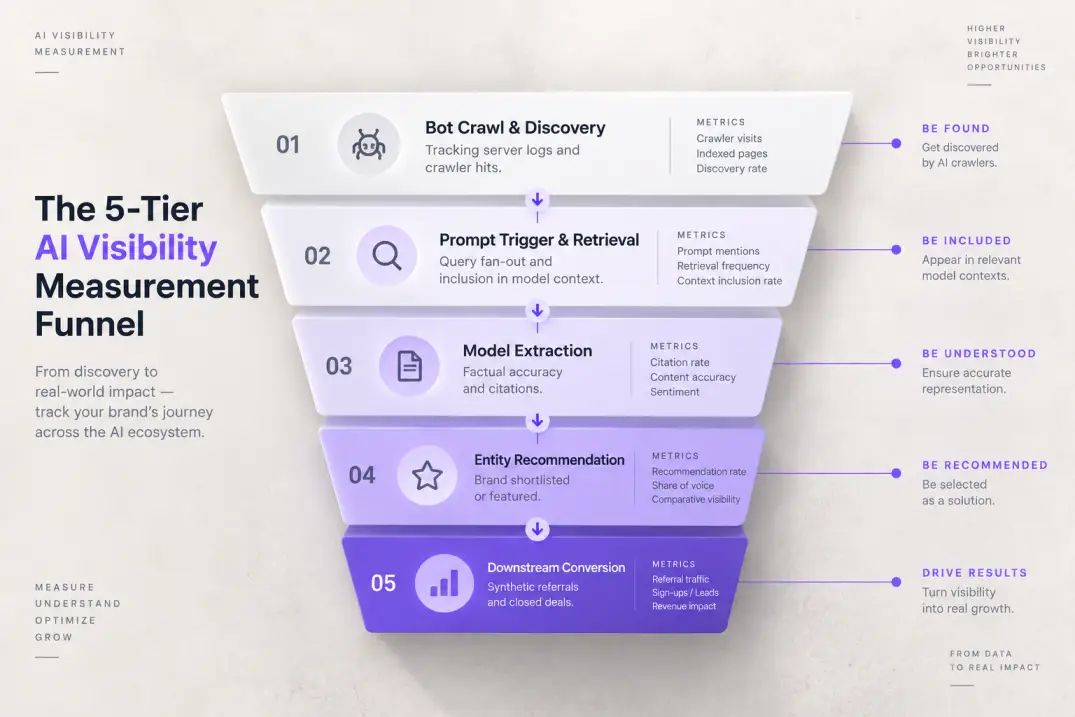
Tracking your brand across generative engines requires abandoning fixed position metrics in favor of five core pillars: Citation Frequency (how often models link to your domain), Entity Share of Voice (how often your brand is named in unbranded prompts), Information Extraction Accuracy (whether the engine quotes your features and pricing accurately), Retrieval Bot Telemetry (how frequently search crawlers fetch your URLs), and Synthetic Referral Conversions. Instead of chasing a static number one ranking, success in generative search is measured by prompt win rates and semantic sentiment across probabilistic answer engines.
For two decades, organic growth relied on a predictable feedback loop: publish a page, earn backlinks, monitor your rank in Google Search Console, and collect clicks. Large language models (LLMs) break that direct line.
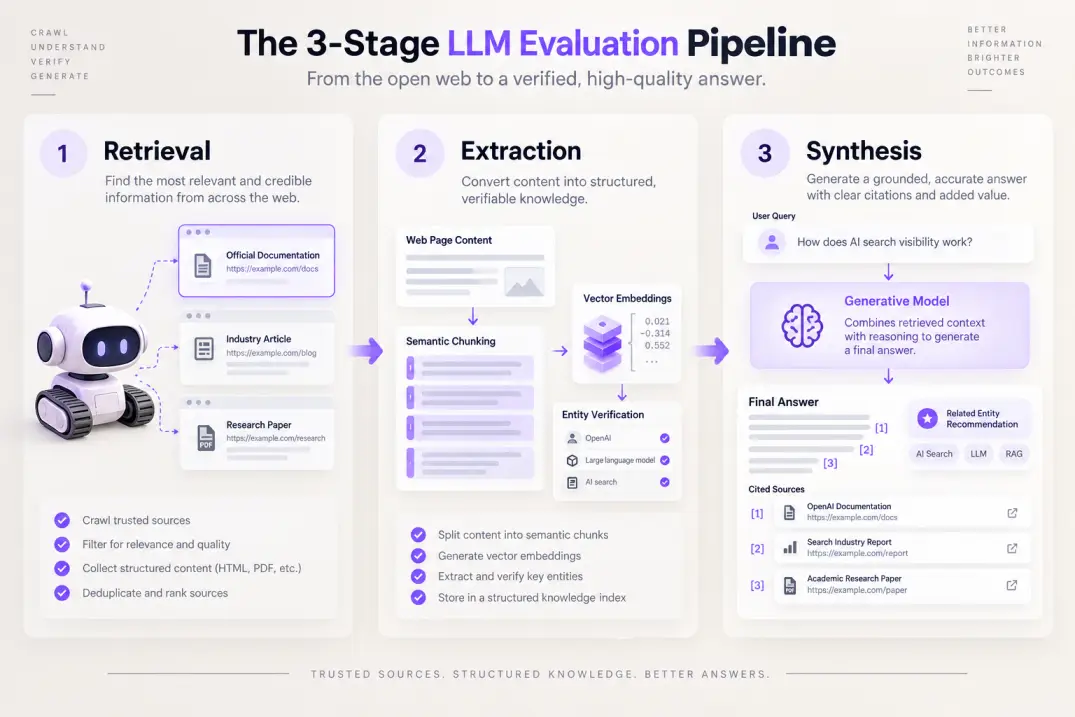
When a user enters a query into an answer engine, the system does not look up a pre-computed list of ten links. Instead, it performs real-time retrieval-augmented generation (RAG), vector embeddings lookups, and query fan-out to synthesize an original response.
Traditional Search:  Query -> Index Lookup -> Static Ranked URL List -> User Click
Generative Search:   Prompt -> Query Fan-Out -> Vector RAG Fetch -> Multi-Source Synthesis -> Extracted Citation
Because the output is synthesized dynamically, your brand can be cited as the top source in one turn and omitted entirely in the next. To build a dependable acquisition strategy, you must rethink your measurement infrastructure from the ground up.
The Death of Rank Tracking: Why Positions Fail in LLMs
Traditional search results are deterministic enough that tracking rank positions 1 through 10 still offers meaningful data. If you rank position 2 for an enterprise query, you can estimate impressions, click-through rates (CTR), and conversion volume with reasonable accuracy.
In generative engines, positional rank does not exist in the same way. An AI answer does not present a neat vertical ladder of competing businesses.
Instead, models surface content through four distinct formats:
- Primary Narrative Anchor: The model uses your content as the structural backbone of its explanation.
- Inline Citation Footnote: A numerical badge or bracketed link verifying a specific factual claim.
- Entity Recommendation Card: A dedicated UI chip or carousel card recommending your product within a list.
- Synthesized Paraphrase (Zero-Citation): The model absorbs your unique insight and presents it as common knowledge without linking back.
Measuring whether you are "number one" misses the real point. If an LLM recommends your software as the top choice for mid-market teams but tucks the citation into footnote four, your business impact is high even if your raw citation index looks secondary.
Conversely, if your domain is cited three times in an AI response solely as a cautionary example of outdated software architecture, a traditional rank scraper counts that as three top citations. In reality, it represents a brand perception crisis.
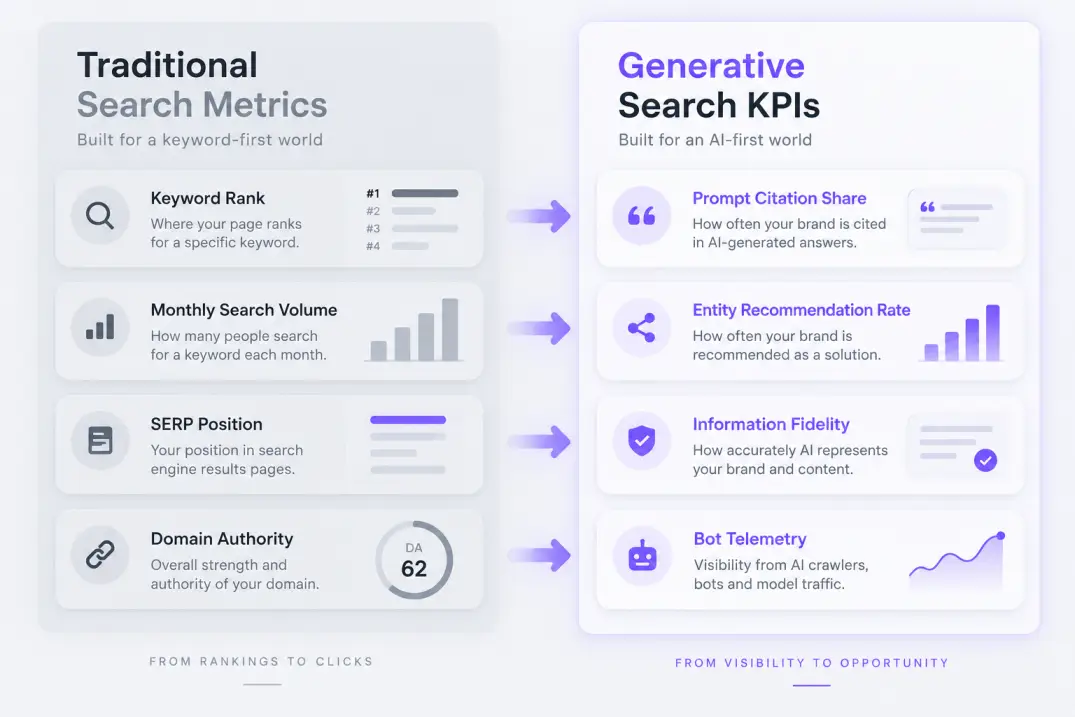
This is why modern teams evaluate their organic footprint using holistic generative search metrics rather than simple rank counts.
| Traditional SEO Metric | Why It Fails in AI Search | Modern Generative Search KPI |
|---|---|---|
| Keyword Rank (1–100) | AI answers are fluid, personalized, and synthesized probabilistically. | Prompt Citation Share (% of queries citing your domain) |
| Search Volume (MSV) | Prompts are conversational, long-tail, and up to 5x longer than queries. | Prompt Cluster Demand & Fan-Out Impression Share |
| Organic CTR Curve | AI Overviews reduce top-link clicks by providing immediate answers. | Entity Recommendation Rate & Synthetic Referral Volume |
| Domain Authority (DA/DR) | Models prioritize topical consensus, schema clarity, and information gain over raw backlink power. | Information Extraction Fidelity & Factual Accuracy Score |
| Landing Page Impressions | Users consume extracted summaries inside the AI platform without page views. | Brand Sentiment Score & Share of Model (SoM) |
The 7 Core AI Search Visibility Metrics & KPIs
Shifting your measurement framework requires concrete, trackable indicators that engineering and marketing teams can monitor week over week. These seven metrics isolate how language models discover, extract, and present your brand.
1. Model Citation Frequency & Citation Share
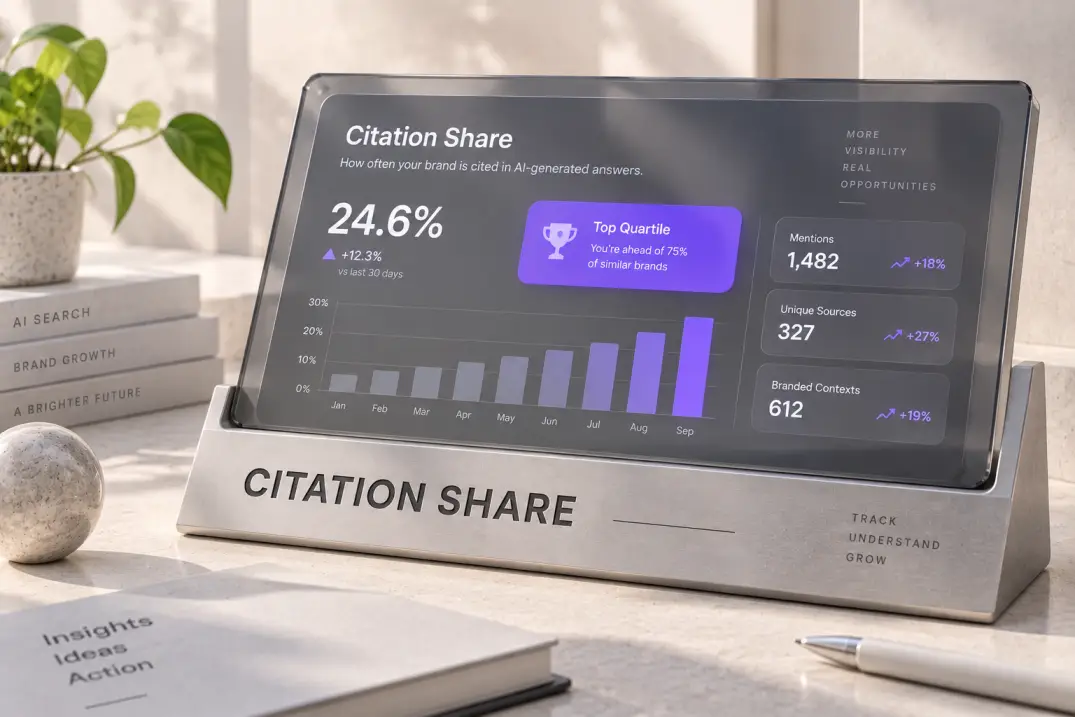
Citation Frequency measures the total number of times an AI engine references your domain across a representative prompt set. Citation Share (also called AI Share of Voice) calculates your brand's presence relative to total available citations in your category.
To calculate Citation Share, evaluate an unbranded prompt cluster (for example, 100 high-intent questions prospective buyers ask) across your target AI platforms:
For example, if Perplexity runs 200 prompt variations covering cloud data warehousing and your site is referenced in 46 of those answers, your Citation Share is 23%.
Tracking this metric across individual engines reveals critical distribution patterns. You might discover a 35% Citation Share in Perplexity, where real-time web retrieval mirrors classic index signals, but only a 4% Citation Share in ChatGPT Search, which places heavy emphasis on licensed media partnerships and consolidated entity databases.
Tracking AI visibility using a single prompt in ChatGPT is misleading. Large language models use non-zero temperature settings and personalized session contexts, meaning two identical queries run seconds apart can cite entirely different domains. Reliable measurement requires testing automated prompt clusters across multiple isolated sessions.
2. Unbranded Entity Recommendation Rate (Prompt Win Rate)
Citations verify factual data, but recommendations drive qualified buyers. The Entity Recommendation Rate measures how often an AI model explicitly suggests your product, service, or company when a user asks for recommendations without mentioning your brand by name.
Consider queries such as:
- "What are the most reliable open-source vector databases for high-concurrency search?"
- "Compare the top SOC 2 compliance automation platforms for early-stage fintechs."
- "What tools should a remote design team use for asynchronous design crits?"
When evaluating these responses, classify your brand's appearance into three distinct tiers:
- Primary Recommendation: Your brand is highlighted as the first choice or default winner.
- Shortlist Consideration: Your brand is included within a balanced list of 3 to 5 options.
- Omission or Negative Consideration: Your brand is omitted entirely, or cited with caveats regarding performance, price, or usability.
Your Prompt Win Rate is the percentage of commercial prompts where your brand achieves Tier 1 or Tier 2 inclusion. If your competitors regularly populate these recommendations while your brand remains unmentioned, the model's underlying knowledge graph lacks strong entity associations between your company and that problem space.
This gap often occurs when sites fail to optimize their entity SEO architectures for dense vector retrieval.
3. Information Extraction Fidelity (Factual Accuracy Score)
Generative engines frequently hallucinate features, quote legacy pricing tiers from three years ago, or misattribute capabilities to competitors. Information Extraction Fidelity measures how accurately an AI model's generated text reflects your actual product specifications, pricing, and positioning.
To measure this systematically, establish an internal rubric that grades model responses against a verified source-of-truth document:
- Feature Accuracy: Does the model attribute features to your product that you do not support?
- Pricing Tier Fidelity: Are the reported price points and subscription tiers accurate?
- Ideal Customer Profile (ICP) Alignment: Does the engine recommend your tool to the right audience segment, or does it misclassify an enterprise tool as an entry-level consumer app?
Score these responses on a scale from 0% to 100%. If an engine repeatedly misrepresents your enterprise security posture, you cannot solve the issue by building generic backlinks. You must deploy structured schema markup, clean HTML definition tables, and machine-readable data blocks that retrieval bots can parse without ambiguity.
4. Query Fan-Out Coverage Rate
When a user enters a complex prompt, generative engines rarely execute a single retrieval search. Instead, they run an algorithmic process known as query fan-out.
A single prompt like "Plan an international expansion strategy for a European B2B SaaS entering the US market" is programmatically broken down into 8 to 15 discrete sub-queries behind the scenes:
Sub-Query 1: "US corporate tax structuring for foreign SaaS entities"
Sub-Query 2: "Delaware C-Corp vs LLC foreign subsidiary tech setup"
Sub-Query 3: "B2B SaaS US sales compensation benchmarks 2026"
Sub-Query 4: "US data privacy compliance requirements for European software"
The AI engine retrieves documents for each sub-query independently, compiles the candidate documents, and synthesizes the final response. Query Fan-Out Coverage Rate measures what percentage of those underlying sub-queries your domain appears in.
If you only publish broad, high-level overview content, you will lose the query fan-out battle. The model will retrieve specialized niche articles, technical documentation, and specific benchmark studies to answer the sub-queries, leaving your high-level overview completely uncited.
Tracking your fan-out footprint helps identify topical gaps in your content library, highlighting where your technical coverage falls short during multi-step retrieval.
5. Brand Sentiment & Semantic Association Score
Language models do not merely count citations; they construct an internal semantic representation of what your brand represents. An answer engine might mention your platform in 80% of answers, but if the surrounding context describes your software as clunky, difficult to integrate, or overpriced, your visibility works against you.
Semantic sentiment scoring analyzes the qualitative adjectives, comparative clauses, and contextual framing models apply to your brand:
- Positive Associations: "Industry-standard," "low-latency," "reliable uptime," "developer-friendly," "transparent pricing."
- Neutral Associations: "Alternative option," "supports standard protocols," "incumbent provider."
- Negative Associations: "Steep learning curve," "hidden maintenance overhead," "frequent sync errors," "legacy codebase."
Using natural language processing (NLP) pipelines, marketing teams can quantify this sentiment into a normalized score from -1.0 (purely negative) to +1.0 (purely positive).
If your sentiment score dips into negative territory on specific features, review sites, community discussions on Reddit, and industry review aggregators are usually the root cause. Large language models weight community consensus heavily when synthesizing qualitative evaluations.
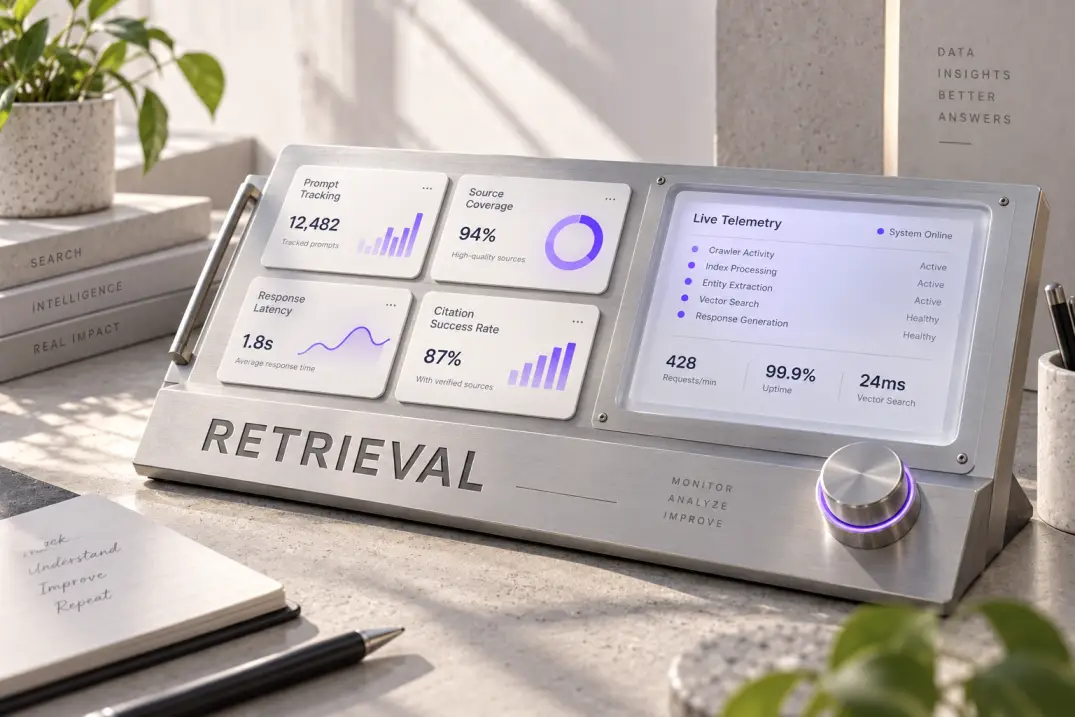
6. Retrieval Bot Telemetry & Log Share
Before an AI engine can cite your content in response to a user prompt, its retrieval bot must physically fetch your page over HTTP. Monitoring server access logs for AI crawler activity provides the earliest possible indicator of generative search health.
Most teams make the mistake of treating all AI bots identically. In reality, you must track two separate classes of bots in your access logs:
- Training Bots (Asynchronous Indexing): Bots like
GPTBot,ClaudeBot, andGoogle-Extended. These crawlers scrape content to update static model weights and periodic dataset releases. They do not directly drive immediate real-time citations. - Retrieval & Citation Bots (Synchronous Search): Bots like
OAI-SearchBot,ChatGPT-User, andPerplexityBot. These bots hit your server in real time or near-real time when a user prompt triggers a live search request.
Tracking request spikes from citation bots gives you a leading metric for real-world user demand. If your server logs reveal that OAI-SearchBot is crawling your comparative benchmarks 400 times a day while ignoring your product pages, the model is actively using your data to answer user questions.
To verify bot authenticity and avoid spoofed user-agents, cross-reference incoming IP addresses against official published IP ranges, such as OpenAI's official crawler documentation.
7. Synthetic Referral Traffic & Conversion Rate
While AI answer engines encourage zero-click consumption, users with high purchase intent still click through to source citations to verify details, download resources, or start software trials.
Tracking synthetic referral traffic measures the real downstream business impact of your generative presence. In Google Analytics 4 (GA4), this traffic arrives from referrers like chatgpt.com, android-app://com.openai.chatgpt, perplexity.ai, and copilot.microsoft.com.
Data from conversion studies indicates that traffic originating from AI answer engines frequently converts at 2 to 4 times the rate of standard organic search traffic. The reason is intent qualification: by the time a user clicks a citation inside an AI answer, the model has already answered basic preliminary questions, evaluated alternatives, and positioned your product as a viable solution.
The visitor lands on your website at the bottom of the consideration funnel rather than the top.
Create a dedicated custom channel group in Google Analytics 4 for AI search referrals using regex matching chatgpt\.com, perplexity\.ai, claude\.ai, and copilot\.microsoft\.com. This isolates bot-driven user visits from your standard organic search and direct traffic buckets.
How to Set Up Your AI Search Tracking Stack
Building a reporting system for these metrics does not require purchasing an expensive enterprise tool suite on day one. You can establish a functional, highly accurate tracking stack using tools your engineering and analytics teams already operate.
Step 1: Configure GA4 Custom Channel Grouping
By default, Google Analytics 4 frequently lumps generative engine visits into generic "Direct" or unassigned "Referral" channels. Setting up a dedicated channel provides an immediate, clean view of generative search traffic.
To build an AI Search channel group in GA4:
- Navigate to Admin -> Data Display -> Channel Groups.
- Click into your primary channel group and select Create New Channel.
- Name the channel
AI Search. - Define the channel rules using the following condition:
Source matches regex:
.*(chatgpt|openai|perplexity|claude|copilot|gemini|deepseek).*
- Save the channel and drag it above the standard Organic Search and Referral rules in the hierarchy.
This regex captures browser visits, mobile web traffic, and deep-linked citations from all major commercial generative assistants. Monitoring this channel allows you to track engagement rate, average session duration, and goal completions exclusively for visitors referred by AI platforms.
Step 2: Implement Server Access Log Monitoring
Because analytics tags require a browser to execute JavaScript, GA4 cannot tell you when an AI crawler inspects your content without clicking a link. For that, you need server access logs or edge firewall telemetry from providers like Cloudflare Radar.
Extract and filter your web server logs (Nginx, Apache, or AWS CloudFront) for known AI retrieval user-agent strings:
# Filter Nginx access logs for live AI search and citation crawlers
grep -Ei "OAI-SearchBot|ChatGPT-User|PerplexityBot" /var/log/nginx/access.log | \
awk '{print $1, $4, $7, $9}' | head -n 20
Analyze this data weekly across three dimensions:
- Crawl Volume per Content Cluster: Which product or blog categories receive the highest citation crawler interest?
- HTTP Status Code Distribution: Are citation bots encountering 403 Forbidden errors, Cloudflare challenge pages, or slow 504 timeouts? A bot that encounters a challenge page will drop your domain from the retrieval set immediately.
- Freshness Request Latency: How quickly do citation bots re-crawl your updated content after you push a product update?
If you discover citation bots repeatedly failing on JavaScript-heavy single-page applications, you may need to implement dynamic server-side rendering to preserve your visibility.
Step 3: Track Real-World AI Referral Traffic with GA4
Setting up the measurement plumbing is straightforward once you understand how referral headers pass through AI chat interfaces. The following tutorial breaks down how to configure tracking, separate bot crawls from human clicks, and analyze user engagement patterns inside analytics dashboards.
Step 4: Build a Controlled Synthetic Prompt Testing Rig
To track Citation Share and Prompt Win Rates consistently over time, you cannot rely on manual queries typed into a chat box. Human queries introduce inconsistent prompt framing, geographic bias, and session memory drift.
Instead, create a structured evaluation dataset of 50 to 100 recurring prompt templates representing your core market:
[
  {
    "id": "prompt_001",
    "cluster": "enterprise_migration",
    "template": "What are the most reliable tools for migrating Postgres databases to Snowflake without downtime?",
    "intent": "commercial_investigation"
  },
  {
    "id": "prompt_002",
    "cluster": "security_compliance",
    "template": "Compare automated SOC 2 audit readiness platforms for AWS infrastructure.",
    "intent": "commercial_comparison"
  }
]
Run these prompts weekly through model APIs (OpenAI API, Perplexity API, Anthropic API) using fixed parameters:
- Temperature: Set to
0.0or0.1to minimize creative variance and ensure reproducible retrieval evaluation. - Search Grounding: Ensure web-search grounding flags are enabled (such as
search_recency_filteror Perplexity's web search domain filters). - Clean Context: Execute each test within an isolated session container with no prior message history.
Parse the JSON responses to detect whether your domain appears in the citations array or if your brand name is returned in the text body. Over three to six months, this synthetic benchmark becomes your primary gauge of market expansion or contraction across answer engines.
The Attribution Challenge: Solving the "Dark AI Traffic" Dilemma
One of the most dangerous traps in tracking generative engines is assuming that GA4 referral logs capture the full commercial impact of your AI visibility.
In practice, a significant percentage of users who discover your brand through ChatGPT or Perplexity never click an inline citation link. Instead, they interact with the AI assistant, evaluate the recommendation, and take one of two actions:
- Direct Navigation: The user opens a new browser tab and types your domain name directly into the omnibox.
- Branded Search: The user switches to Google or DuckDuckGo and searches for your brand name or product reviews.
In standard analytics reporting, those conversions are categorized as Direct or Organic Brand Search. If your marketing leadership relies solely on last-click referral data, they will conclude that generative search initiatives yield low ROI, while your brand search and direct channels appear to surge without clear explanation.
This discrepancy represents Dark AI Traffic.
Observed in Analytics:      Direct Traffic Spike + Brand Search Spike
Actual User Journey:       ChatGPT Recommendation -> Unclicked Citation -> Browser Omnibox -> Direct Visit
Capturing Dark AI Traffic with Self-Reported Attribution
To bridge this attribution gap, implement qualitative self-reported attribution at key conversion points, such as onboarding forms, lead capture forms, or post-purchase checkout surveys.
Add an open-text or hybrid field: "How did you first discover our company?"
Include common digital channels, but explicitly provide options for:
- AI Assistant (ChatGPT, Claude, Copilot)
- AI Search Engine (Perplexity, Google AI Overviews)
- Peer Recommendation / Community
Cross-referencing self-reported AI discovery against spikes in your Synthetic Prompt Citation Share will frequently reveal that while direct referral traffic accounts for 200 monthly visits, self-reported conversions reflect dozens of qualified enterprise deals influenced directly by LLM recommendations.
Content Architecture: Optimizing for Extraction and Citation
Language models cite websites that make synthesis mathematically efficient. When an engine performs retrieval-augmented generation, it pulls chunks of text (typically 200 to 500 tokens) and evaluates which chunk answers the user's intent with the highest factual density.
If your post buries the answer beneath 1,000 words of conversational preamble, the retrieval algorithm's semantic scoring will demote your chunk in favor of a concise, structured competitor page.
To maximize your Citation Frequency and Extraction Fidelity, structure content around Atomic Information Architecture:
- Lead with Direct Declarative Answers: Place the core definition or solution in the first 40 words of each major heading, following the principles of Generative Engine Optimization.
- Use HTML Definition Lists and Tables: LLM tokenizers parse structured markdown tables and HTML definition pairs with far fewer hallucinations than dense prose.
- Cite Original Primary Data: Answer engines heavily favor unique statistics, survey results, and proprietary metrics. Citing third-party summaries makes you swappable; publishing original benchmarks makes your page the authoritative citation anchor.
- Align with Quality Directives: Ensure your domain adheres to Google Search Central's helpful content guidelines to maintain high baseline document trust across general web indices.
Structuring content for consistent LLM citation requires deliberate information architecture rather than random long-form drafting. For example, autonomous publishing platforms like Qoreta separate topic discovery, entity structuring, and citation-ready drafting into distinct algorithmic stages, ensuring that every published piece contains clear extractable definitions and structured data. This multi-stage pipeline makes it significantly easier for retrieval bots to ingest and quote specific factual claims without human intervention.
Publishing teams that structure their content with clear entity tags and atomic explanations naturally dominate retrieval sets, insulating their sites from sudden changes in user search habits.
Common Measurement Pitfalls to Avoid
As organizations build out reporting around AI search visibility metrics KPIs, marketing teams often fall into recurring operational traps that distort data.
Pitfall 1: Treating All LLM Engines as a Single Monolith
Reporting a blended "AI Visibility Score" across all platforms obscures actionable insights. The retrieval mechanisms powering these systems differ fundamentally:
- Google AI Overviews: Heavily dependent on top-ranking traditional search URLs, Google's Knowledge Graph, and authoritative community discussions (Reddit, YouTube).
- Perplexity: Relies on real-time web search APIs, rewarding sites with fresh content, high domain authority, and clean tabular data.
- ChatGPT Search: Combines licensed media publisher catalogs with fine-tuned entity embeddings and live web index lookups.
Optimizing for one does not automatically guarantee visibility in another. Track your metrics by engine to identify platform-specific technical blockers.
Pitfall 2: Optimizing Exclusively for Citation Volume
Earning 500 citations across low-value informational definitions (such as "What is an API?") generates negligible commercial value. If users consume the definition and close the browser, your citation volume looks impressive on paper while pipeline revenue remains flat.
Prioritize citations within high-intent comparative prompts and problem-solving workflows. A brand cited 20 times per month on prompts directly evaluating enterprise data migration software will drive substantially more pipeline than a brand cited 5,000 times for basic technical glossaries.
Pitfall 3: Ignoring Citation Decay
AI citations suffer from rapid decay. An engine may cite your technical whitepaper consistently for four months, only to replace it overnight when a competitor releases newer survey data or when the model's retrieval weighting is refreshed.
Track your Citation Half-Life: the rate at which citations on historical prompt sets degrade over time. When you observe citation frequency dropping on high-value prompt clusters, update your underlying content with fresh data, revised dates, and expanded case studies to recapture the model's retrieval preference.
The 30-Day Implementation Roadmap
Transitioning your search reporting from legacy rank trackers to a generative framework requires structured execution. Follow this four-week sprint to stand up your reporting infrastructure.
Week 1: Audit Log Files & Classify Bots
- Configure server log exports to aggregate requests from
OAI-SearchBot,ChatGPT-User, andPerplexityBot. - Verify that your
robots.txtconfiguration does not unintentionally block citation crawlers while attempting to block training scrapers. - Establish baseline daily crawl request counts across all major content categories.
Week 2: Build the High-Intent Prompt Cluster
- Interview sales and customer success teams to collect 100 actual questions prospects ask during discovery calls.
- Format these questions into standardized prompt templates categorized by purchase intent (informational, comparative, commercial evaluation).
- Remove brand mentions from the prompt dataset to test organic discovery rather than branded navigation.
Week 3: Configure Analytics & GA4 Custom Channels
- Implement the regex-based custom channel group in Google Analytics 4 to isolate AI search referrals.
- Set up automated weekly alerts for sudden spikes or drops in generative referral sessions.
- Add an open-text self-reported attribution field to primary lead capture and signup workflows.
Week 4: Establish the Executive Dashboard & Baseline
- Run your prompt cluster through your synthetic testing rig to establish baseline Citation Share and Prompt Win Rates across ChatGPT, Perplexity, and Google AI Overviews.
- Audit Information Extraction Fidelity for your core product features and pricing tiers, logging common model hallucinations.
- Present the baseline AI visibility scorecard to cross-functional stakeholders, aligning editorial, technical SEO, and product marketing teams around consistent generative KPIs.
By measuring what language models actually retrieve, extract, and recommend, your team can navigate the transition to zero-click search environments with clarity, turning generative search visibility from an unpredictable challenge into a measurable growth engine.
Artificial Intelligence
Intelligence without limits.
We believe great content deserves honest authorship—even when it's AI.
Frequently Asked Questions
Review and update your synthetic prompt dataset every quarter, but run your automated evaluations weekly. Quarterly updates allow you to incorporate new customer language, shifting competitor positioning, and emerging industry questions, while weekly runs ensure you detect model updates, retrieval index shifts, and citation decay before they hurt inbound pipeline.
Perplexity relies heavily on live web retrieval APIs that closely mirror traditional search indexing, meaning high-ranking informational content with clean tabular data is quickly ingested and cited. ChatGPT Search relies more heavily on curated entity databases, high-DR media partnerships, and fine-tuned offline weights. Winning citations in ChatGPT typically requires stronger third-party brand consensus and broader entity coverage.
Check the exact user-agent string and verify the source IP addresses. Training bots like GPTBot or ClaudeBot crawl asynchronously in large batches to train foundation models, rarely triggering user visits. Live citation bots like OAI-SearchBot, ChatGPT-User, and PerplexityBot fetch single URLs in real time or near-real time when responding to active user queries, directly driving citation traffic.
In competitive B2B software verticals, a Citation Share between 15% and 25% across a clean 100-prompt unbranded cluster represents strong category visibility. Niche market leaders often reach 35% to 50% Citation Share within specialized queries, while brands with poor entity SEO or fragmented web consensus typically sit below 5%.
No. Data across commercial queries shows less than 12% citation overlap between Google AI Overviews and ChatGPT Search. Google AI Overviews pulls heavily from top-ranked organic search URLs, Google Knowledge Graph entities, and YouTube transcripts, whereas ChatGPT Search pulls from separate web indices, licensed digital publishers, and broad web consensus.
Schema markup provides disambiguated semantic context that LLMs can ingest without tokenization errors. Implementing nested JSON-LD schema (such as Product, TechArticle, FAQPage, and Organization) allows retrieval bots to extract exact pricing, technical specifications, and author entities directly, which dramatically improves your Information Extraction Fidelity score and minimizes hallucinations.
Language models evaluate semantic sentiment across community discussions (such as Reddit, G2, Trustpilot, and technical forums) before recommending products. Even if an engine indexes your site, negative contextual sentiment around reliability or pricing will cause the model to exclude your product from its recommended shortlist or include it with explicit cautionary warnings.
Avoid reporting raw citation counts or unweighted visibility scores. Instead, present an executive scorecard featuring three business-centric metrics: Prompt Win Rate on commercial evaluation queries, Synthetic Referral Conversions tracked via GA4 and self-reported attribution, and Information Extraction Fidelity for core product pricing and security features.