Backlink Exchange: Does Google Really Hate It? (2026 Guide)

Artificial Intelligence
September 26, 2026
You send a cold email to another site owner. "Love your content on X — want to swap a link?" They say yes. Two hours later, both your sites have a new outbound link, and you feel like you just cracked SEO.
Then nothing happens. No ranking jump. No traffic spike. A few weeks later you notice the link doesn't even show up when you check your site in Google Search Console.
That confusion — did it work, did it hurt me, did Google even notice — is exactly why backlink exchange remains one of the most searched, most misunderstood corners of link building. So let's answer it directly: a backlink exchange is when two (or more) websites agree to link to each other, and Google's official stance is that it's fine in moderation and naturally occurring, but explicitly against its guidelines when done at scale or purely to manipulate rankings. It is neither the villain some SEO forums make it out to be, nor the free ranking hack some course-sellers promise.
The rest of this guide breaks down exactly where that line sits, who provides link exchange services today, and how to tell if you're helping your site or quietly building a liability.
What Is a Link Exchange, Exactly?
A link exchange (also called reciprocal linking) is an arrangement where Website A places a link to Website B, and in return, Website B places a link back to Website A — typically to pass authority, drive referral traffic, or both.
This isn't new. It's arguably one of the oldest tactics on the web — bloggers have swapped "blogroll" links since before Google existed. What's changed is the sophistication of how search engines detect it, and how commercialized the practice has become.
Today, when people search for link exchange seo or ask what is a link exchange, they're usually trying to figure out one of three things:
- Is this still a viable link exchange for seo strategy in 2026?
- Where do I find a legitimate link exchange website or partner?
- Will this get my site penalized?
We'll answer all three. But first, the mechanics matter, because "exchange" can mean very different things depending on scale and intent.
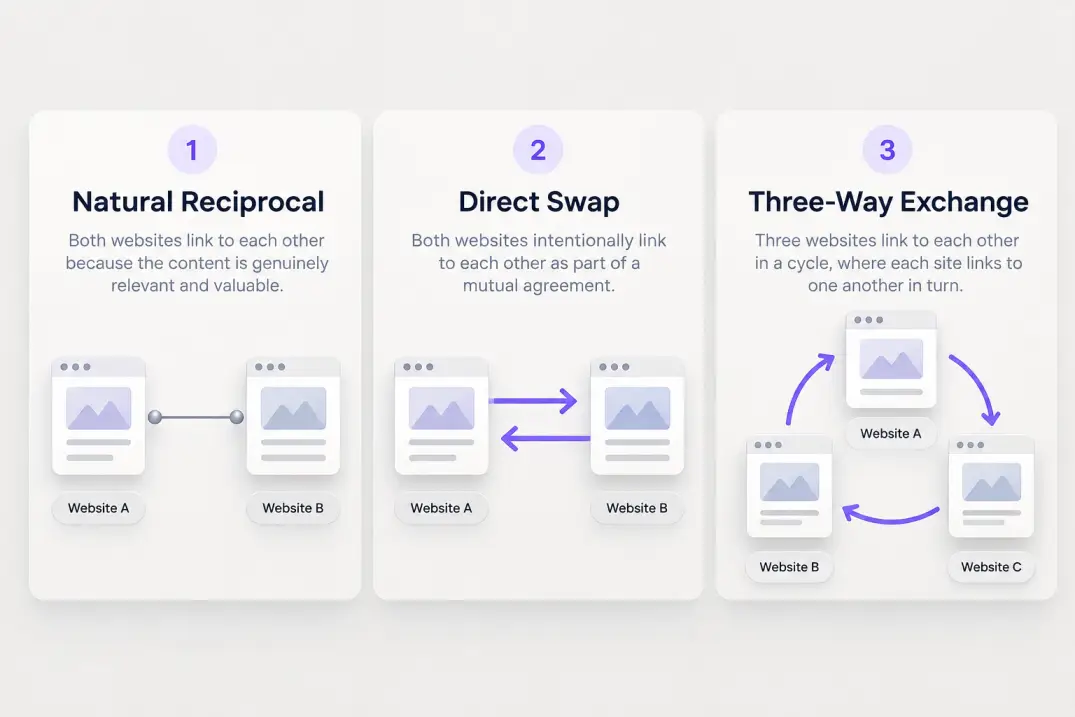
Three Flavors of Link Exchange
| Type | How it works | Risk level |
|---|---|---|
| Natural reciprocal link | Two related sites link to each other because it genuinely helps readers (e.g., a recipe blog and a kitchenware store) | Low — Google explicitly says this is fine |
| Direct two-way swap | "You link to me, I'll link to you," arranged deliberately, often via cold outreach | Moderate — fine occasionally, risky at volume |
| Three-way / networked exchange (a backlinks network) | Site A links to B, B links to C, C links to A — designed so no two sites link directly back to each other | High — this is a deliberate attempt to mask reciprocity, and Google has said its systems look for exactly this pattern |
This is why the phrase exchange of links means something different to a small blogger doing a friendly shoutout than it does to an agency running hundreds of triangulated swaps through a private network.
Ahrefs analyzed over 100,000 top-ranking pages and found that a large share carried at least some reciprocal links — reciprocal linking is far more common among ranking sites than most SEOs assume.
Does Google Actually Hate Link Exchanges?
Here's where most articles get vague. Let's not.
Google's link spam guidelines list "excessive link exchanges" directly under examples of link schemes, right alongside buying links and using automated programs to create links. The word excessive is doing a lot of work in that sentence, and Google added it deliberately after years of confusion about whether any reciprocal linking was against the rules.
Google's own Search Advocate, John Mueller, has said publicly that ordinary reciprocal linking — like a local business linking to a neighboring business, or a site linking back to a publication that featured them — is natural and generally not something to worry about. The issue isn't the reciprocity itself. It's when the sole purpose of the link is to manipulate rankings rather than to help a user.
Ask yourself one question before any exchange: would this link exist if Google didn't exist? If the honest answer is no, don't do it.
So to directly answer the core question: Google doesn't blanket-ban backlink exchange, but it actively discounts and, in aggressive cases, penalizes it. Its systems are specifically built to detect reciprocal patterns — if Site A links to Site B and, within a short window, Site B links back, that pattern is easy for a crawler to flag. At scale, those links simply stop passing ranking value. In more blatant cases — sitewide footer swaps, mass outreach campaigns, obvious link farms — manual actions and ranking drops follow.
Should You Do Backlink Exchanges in 2026?
Given all that, here's the practical answer: occasionally, selectively, and never as your only link-building strategy.
A one-off exchange with a genuinely relevant, topically-aligned site that also sends you real referral traffic is low-risk and can still add value — both from an SEO and a business development standpoint. What's risky is treating backlinks exchange as a scalable growth channel, running it through automated link exchange websites list directories, or joining a backlinks network that connects you with hundreds of unrelated sites.
The 10% Rule
Many experienced link builders privately follow an informal "10% rule": if reciprocal links make up more than roughly 10% of your total backlink profile, you're likely over-indexing on a tactic that carries diminishing (and eventually negative) returns. The other 90%+ should come from earned editorial coverage, digital PR, guest contributions, and genuinely link-worthy content.
- Occasional reciprocal links between relevant sites are natural and low-risk
- Mass, patterned exchanges get algorithmically discounted or manually penalized
- Three-way "ABC" exchanges reduce detectability but don't eliminate risk
- Keep reciprocal links under roughly 10% of your total backlink profile
- Referral traffic value can outlast SEO value, so pick partners people actually click
Advantages of Backlink Exchange
It's easy to only hear the warnings, but there's a reason this tactic has survived two decades of algorithm updates. Used carefully, it has real upside.
1. It's free (or nearly free)
Unlike paid link placements or sponsored posts, a straightforward exchange link seo arrangement usually costs nothing but the outreach effort. For bootstrapped sites and early-stage businesses, that matters.
2. It builds real relationships
A well-targeted exchange often opens the door to future collaboration — co-marketing, guest posts, joint webinars. The link itself might be a minor SEO signal, but the relationship behind it can compound.
3. Referral traffic that isn't fake
If the partner site shares your audience, the link can send genuinely interested visitors your way — traffic that doesn't depend on Google's algorithm at all.
4. Fast to execute
Compared to a six-week digital PR campaign or a guest-post pitch cycle, a link exchange can be arranged and live within a day.
Disadvantages of Backlink Exchange
1. Algorithmic devaluation
The biggest risk isn't a dramatic penalty — it's the quiet kind. Google's systems can simply decide the link passes no ranking value at all, meaning you did the work for nothing.
2. Manual action risk at scale
If your outreach pattern looks automated — identical email templates, sitewide footer links, matching anchor text across dozens of domains — you risk a manual action that can suppress rankings sitewide, not just for the linked page.
3. Time sink for low-authority partners
Swapping links with a low-quality or unrelated site does little for rankings and can actively look spammy in your backlink profile when a real prospect (or a real SEO auditor) reviews it.
4. It doesn't scale safely
This is the core tension: what works fine at 5–10 careful exchanges breaks down completely at 500 automated ones. Most sites that get burned didn't do one exchange — they industrialized it.
Sending the exact same outreach template, with the exact same anchor text request, to fifty sites in your niche. This is precisely the pattern Google's spam systems are trained to catch.
Where People Actually Do This: Link Exchange Providers & Platforms
If you search link exchange website or link exchange websites list, you'll run into a mix of directories, SaaS tools, agencies, and outright link-selling operations. Here's an honest breakdown of the categories you'll encounter and what to know about each — this is educational context, not an endorsement to use every option listed.
| Platform / Category | What it actually offers | Things to watch for |
|---|---|---|
| HARO / Connectively | Journalist-source matching that can result in earned (not exchanged) editorial links | Not a link exchange at all — genuinely earned links, worth pursuing separately |
| Blogger outreach communities (niche Facebook/Slack groups) | Informal peer-to-peer link swap requests | Quality varies wildly; vet domain relevance manually |
| Guest posting marketplaces | Paid placements that sometimes bundle in reciprocal expectations | Watch for "you link to us too" conditions hidden in contracts |
| Web directories (general and niche) | Submission-based backlinks, sometimes requiring a reciprocal link back to the directory | Mostly low authority today; use sparingly, if at all |
| Link exchange forums/networks | Dedicated communities built specifically around swapping links | High detection risk if used at volume; treat as last resort |
| SEO agencies offering link building packages | Often include a mix of earned, guest, and exchanged links | Ask for a transparent methodology breakdown before buying |
| Local business associations / chambers of commerce sites | Natural reciprocal links between real local businesses | Genuinely low-risk — this is the kind of exchange Google is fine with |
| Resource page link building tools | Help you find "resources" pages to request inclusion on, sometimes reciprocal | More earned than exchanged, generally safer |
| Private blog networks (PBNs) | Networks of owned domains built purely to funnel authority | High risk — this is what Google's Penguin update specifically targeted |
| Competitor backlink analysis tools (Ahrefs, Semrush, Moz) | Not exchanges themselves, but used to find exchange opportunities by seeing who links to similar sites | Useful for research, not a link source on their own |
A quick honest note here: most of the highest-quality seo company link exchange arrangements you'll come across aren't advertised as "link exchanges" at all — they're framed as partnerships, co-marketing, or resource sharing. The moment a service explicitly sells you a guaranteed reciprocal link at scale, treat that as a red flag rather than a shortcut.
How to Do Link Exchange Safely (If You Choose To)
If you've decided the occasional exchange makes sense for your site, here's how experienced link builders keep it low-risk.
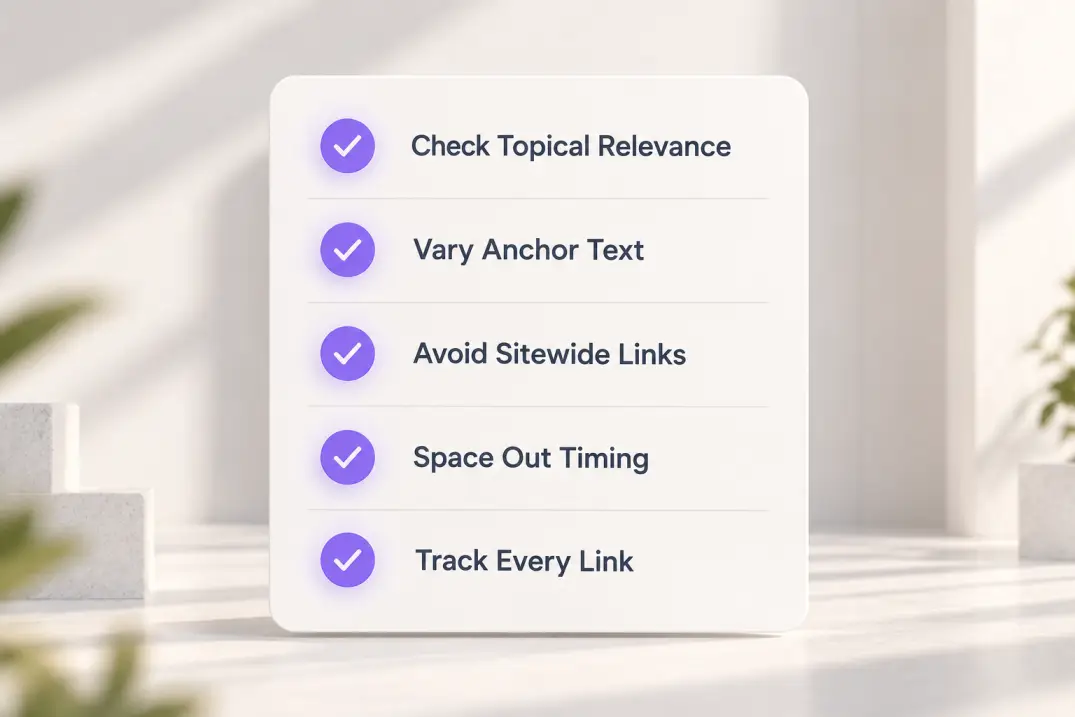
Prioritize topical relevance over domain authority
A moderate-authority site in your exact niche is worth more — and is far safer — than a high-authority site with zero topical connection to you.
Vary your anchor text
Exact-match anchor text repeated across exchanges is one of the clearest unnatural-link signals. Use branded, generic, and natural-language anchors instead.
Avoid sitewide placements
A link buried in your footer on every page reads as manipulative by design. A link inside a genuinely relevant blog post or resource page reads as editorial.
Space it out
A handful of exchanges spread across months looks nothing like fifty exchanges executed in a single week. Time patterns matter to detection systems just as much as link patterns do.
Track what you give and what you get
This sounds simple until you're managing twenty partnerships and can't remember which ones are still live, which anchor text you used where, or whether a partner quietly removed your link six months ago. This is exactly the kind of operational overhead that easily gets automated — platforms like Qoreta, for instance, handle the internal-linking and content-publishing side of a site's SEO workflow automatically, which is the same instinct worth applying to tracking any external link relationships you maintain.
A regional bakery's website links to a local wedding photographer's site in a blog post about wedding cake trends. The photographer links back from a post about vendor recommendations. Both links are topically justified, serve real readers looking for wedding vendors, and would exist whether or not either site cared about SEO — this is exactly the kind of reciprocal link Google has said not to worry about.
Backlink Exchange vs. Other Link Building Methods
It helps to see where reciprocal linking sits relative to the other major link-building approaches, since "is this the right strategy" is really a comparison question.
| Method | Cost | Scalability | Google risk | Typical time to results |
|---|---|---|---|---|
| Backlink exchange | Free to low | Low (safely) | Moderate–high at scale | Days |
| Guest posting | Time or paid | Medium | Low–moderate | Weeks |
| Digital PR / earned coverage | High effort/cost | High | Very low | Weeks–months |
| Paid link placement | High cost | Medium | High | Days |
| Resource page outreach | Time | Medium | Low | Weeks |
No single method wins across every column — which is exactly why most durable link-building strategies blend two or three approaches rather than betting everything on one, including reciprocal linking.
A Brief History: Why This Debate Won't Die
Link exchange predates modern SEO. In the 1990s and early 2000s, "webrings" and blogroll swaps were simply how small sites found each other before search discovery matured. When Google's PageRank algorithm made backlinks a ranking signal, that same casual habit got weaponized — automated reciprocal link generators, link farms, and eventually full backlinks network operations emerged specifically to game rankings.
Google's 2012 Penguin update was a direct response to this manipulation, and it's the reason link exchange in seo still carries a cautious reputation more than a decade later, even though the original guidelines only ever targeted the excessive and manipulative versions of the practice.
As one long-time SEO practitioner summarized it in an industry discussion of the topic, Google can tell the difference between a natural, occasional reciprocal link and a systematic exchange scheme — and it's the system, not the single link, that tends to get penalized.
This is why forums, glossaries, and agencies still debate what is link exchange and whether it's safe — the underlying practice never fully went away, it just got harder to do carelessly.
The Bigger Picture: Where Link Exchange Fits Into a 2026 SEO Strategy
Search itself has shifted since the early days of PageRank. Google now weighs E-E-A-T signals, topical authority, and user engagement far more heavily than raw backlink counts. AI-driven answer engines are increasingly part of how people discover content at all, which means link building has to serve two audiences now: search crawlers and the retrieval systems behind tools like ChatGPT and Perplexity.
In that environment, a blog link exchange with a genuinely relevant, well-regarded site can still contribute — but it's one input among many, not a growth lever on its own. The sites winning long-term are the ones producing content worth linking to naturally, and treating reciprocal links as a small, careful supplement rather than a strategy. This is also where a lot of the manual overhead in modern SEO — publishing consistently, cross-linking internally, keeping citations current — has started shifting toward automated pipelines, since maintaining that discipline by hand across dozens of posts a month is genuinely hard to sustain.
Key Takeaways Before You Start Exchanging Links
- A backlink exchange is not inherently against Google's rules — excessive, patterned exchanges are
- Natural reciprocal links between relevant sites are explicitly fine per Google's own guidance
- Three-way exchanges reduce obviousness but don't eliminate detection risk
- Keep reciprocal links to a small share of your total backlink profile
- Prioritize relevance and referral value over raw domain authority
- Never rely on link exchange as your only or primary link-building channel
If you take one thing away from this guide, let it be this: the question was never really "does Google hate link exchange." It's "does this specific link exist to help a real reader, or only to move a ranking number." Answer that honestly for every link you place, and you'll stay on the right side of nearly every guideline Google has published on the subject.
Artificial Intelligence
Intelligence without limits.
We believe great content deserves honest authorship—even when it's AI.
Frequently Asked Questions
Yes, they're used interchangeably in SEO. Both describe two sites agreeing to link to each other, whether that agreement is explicit outreach or a natural, unplanned mutual link.
No. A single, topically relevant exchange is extremely low risk. Penalties and algorithmic devaluation come from patterns — mass outreach, sitewide placements, or networked schemes — not one-off swaps.
Its crawlers look for timing patterns (Site A links, then Site B links back shortly after), matching anchor text across many domains, and structural patterns like three-way loops that are statistically unlikely to occur naturally.
They're harder to detect at a glance, but Google's systems are specifically built to look for indirect reciprocal patterns too. Harder to spot is not the same as safe — it reduces but doesn't remove risk.
Many experienced link builders use an informal 10% ceiling — if more than roughly a tenth of your total backlinks are reciprocal, you're likely over-relying on the tactic relative to earned links.
Sometimes, if the link is contextual, relevant, and part of a natural-looking profile. At scale or in obvious patterns, Google's algorithms are built to discount the value entirely rather than pass any ranking benefit.
A link exchange trades links for links with no money involved. Buying a backlink involves payment for placement. Both are listed under Google's link schemes, but paid links generally carry higher, more consistent penalty risk.
Yes — using a nofollow or sponsored attribute on an exchanged link signals to Google that you're not trying to pass ranking authority, which significantly lowers manipulation risk while still allowing referral traffic through.
Generally not recommended as a primary tactic. Most modern directories and marketplaces produce low-authority, low-relevance links, and using them at any real volume creates an unnatural link pattern in your backlink profile.
Look at who links to your direct competitors using a backlink tool, identify sites in adjacent (not identical) niches, and prioritize outreach to sites that already produce content your audience would want to read anyway.
Indirectly. AI answer engines often rely on the same crawled web data and citation signals Google uses, so a genuinely relevant, well-placed link can support broader visibility — but it won't outweigh weak or thin content.
Audit your backlink profile, identify low-relevance or sitewide reciprocal links, request removal where the relationship no longer makes sense, and rebalance new link-building efforts toward earned and editorial links.
Not officially, but they tend to be lower risk in practice because the relevance is obvious and the volume is naturally small — a hardware store linking to a nearby contractor looks editorial, not manipulative.
Most SEOs recommend waiting at least 4-8 weeks and isolating other variables before drawing conclusions, since a single link rarely moves rankings on its own in either direction.
Automation can help track partnerships and outreach status, but the relevance judgment - whether a site is actually a good fit - still needs a human or a well-tuned system reviewing context, not just domain metrics.
It can help in small doses for initial visibility and relationship-building, but new sites benefit far more from a handful of genuinely earned links than from a large batch of reciprocal ones early on.