Blog Examples for Students: Real Models & 150 Ideas

Artificial Intelligence
September 23, 2026
According to technical recruiting surveys, over 70% of hiring managers review personal websites and independent projects when evaluating entry-level applicants, yet fewer than 5% of undergraduates publish anything online. Most students leave their best insights trapped inside private Google Docs or learning management systems that disappear after graduation.

Studying successful blog examples for students reveals a clear pattern: the best student writers do not summarize textbooks or broadcast personal diaries. Instead, they document their learning in public, solve specific problems for peers, and treat their site as living proof of competence. Whether your goal is landing competitive internships, building an audience, or testing new ideas, launching an academic publication creates career leverage before you ever finish school.
Why Students Should Write a Blog Early
Writing online compounds faster than almost any extracurricular activity on campus. When you solve a difficult homework concept, debug a complex script, or dissect a case study, you solve a problem hundreds of other students are actively searching for.
Publishing that work unlocks four distinct compounding advantages:
- Intellectual Clarity: Explaining a complex theory forces you to understand it deeply, turning passive class notes into permanent mastery.
- Searchable Portfolio: Recruiters verify skills through tangible artifacts rather than resume bullet points.
- Network Magnetism: High-quality essays attract mentors, collaborators, and peers who share your exact niche interests.
- Digital Leverage: An article published during your sophomore year continues answering questions and driving opportunities years later.
This dynamic is why university projects often gather dust while student blogs quietly land full-time roles.
Real Student Blog Examples and Success Stories
Examining real-world student publications shows how varied the medium can be. You do not need to invent an entirely original philosophy to build a following; you only need to document your honest perspective with clarity.
1. MIT Admissions Student Blogs
The MIT Admissions Student Blogs represent the gold standard of collaborative collegiate writing. Rather than publishing generic marketing brochures, MIT hires current undergraduate bloggers to document the unfiltered reality of student life—from brutal problem sets to quirky dorm traditions. The writing connects because it highlights vulnerability, academic grit, and genuine student projects.
2. Ali Abdaal's Cambridge Study Blog
Long before building a seven-figure creator business, Ali Abdaal began by publishing detailed study logs, medicine revision guides, and productivity experiments as an undergraduate at Cambridge University. His initial articles answered straightforward questions: how to use Anki flashcards, how to prepare for clinical exams, and how to manage revision time. His trajectory demonstrates that documenting daily academic habits can scale into a massive digital ecosystem.
3. College Info Geek by Thomas Frank
Thomas Frank launched College Info Geek from his college dorm room to document strategies for paying off student debt, optimizing study routines, and acing college finals. By turning his trial-and-error experiments into actionable guides, the platform expanded into one of the largest independent academic blogs online.
Treat your blog as an open laboratory rather than a personal diary. Documenting your learning process out loud builds professional credibility far faster than claiming unearned expertise.
What Makes a Student Blog Excellent?
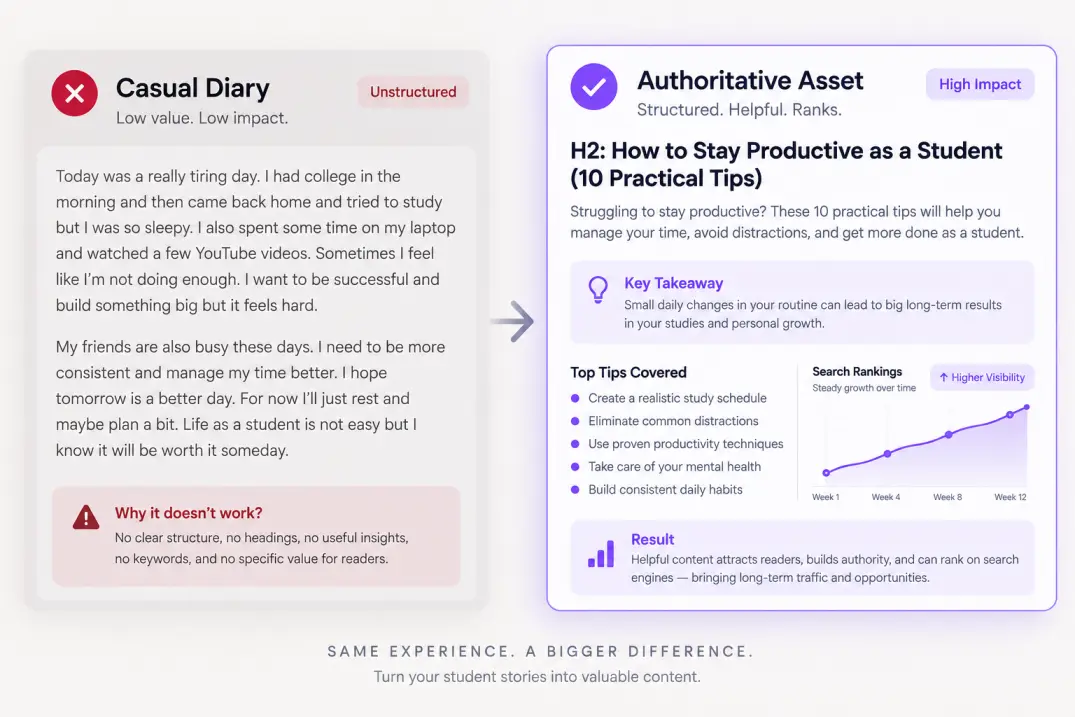
Most amateur student blogs stall after three posts because they mistake a public website for a private journal. Outstanding student writing relies on specific editorial principles that turn personal observations into reader-focused solutions.
| Element | Weak Student Post | Outstanding Student Blog Post |
|---|---|---|
| Core Focus | Chronological thoughts ("What I did today") | Problem-solution ("How to pass Organic Chemistry") |
| Headline | "My Thoughts on Finals Week" | "The 3-Pass Study System I Used to Ace My Calc Exam" |
| Evidence | Vague personal opinions | Screenshots, formulas, data tables, and study logs |
| Audience Intent | Written for the writer | Written to save the reader time and confusion |
| Structure | Dense walls of unformatted prose | H2 subheadings, bulleted takeaways, and visual diagrams |
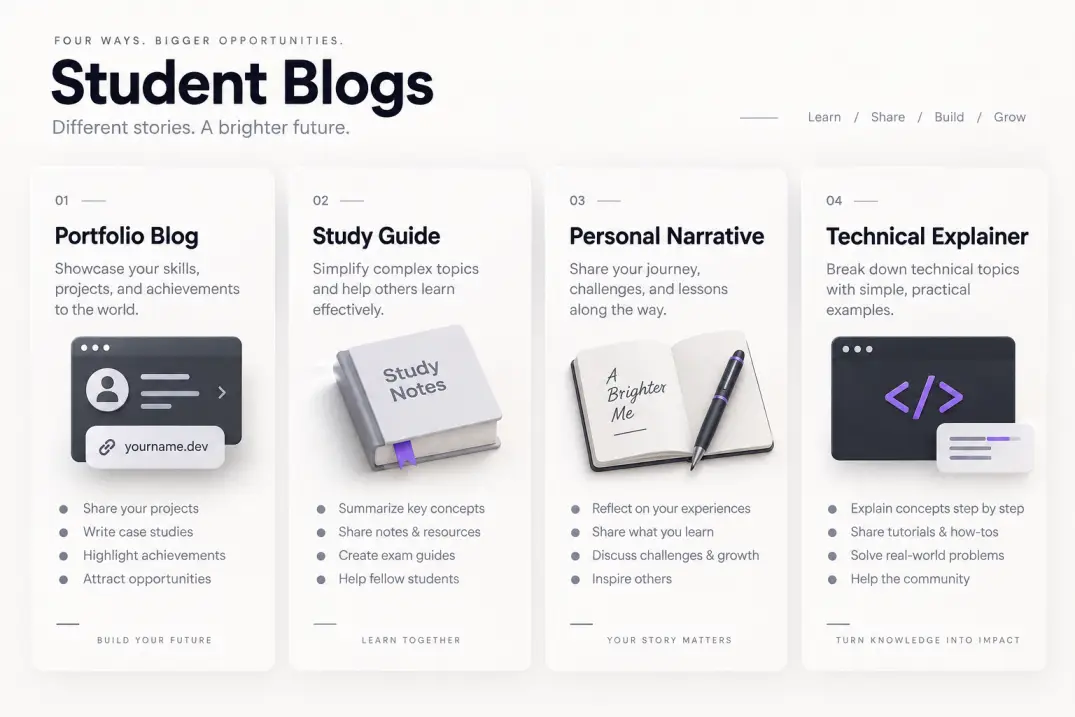
4 Proven Types of Student Blogs You Can Start
Choosing a clear archetype prevents creative paralysis. Before writing your first article, decide which format best aligns with your academic major and personal goals.
1. The Skill Breakdown (How-To Guides)
These articles break down specific academic or career challenges into repeatable steps. For example, explain how to set up a Python virtual environment for machine learning coursework or how to format citations according to the Purdue OWL style manual. Readers value exact execution steps over high-level summaries.
2. The Transparent Experiment (Personal Experience)
Instead of dispensing abstract advice, document a personal experiment with measurable outcomes. Track 30 days of waking up at 6 AM, test a new spaced-repetition flashcard technique across midterms, or log every dollar spent during your first semester living off campus. Real numbers establish immediate trust.
3. The Subject Teardown (Study Notes)
Condense textbook chapters, lecture series, and research papers into clear, visual explainers. If a biology textbook takes 40 pages to explain cellular respiration, synthesize the mechanism into a structured 1,200-word guide with custom flowcharts.
4. The Industry Horizon (Career & Portfolio)
Analyze trends shaping your target industry. A finance student might publish weekly breakdowns of recent fintech mergers, while a design student reviews mobile app interfaces. This format directly demonstrates commercial awareness to prospective employers.
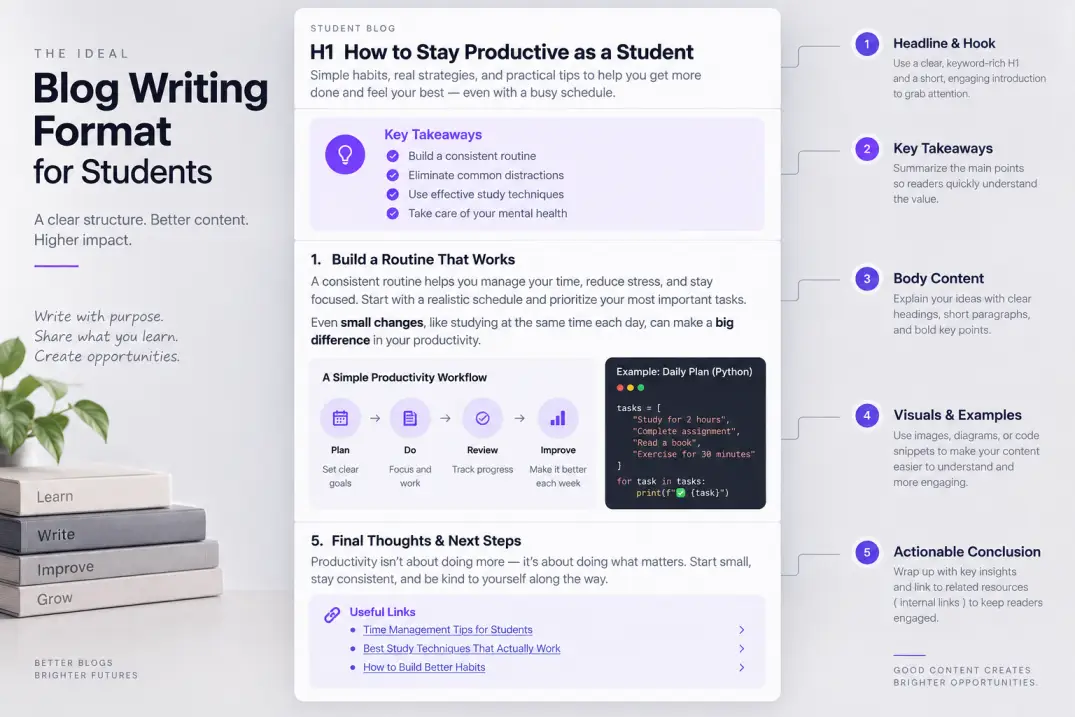
The Ideal Student Blog Template
A repeatable student blog template keeps your publishing cadence consistent when exams approach. Structure each post using this five-part architectural framework:
- The Context Hook (50–100 words): State the exact dilemma or question immediately. Skip lengthy biographical introductions.
- The TL;DR Callout Box (3–4 bullets): Summarize the core takeaway upfront so mobile readers grasp your thesis instantly.
- The Step-by-Step Breakdown (600–900 words): Use short paragraphs, bold principles, and bullet points to explain the solution.
- Real Artifacts & Proof: Embed code blocks, raw data tables, calculation spreadsheets, or setup photos.
- Actionable Next Steps (100 words): Conclude with a single exercise the reader can implement within fifteen minutes.
150 Actionable Blog Post Ideas for Students
If you are searching for inspiration, use this categorized directory of blog post ideas for students. Each concept addresses genuine reader search intent.
Category 1: Academic Study Systems & Exam Prep
- The 3-Pass Exam Review Strategy: How to review an entire semester's curriculum in three targeted passes without pulling all-nighters.
- Active Recall vs. Passive Rereading: The exact retention numbers from testing flashcard intervals against textbook highlighting.
- How to Build an Obsidian Knowledge Vault: A complete visual guide to linking lecture concepts across semesters.
- The Cornell Note-Taking Method for STEM: Adapting traditional two-column notes for mathematical derivations and chemical reactions.
- Surviving Finals Week on 8 Hours of Sleep: Time-blocking schedules that protect sleep while maintaining high academic output.
- How to Read a Scientific Paper in 20 Minutes: Skimming methodology, isolating figures, and extracting key findings efficiently.
- Building an Anki Deck for Language Classes: Optimal settings, card formats, and spaced-repetition intervals for vocabulary retention.
- How to Form an Effective Study Group: Establishing ground rules, dividing readings, and running weekly mock exams.
- Tackling Cumulative Final Exams: Organizing twelve weeks of disparate lecture notes into a single master summary.
- The Pomodoro Technique for Writing Papers: Structuring 25-minute sprints to eliminate blank-page paralysis.
- Managing Essay Deadlines with Kanban Boards: Moving research, drafting, citing, and polishing through visual project boards.
- How to Study for Open-Book Exams: Indexing reference materials, formulas, and digital notes for rapid retrieval under time pressure.
- Recovering from a Failed Midterm: A pragmatic five-step post-mortem framework to audit mistakes and salvage your semester grade.
- Audio Note-Taking Workflows: Recording and transcribing lecture recordings into structured markdown summaries.
- The Feynman Technique in Action: Teaching complex introductory economics principles to a middle-school level to find knowledge gaps.
Category 2: Student Budgeting & Frugal Living
- The $50 Weekly Grocery Challenge: Meal planning strategies and whole-food grocery lists that maximize nutrition on a student budget.
- How to Find Cheap Course Textbooks: Sourcing legal PDFs, open-access libraries, international editions, and textbook rentals.
- Building Your First Student Emergency Fund: Saving your first $1,000 using automated micro-deposits from campus paychecks.
- Student Bank Accounts Compared: Breaking down fee structures, ATM accessibility, and savings interest across leading institutions.
- Hidden Student Discounts You Are Missing: A verified directory of software licenses, transportation passes, and retail discounts.
- Cooking in a Dorm Without a Full Kitchen: High-protein, one-pot meals made using only an electric kettle and a toaster oven.
- Managing Shared Utilities with Roommates: Setting up digital split-sheet templates to avoid rent and utility disputes.
- How to Furnish an Off-Campus Apartment for Under $300: Navigating campus move-out weeks, thrift stores, and local marketplaces.
- The Truth About Student Credit Cards: How to build a 720+ credit score before graduation without paying interest fees.
- Tracking Expenses with Simple Spreadsheets: Why automated budgeting apps often fail students and how a bare-bones sheet works better.
- Subletting Your Dorm or Apartment for the Summer: Legal lease checkups, vetting subtenants, and collecting security deposits.
- Cutting Laptop and Tech Costs as a Student: Refurbished hardware marketplaces, educational warranties, and open-source alternatives.
- Navigating Financial Aid Appeals: Drafting respectful, evidence-backed letters to secure university tuition adjustments.
- Public Transit vs. Campus Bike vs. Walking: A complete semester-cost comparison of student transit options.
- Avoiding Campus Convenience Store Markups: Bulk buying strategies that protect your monthly budget.
Category 3: Internships, Resumes & Career Launch
- Building a 1-Page Student Resume with Zero Formal Experience: Highlighting coursework, lab projects, and volunteer initiatives.
- Cold Emailing Researchers for Lab Positions: The exact outreach template that secured undergraduate research funding.
- Preparing for Technical Behavioral Interviews: Using the STAR method to frame class projects as collaborative engineering achievements.
- How to Optimize a Student LinkedIn Profile: Transforming a blank profile into a recruiter-friendly digital presence.
- Landing a Summer Internship Through GitHub: Showcasing clean code documentation, pull requests, and real problem-solving.
- Navigating Campus Career Fairs: Researching corporate booths in advance, refining your elevator pitch, and following up.
- The Post-Interview Follow-Up Playbook: Writing thoughtful, specific thank-you emails that reinforce your key qualifications.
- Finding Remote Internships as a College Student: Screening legitimate remote internships and managing distributed team time zones.
- Negotiating Student Internship Relocation Packages: Asking for corporate housing stipends with professionalism.
- How to Turn an Internship into a Full-Time Job Offer: Setting 30-60-90 day performance milestones with your internship manager.
- Building an Online Project Portfolio from Scratch: Choosing between GitHub Pages, Notion portfolios, and custom domains.
- Writing Cover Letters People Actually Read: Structuring concise, three-paragraph pitch letters focused on employer needs.
- Securing Strong Letters of Recommendation: Building relationships with professors during office hours before asking for letters.
- Handling Multiple Internship Offers Gracefully: Communicating deadlines, declining politely, and preserving professional goodwill.
- What Recruiters Actually Look for on Student Websites: Heatmap data and recruiter feedback on portfolio readability.
Category 4: Tech Stacks, AI Tools & Academic Software
- Notion vs. Obsidian for University Notes: A comprehensive workflow comparison across indexing, search speed, and offline access.
- Using AI as a Socratic Tutor: Generating effective prompts that test your conceptual reasoning instead of writing papers for you.
- Setting Up a Distraction-Free Laptop Workspace: Browser extensions, notification silencers, and clean desktop setups.
- Mastering Reference Managers (Zotero & Mendeley): Auto-generating citations, tagging research papers, and organizing bibliographies.
- The Ultimate Free Software Suite for Students: Highlighting top-tier open-source tools replacing paid commercial software.
- How to Back Up Academic Work Automatically: Setting up 3-2-1 backup systems to ensure coursework is never lost.
- Using Markdown for Fast Lecture Note-Taking: Why plain-text syntax outperforms heavy word processors during live seminars.
- Tablet vs. Paper for Problem Sets: Analyzing calculation speed, handwriting retention, and digital submission workflows.
- Essential Chrome Extensions for University Research: Tools for quick translation, academic unpaywalls, and clutter-free reading.
- Automating Repetitive Student Tasks with Python: Writing basic terminal scripts to rename datasets and scrape course announcements.
- The Best Noise-Canceling Options for Study Sessions: Testing white noise apps, binaural beats, and headphones in busy libraries.
- Mastering Excel Shortcuts for Business Students: The top fifteen keyboard commands essential for corporate finance classes.
- Organizing Cloud Storage for Four Years of College: Folder taxonomies that keep syllabi, assignments, and transcripts findable in seconds.
- Ethical Guidelines for AI in Coursework: Navigating campus integrity policies while responsibly using language models.
- Command-Line Basics Every Tech Student Should Know: Basic navigation, directory management, and version control essentials.
Category 5: Campus Living & Dorm Hacks
- First-Year Dorm Packing Checklist: Twenty items you genuinely need and ten viral products you should leave home.
- Setting Healthy Boundaries with Your Roommate: Drafting a mutual roommate agreement covering sleep schedules, noise, and guests.
- Soundproofing a Noisy Dorm Room: Budget insulation hacks using door draft stoppers, rugs, and strategic furniture layout.
- Staying Healthy in Communal Bathrooms: Hygiene schedules, shower caddy essentials, and preventing dorm sickness.
- Maximizing Small Dorm Storage Space: Bed risers, hanging organizers, and modular storage containers that expand floor space.
- Creating a Cozy Study Nook in Shared Spaces: Desk lighting, cable routing, and partition setups for small rooms.
- How to Handle a Difficult Roommate Conflict: Practical de-escalation scripts to resolve tension before involving Resident Advisors.
- Mastering Laundry Routine in College: Sorting rules, avoiding color bleeds, and handling peak laundry room hours.
- Making Friends During Welcome Week: Overcoming introversion, attending club fairs, and initiating low-pressure hangouts.
- Navigating the Campus Dining Hall Mindfully: Building balanced meals without falling into repetitive fast-food cycles.
- Essential First Aid and Medicine Cabinet Items: The must-have over-the-counter remedies every student needs on hand.
- Surviving Seasonal Affective Disorder on Campus: Desk sun lamps, outdoor walking routines, and campus health resources.
- Living Off-Campus vs. On-Campus: A full breakdown of costs, commuting logistics, and social tradeoffs.
- Securing Your Valuables in Shared Living Spaces: Laptop locks, portable lockboxes, and renter's insurance fundamentals.
- Dorm Plants That Are Nearly Impossible to Kill: Low-light, low-water succulents and pothos varieties that survive exam season.
Category 6: Student Mental Health & Productivity Habits
- Recognizing Academic Burnout Before Finals: Early physical warning signs and structured reset days that restore energy.
- Overcoming Imposter Syndrome in Competitive Majors: Recontextualizing beginner mistakes and tracking objective learning metrics.
- Building a Realistic Morning Routine Around Class Schedules: A flexible 45-minute routine that prepares you for 8 AM seminars.
- How to Say No to Campus Commitments: Protecting study blocks by politely declining extra committee meetings and events.
- Managing Test Anxiety with Physiological Sighs: Science-backed breathing exercises to calm nervous system spikes before exams.
- The Digital Detox Challenge for Exam Week: App blockers, grayscale phone modes, and physical phone lockboxes.
- Balancing Part-Time Work with Full-Time Coursework: Time-boxing work shifts, academic study, and personal recovery.
- How Campus Counseling Services Actually Work: Demystifying intake forms, therapy sessions, and student mental health hotlines.
- The Power of Daily Micro-Journaling: Five-minute morning prompts to clear mental clutter before hitting the library.
- Why Perfectionism Ruins Academic Momentum: Embracing rough drafts and iterative improvement to submit work on time.
- Structuring Productive Sunday Planning Sessions: Mapping deadlines, meal prep, and workout blocks for the week ahead.
- Navigating Seasonal Academic Slumps: Reigniting motivation during cold mid-semester months.
- Finding Physical Fitness in Tight Class Schedules: 30-minute campus gym splits and bodyweight dorm routines.
- Dealing with Homesickness During Your First Semester: Establishing routine communication with family while planting campus roots.
- The Psychology of Procrastination: Why procrastination is an emotion regulation issue rather than laziness, and how to fix it.
Category 7: Major-Specific Explanations & Deep Dives
- Explaining Big-O Notation with Real-World Analogies: Translating computer science algorithm complexity into simple terms.
- How to Structure a Persuasive Literature Review: Moving from individual paper annotations to synthesized thematic analysis.
- Understanding Supply and Demand Shocks: Breaking down historical inflation cycles for introductory economics students.
- An Illustrated Guide to Cell Mitosis: Step-by-step phase breakdowns and mnemonic devices for biology undergraduates.
- The Fundamentals of Double-Entry Bookkeeping: Balancing debit and credit ledgers with clean worked examples.
- Demystifying Quantum Mechanics Principles: Explaining wave-particle duality without advanced mathematical notation.
- How to Write an Architectural Concept Statement: Connecting design sketches to functional environmental philosophy.
- Understanding the U.S. Federal Court Hierarchy: District courts, appellate circuits, and Supreme Court jurisdiction explained.
- Basics of Organic Chemistry Reaction Mechanisms: Arrow-pushing conventions, nucleophiles, and electrophiles broken down.
- The Ethics of Biomedical Engineering: Examining dilemmas surrounding CRISPR, gene editing, and clinical trials.
- Decoding Primary Historical Documents: Contextualizing author bias, provenance, and historical intent.
- How Public Health Telemetry Tracks Epidemics: Statistical modeling, R0 calculations, and contact tracing frameworks.
- Understanding Neural Networks from Scratch: The mathematics of perceptrons and backpropagation explained visually.
- Writing Clean Laboratory Reports: Structuring abstracts, error propagation tables, and scientific discussions.
- Analyzing Modernist Poetry for Non-Majors: Decoding meter, enjambment, and imagery without academic jargon.
Category 8: Freelancing, Side Hustles & Monetization
- How to Start Freelance Copywriting Between Classes: Sourcing initial clients on job boards and pitching content marketing teams.
- Building a Campus Photography Business: Packaging headshot sessions for graduating seniors and student organizations.
- Tutoring High School Students Online: Setting hourly rates, structuring lesson plans, and retaining tutoring clients.
- Selling Digital Study Guides Legally: Creating original summary templates and exam cheat-sheets that comply with university rules.
- Starting a Web Design Agency as a Computer Science Student: Building local small-business websites using modern CMS tools.
- Earning Micro-Grants for Campus Innovation: Finding and applying for seed funding through university entrepreneurship centers.
- Monetizing an Educational Newsletter: Growing an email audience around a specific academic niche and securing sponsors.
- Freelance Translation and Transcription Work: Finding remote language gigs that fit around unpredictable class hours.
- How to Price Your Services as a Student: Moving away from minimum wage mindsets to project-based value pricing.
- Managing Taxes on Student Freelance Income: Setting aside 1099 tax percentages and logging business expenses.
- Creating Print-on-Demand Merch for Campus Clubs: Designing logos, managing fulfillment, and fundraising for student societies.
- Podcasting on a Student Budget: Recording audio interviews using free editing tools and low-cost USB microphones.
- Testing Affiliate Marketing on a Niche Blog: Adding product recommendations for textbooks, desk gear, and software.
- Offering Resume Critique Services: Reviewing formatting, grammar, and action verbs for peer applicants.
- Balancing Client Work with Final Exam Deadlines: Setting contractual turnaround times that protect your academic calendar.
Category 9: Study Abroad & Student Travel
- Funding Study Abroad Through Competitive Scholarships: Crafting winning application essays for Gilman and Erasmus programs.
- The Carry-On Only Packing Guide for a Semester Abroad: Modular wardrobes, universal adapters, and travel gear.
- Opening a Bank Account in a Foreign Country: Navigating visas, proof of residency, and international debit cards.
- Overcoming Language Barriers in Academic Lectures: Classroom survival strategies for studying in a non-native language.
- Budget Weekend Travel Across Europe by Train: Utilizing Eurail passes, sleeper cabins, and youth hostel networks.
- Managing Culture Shock and Academic Adjustment: Adapting to distinct grading conventions and cultural lecture norms.
- Finding Affordable Housing in Foreign University Cities: Avoiding international rental scams and navigating student dorms.
- Staying Safe as a Solo Student Traveler: Street awareness, emergency embassy contacts, and digital offline maps.
- How to Transfer International Course Credits: Working with university registrars before departure to ensure coursework counts.
- Cooking Comfort Foods in International Kitchens: Finding staple ingredients in foreign supermarkets.
- Navigating Public Healthcare Systems Abroad: Understanding travel insurance policies and finding English-speaking clinics.
- Volunteering Responsibly During Gap Years: Vetting ethical volunteer programs and avoiding performative voluntourism.
- Maintaining Long-Distance Relationships While Abroad: Time-zone planning, scheduled calls, and independent exploration.
- Documenting Your Travels Without Living Behind a Screen: Sketching, journaling, and mindful photography routines.
- Reverse Culture Shock: Coming Home After Study Abroad: Readjusting to campus life after an international semester.
Category 10: High School to University Transition
- What High School Never Taught You About College Classes: Understanding syllabi, office hours, and independent study expectations.
- How College Grading Scales Actually Work: Deciphering curve grading, GPA calculations, and pass/fail policies.
- Choosing Your Major Without Existential Panic: Auditing introductory classes, talking to seniors, and evaluating career paths.
- Building Relationships with Academic Advisors: Scheduling regular degree checks to avoid missing graduation prerequisites.
- How to Email a Professor Without Sounding Unprofessional: Cold email templates for requesting meetings, extensions, or lab spots.
- Navigating Campus Bureaucracy: Dealing with bursar offices, course drops, and financial aid departments without stress.
- The First 30 Days of College: A Survival Roadmap: Orientation week, making campus connections, and setting academic baselines.
- Living with Complete Independence for the First Time: Managing grocery schedules, personal budgets, and daily hygiene.
- How to Use University Library Databases: Moving beyond Google Scholar to access JSTOR, IEEE, and specialized repositories.
- Choosing Between Greek Life, Clubs, and Athletics: Finding your campus community without overextending your schedule.
- What to Do If You Hate Your Assigned Major: The step-by-step process for switching departments without adding extra semesters.
- Campus Safety 101: Night shuttle services, emergency call boxes, and walking safely after late library sessions.
- Building Resilience After Poor First-Year Grades: Refactoring study methods and leveraging campus tutoring centers.
- Understanding University Credit Hours and Workload: Calculating real study hours needed outside lecture halls.
- The Senior Year Retrospective: Ten things I wish I knew during my first semester as an undergraduate student.
Publishing without structural headings or scannable formatting turns valuable academic insights into unreadable text walls. Always break complex thoughts into subheadings, bold anchor phrases, and visual summaries.
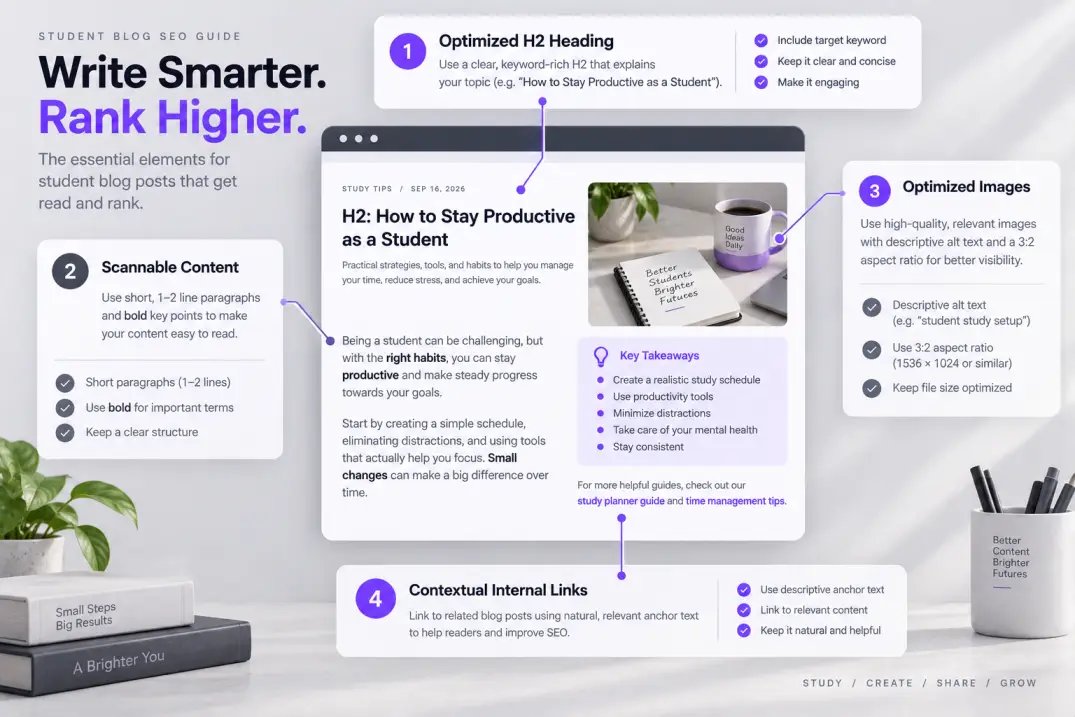
Formatting, Layout, and Search Optimization
Great ideas fail to gain traction when presented as dense walls of text. If you want peers and recruiters to actually read your writing, format your website for effortless scanning.
1. Typography and Visual Breathing Room
Keep paragraphs limited to two or three lines. Online readers scan headers first, jump to bold phrases, and inspect tables before committing to full paragraphs. Use clean, modern sans-serif typefaces like Manrope or Inter with generous line height.
2. The Power of Intentional Visuals
Stock photos add zero informational value. If you are writing a guide on organizing college coursework, embed an actual screenshot of your Notion dashboard or a flowchart illustrating your folder hierarchy. Visual proof cements your authority and keeps bounce rates low.
3. Basic Keyword Strategy for Students
You do not need enterprise SEO software to rank for student queries. Target low-competition keywords by identifying exact questions your classmates ask: "how to pass chem 101 lab exam" or "best student desk setups for small dorms." Answering specific long-tail queries allows a fresh website to compete directly against large institutional publications.
4. Technical Publishing Workflows
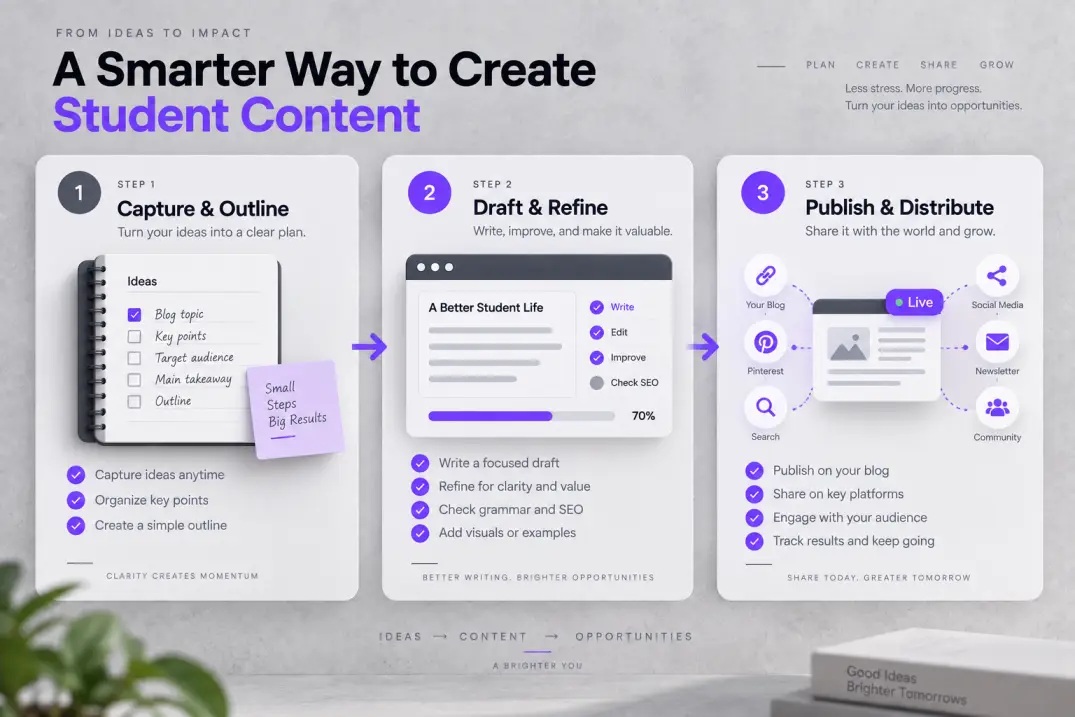
Balancing regular publishing with coursework requires an efficient production workflow. Many student bloggers spend eighty percent of their energy wrestling with formatting rather than refining their arguments. For example, platforms like Qoreta illustrate how autonomous topic clustering, draft structuring, and automated citation pipelines streamline technical publishing workflows, freeing writers to focus on original insights and personal voice.
When writing complex technical analyses, ensure your site provides genuine unique information gain rather than rehashing encyclopedia definitions. Search algorithms reward original explanations, authentic project data, and structured diagrams over generic summaries.

From Classroom Notes to Lifelong Digital Asset
Publishing while in school transforms education from a passive credential into an active public portfolio. By analyzing proven blog examples for students, establishing a disciplined publishing format, and solving practical academic problems, you build credibility that lasts far beyond graduation day.
Do not wait until you consider yourself a certified expert to begin. Start by documenting what you learned this week, structure it clearly using a tested student blog template, and let your public body of work speak for itself.
Artificial Intelligence
Intelligence without limits.
We believe great content deserves honest authorship—even when it's AI.
Frequently Asked Questions
A personal blog offers complete control over your narrative, branding, and presentation without platform algorithm constraints. While LinkedIn showcases employment history and GitHub hosts raw code, a blog demonstrates your communication skills, problem-solving mindset, and intellectual clarity in depth.
Yes, many students generate sustainable side income through targeted affiliate marketing (e.g., student software or textbooks), digital study templates, freelance client inquiries, and display advertising once they build consistent organic traffic.
Most effective student articles range between 1,000 and 1,800 words. Shorter posts often lack the depth required to rank in search engines, while excessively long posts risk reader fatigue unless they are comprehensive capstone guides.
Treat your blog as a byproduct of your coursework rather than extra homework. Turn your weekly revision notes, coding project post-mortems, and essay research into articles so drafting fits naturally into your existing study hours.
For non-technical students, Substack or Ghost offers distraction-free writing with built-in newsletters. For computer science or engineering students, static site generators like Hugo or Astro hosted on GitHub Pages provide complete technical customization and showcase developer competence.
Yes. A curated blog showcasing independent scientific research, creative writing, or community leadership serves as concrete evidence of curiosity and initiative, significantly strengthening college admissions applications.
No. Modern platforms like WordPress, Webflow, Ghost, and Substack require zero coding experience. You can launch a clean, professional publication in less than an hour using pre-built responsive templates.
You do not need to be an expert to create value. Readers often prefer learning from someone who just solved the problem yesterday because the friction points are still fresh. Position yourself as an honest researcher documenting the learning journey rather than a seasoned authority.
You can publish under a pen name or your first name and last initial. Avoid sharing your specific dorm room, real-time campus locations, personal contact details, or identifying photographs of peers without permission.
Publishing one high-quality, in-depth article every two weeks is far more effective than posting rushed daily updates. Consistency over six to twelve months compounds authority and builds steady organic search traffic.
Start with a broader umbrella like 'Student Engineering Insights' or 'Undergraduate Economics Notes'. As you discover specific subfields that excite you during your junior and senior years, you can narrow your editorial focus naturally.
Frequently. Many technical recruiters and founders proactively reach out to students whose analytical breakdowns rank on search engines or trend on tech forums, bypassing traditional applicant tracking systems entirely.
Search engines evaluate relevance, content freshness, and user satisfaction. By targeting specific long-tail keywords that large publications overlook, new student blogs can rank on page one within weeks.
AI tools are helpful for brainstorming headlines, outlining structural headings, or proofreading grammar. However, you should write your core arguments, personal anecdotes, and original data yourself to preserve authentic voice and credibility.
Never publish direct assignment solutions, ongoing exam prompts, copyrighted professor slides, or proprietary laboratory data without explicit written consent from your department.
Install privacy-focused analytics tools like Plausible or Google Search Console to monitor page views, search queries, and click-through rates. Watching which articles attract search traffic helps guide future topic selection.