GEO Roadmap: Your Guide to Generative Engine Optimization

Artificial Intelligence
September 24, 2026
You rank on page one for your best keyword. Then you ask ChatGPT the same question, and your brand is nowhere in the answer. Nothing broke on your site. The selection rules changed.

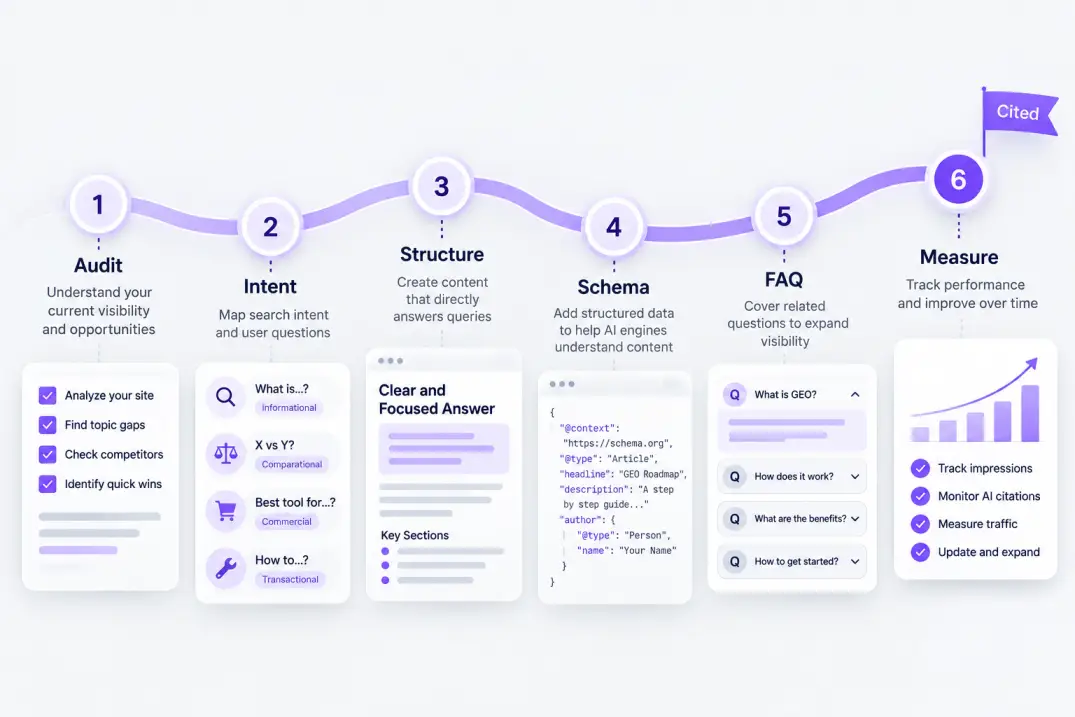
A GEO roadmap is a phased plan for making your content easy for AI systems to find, understand, and cite. It runs in six stages: audit, intent research, content structure, schema, FAQs, and measurement. Each stage feeds the next, so skipping ahead wastes effort.
Search engines rank pages. Answer engines assemble responses from individual passages, then credit a handful of sources. Your goal shifts from "be the best page" to "be the easiest passage to quote."
Generative Engine Optimization (GEO) is the practice of shaping content, structure, and signals so AI answer engines such as ChatGPT, Perplexity, and Google's AI features retrieve and cite it inside generated answers.
Research supports the idea that specific edits matter. The original GEO study from Princeton and collaborators found that adding statistics, quotations, and source citations lifted visibility in generative answers by up to 40% in their tests. Results vary by engine and niche, but evidence consistently beats fluff.
Want the conceptual background first? Our guide on how to rank in AI search covers it. This article is the sequence: what to do, and in what order.
Phase 1: Audit Your AI Visibility
Before building anything, learn where you stand. Take 20 to 30 questions your buyers really ask and run them through ChatGPT, Perplexity, Gemini, and Google's AI Overviews. Log whether your brand appears, which competitors do, and which URLs get cited.
A simple spreadsheet is enough: query, engine, mentioned yes or no, cited source. Run each prompt in a fresh session, because personalized history can flatter your results and hide real gaps.
This baseline turns opinions into evidence. It also reveals a pattern: engines tend to cite pages that answer one narrow question directly, not pages that cover everything vaguely.
Pay attention to the wording of the answers, too. If an engine describes your product incorrectly or leans on an outdated source, you have found a concrete fix: update the page it cites, or publish a clearer one. Those gaps become your first content tasks.
Phase 2: Keyword and Intent Strategy for GEO
Classic research asks, "What do people type?" Generative search asks, "What are they trying to decide?" AI engines often split one prompt into several sub-questions behind the scenes, so a single page can be cited for queries you never targeted.
Build your list in three layers:
- Core topics: the problems your product or expertise solves.
- Conversational prompts: full-sentence questions, comparisons, and "best for" queries.
- Follow-ups: what someone asks right after the first answer.
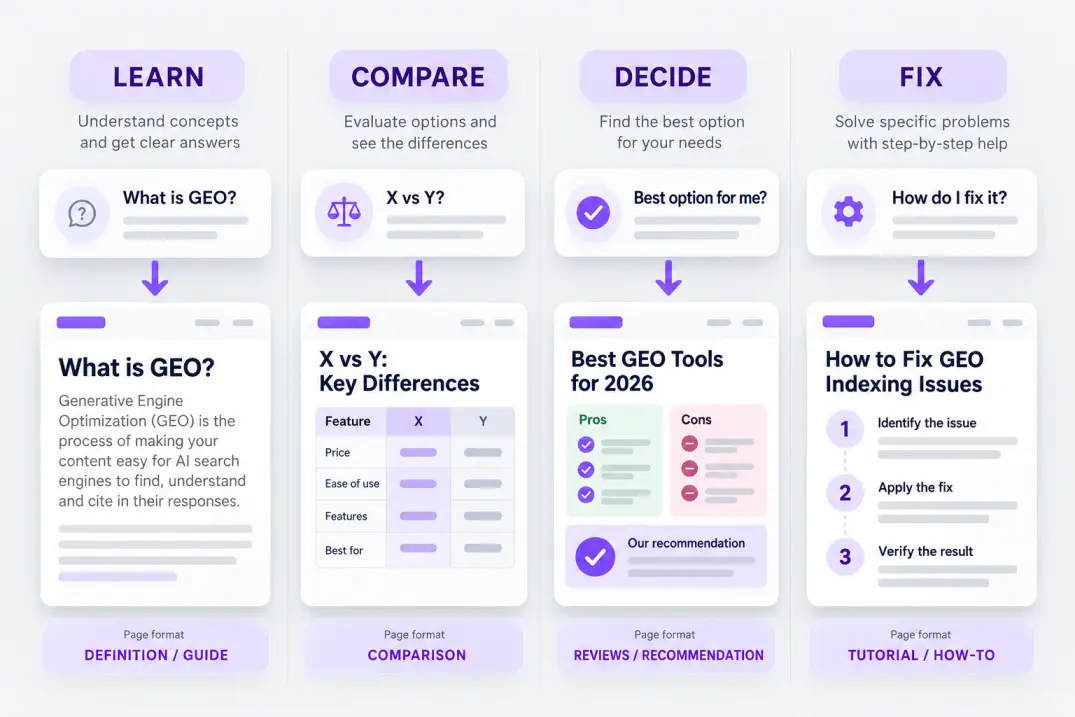
Then tag every prompt by intent: learn, compare, decide, or fix. A comparison prompt needs a table. A fix prompt needs numbered steps. That mapping is the heart of a workable keyword and intent strategy for GEO, because it tells you the format each page must take.
Automating the Research
Doing this by hand across hundreds of prompts is slow, which is why teams study how to automate keyword research for GEO. Export questions from Search Console, People Also Ask, Reddit threads, and sales calls, then let a language model cluster them by intent. AI-assisted keyword research for GEO works best as a filter, not an oracle: the model sorts and labels, you decide which clusters deserve a page.
Trusting model-generated search volumes. Language models cannot see real query data, so validate priority in Search Console or a keyword tool before you commit writing time.
Start with long-tail questions where few strong pages exist. Fewer competitors means an easier path to the citation.
Phase 3: Build Your GEO Framework
If you are figuring out how to build a GEO strategy from scratch, this is where it becomes concrete. A working GEO framework is a set of rules applied to every page, so quality does not depend on who wrote it.
| Rule | What to do | Why engines care |
|---|---|---|
| Answer first | Put a short, direct answer right under each heading | Easy to extract and quote |
| Show evidence | Add statistics, dates, and named sources | Gives the model verifiable claims |
| Name entities clearly | Use consistent names for products, people, and concepts | Reduces ambiguity |
| Self-contained sections | Make each H2 understandable on its own | Passages are retrieved individually |
This is why your best-written page can still lose. If the answer sits in paragraph six behind a story, a retrieval system grabs a competitor's cleaner passage instead.
Format matters as much as facts. Use descriptive headings that mirror real questions, keep paragraphs short, and put comparisons in tables. Trust signals count here as well. Real author names, visible credentials, publication dates, and links to primary sources tell a retrieval system that a human stands behind the claim. Pages that read as anonymous and undated give models little reason to prefer them over a competitor.
Original data is the strongest lever of all, because a model cannot cite a statistic that exists nowhere else unless it cites you.
Phase 4: Schema for GEO
Structured data will not guarantee a citation, but it removes guesswork about what your page is. Google's structured data introduction explains that markup helps its systems understand page content, and other crawlers benefit from the same clarity.
Prioritize schema for GEO in this order:
- Organization and Person: who publishes the content and who wrote it.
- Article: headline, dates, author, and publisher.
- FAQPage: questions and answers that match visible text. See the schema.org definition.
- Product or SoftwareApplication: only where the page truly describes one.
Google now shows FAQ rich results for a narrow set of sites, but the markup still labels question-and-answer content clearly. Keep every value identical to what readers see on the page. Our breakdown of how structured data wins in AI search goes deeper on nesting with JSON-LD.
Phase 5: Write a GEO FAQ That Gets Quoted
A strong GEO FAQ mirrors how people prompt: full questions, plain answers, no throat-clearing. Pull questions from your Phase 2 research, not from guesswork, and answer each in two or three sentences that lead with the conclusion.
AI-generated FAQs for GEO are a fair shortcut if you supervise them. Let a model draft, then verify every fact and add one detail only you have, such as a benchmark, a pricing range, or a customer result. A prompt like this keeps drafts honest:
Using these customer questions: [list], draft 2-3 sentence answers.
Lead with the direct answer. Use only facts from [source document].
Flag any claim you cannot verify.
Place FAQs near the end of the page, mark them up with FAQPage schema, and avoid repeating what the body already covers in full. Each question should extend the topic, not echo it.
Phase 6: Measure and Iterate
Traditional rank tracking will not show this work paying off. Track four signals monthly, using the same prompt set from Phase 1:
- Citation rate: the share of tracked prompts where your URL is cited.
- Brand mentions: appearances in answers even without a link.
- AI referral traffic: sessions from chat and answer engines in your analytics.
- Sentiment and accuracy: whether the engine describes you correctly.
Our guide to AI search visibility metrics details how to build that dashboard. Expect noise, since answers change between runs. Judge trends across at least a month, not single checks.
Also keep expectations honest. Google's own guidance on AI features says the same foundations apply: crawlable, helpful, people-first content. GEO builds on SEO rather than replacing it.
A 90-Day Rollout
| Days | Focus | Output |
|---|---|---|
| 1-15 | Audit and baseline | Prompt log with citation gaps |
| 16-30 | Intent research | Prompts clustered by intent |
| 31-60 | Rewrite top pages | Answer-first structure, evidence added |
| 61-75 | Schema and FAQs | Validated markup, supervised FAQs |
| 76-90 | Measure and refine | Month-over-month citation report |
Start with your ten most valuable pages, not the whole site. Small, complete upgrades beat a sprawling rewrite you never finish.
- A GEO roadmap works in order: audit, intent, structure, schema, FAQs, measurement.
- Map every prompt to an intent, then match the page format to it.
- Lead each section with a direct answer and back it with evidence.
- Use schema and FAQs to clarify content, not to decorate it.
- Track citation rate monthly and treat single results as noise.
The engines will keep changing, but the habits in this roadmap hold up: answer clearly, prove your claims, and make every passage worth quoting. Build them one phase at a time, and your visibility compounds.
Artificial Intelligence
Intelligence without limits.
We believe great content deserves honest authorship—even when it's AI.
Frequently Asked Questions
Collect real questions from Search Console, People Also Ask, forums, and sales calls, then use a language model only to cluster and label them by intent. Verify demand with a keyword tool, since models cannot see actual search volume. Automate the sorting, keep the prioritization human.
Expect to see early movement in citation tracking within four to eight weeks on updated pages, but treat that as a directional signal. Answers change between runs, so compare month-over-month trends rather than single checks.
No. Answer engines still depend on crawlable, indexable, trustworthy pages, and Google says its AI features build on the same foundations. Think of GEO as an extra layer of structure and evidence on top of solid SEO.
Yes, when the questions and answers appear visibly on the page. The rich result may not show for your site, but the markup still labels question-and-answer content clearly for crawlers and other systems that parse it.
Only if you publish them unchecked. Unverified answers can contain errors or generic filler that adds nothing. Fact-check each response, cut anything the page already covers, and add one original detail per answer.
Start with 20 to 30 prompts that reflect real buyer questions, split across the four intents. That is large enough to spot patterns and small enough to rerun by hand each month.
Begin with your ten highest-value pages: those tied to revenue, already ranking on the first two results pages, or frequently cited by competitors. Upgrading a few pages completely beats lightly editing dozens.