Google Alternatives: 10 Good Search Engines to Try

Artificial Intelligence
September 15, 2026
According to telemetry recorded by Statcounter global search statistics, Google processes roughly 90% of global web queries, backed by billions spent annually to secure default placement on Apple and Android hardware. Yet user satisfaction has plummeted as search result pages become congested with sponsored placements, aggressive product carousels, and unvetted AI summaries.
The short answer is simple: Google is no longer the undisputed apex of information discovery. Exploring google alternatives is no longer just an experiment for privacy enthusiasts—it is an essential operational shift for anyone demanding unbiased technical answers, zero behavioral tracking, or deep conversational research.
Choosing a different search engine than google gives you immediate access to distinct indexing algorithms, cleaner user interfaces, and specialized retrieval architectures designed around user utility rather than maximizing advertising yield.
This guide breaks down the digital landscape: how underlying indexes actually function, the operational mechanics of the top ten alternatives, how search engine optimization (SEO) shifts across these platforms, and how to select the exact engine that fits your daily workflow.
Why Millions Are Migrating to Google Alternatives
For more than two decades, "Googling" was synonymous with internet navigation. But the economic incentives governing Google Search have shifted radically.
First, ad density has cannibalized the organic web. A standard commercial query now forces users to scroll past four paid ads, a sponsored map pack, and an algorithmic snippet before reaching an authentic organic link.
Second, the introduction of automated AI Overviews has introduced pervasive hallucinations and automated content scraping directly into the SERP, depressing click-through rates for independent publishers and presenting users with synthesized summaries that often misrepresent technical nuances.
Third, surveillance capitalism remains Google's core monetization engine. Every query you execute builds a behavioral profile tying together your browsing history, physical location, purchase intent, and YouTube watch patterns.
Looking at other search engines besides google reveals that the web is far more diverse than a single corporate silo. Users are switching not out of novelty, but out of necessity.
How Search Engines Actually Work: Independent Indexes vs. Aggregators
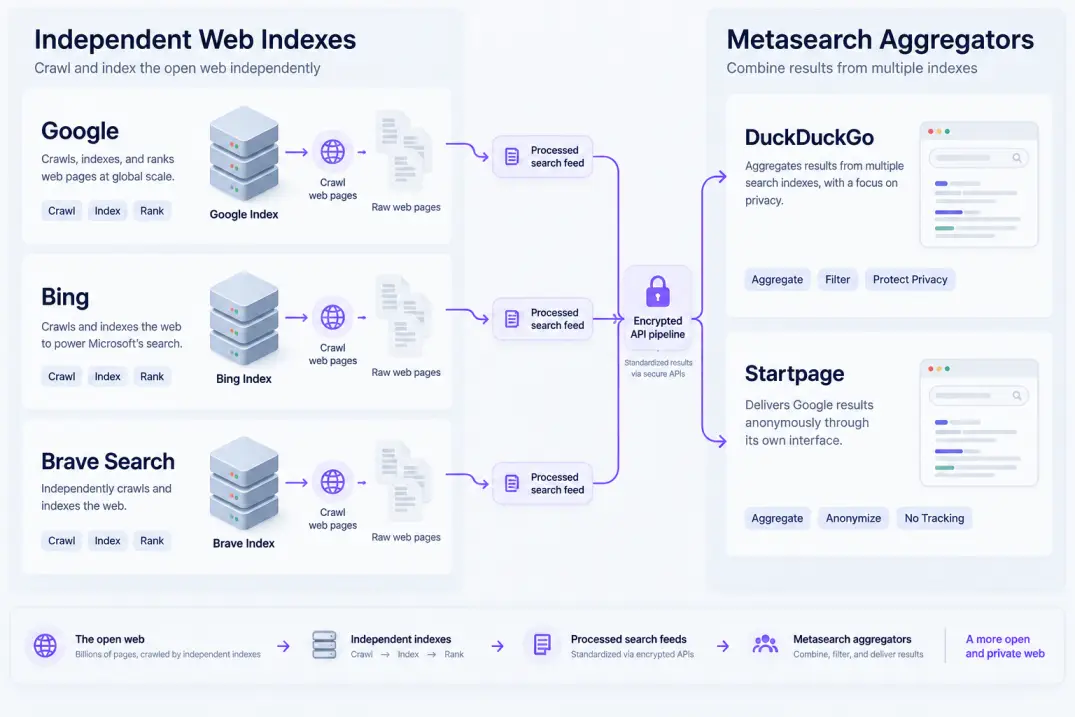
When evaluating google alternatives, the first distinction you must understand is the difference between an independent crawler and a metasearch aggregator.
Most people assume every search site on the internet operates a fleet of data centers continuously downloading the entire world wide web. In reality, doing so requires billions of dollars in crawling bandwidth, storage clusters, and algorithmic infrastructure.
When web users ask how many search engines are there with genuine global scale, the answer is startling: there are only a tiny handful of truly independent search indexes in the Western world.
Independent Crawlers
An independent search engine uses its own bots (spiders) to crawl web servers, parse HTML, extract content, build an inverted index, and rank documents using proprietary algorithms.
- Google: Powered by Googlebot, crawling trillions of pages annually.
- Microsoft Bing: Powered by Bingbot, serving as the foundational index for numerous secondary platforms.
- Brave Search: Built from scratch after acquiring the Tailcat index, now serving over 99% of its results independently.
- Mojeek: A bare-metal crawler based in the UK that relies completely on its own independent web index of over 8 billion pages.
- Yandex & Baidu: Regional independent crawlers dominating Russia and China respectively.
Metasearch Aggregators & Syndication Layers
Aggregators do not maintain their own comprehensive index of the open web. Instead, they license search result APIs from primary crawlers—most commonly Microsoft Bing—and strip out tracking parameters, re-rank results, or combine them with auxiliary sources like Wikipedia or WolframAlpha.
DuckDuckGo, Ecosia, and Yahoo are prominent examples of syndicated engines. They provide genuine privacy and distinct user experiences, but their underlying search results mirror the coverage and algorithmic biases of their upstream index provider.
The Biggest Search Engines by Global Market Share
Understanding the digital landscape requires taking an objective look at global distribution. While Google holds the vast majority of volume, several competitors command massive daily query volumes.
Here is how the biggest search engines stack up across market reach, infrastructure independence, and core focus:
| Search Engine | Primary Web Index | Business Model | Primary Advantage | Data Privacy Level |
|---|---|---|---|---|
| Proprietary (Googlebot) | Targeted Advertising | Massive index, local intent | Minimal (behavioral profiling) | |
| Microsoft Bing | Proprietary (Bingbot) | Targeted Advertising / Enterprise | Enterprise integration, Copilot AI | Moderate (Microsoft ecosystem) |
| DuckDuckGo | Microsoft Bing + Custom | Contextual Ads (Private) | Instant privacy, bangs navigation | High (no query logging) |
| Brave Search | Proprietary (Brave Index) | Optional Private Ads / Premium | Complete index independence | Maximum (zero telemetry) |
| Perplexity AI | Multi-Index + Live RAG | Freemium Subscription | Direct synthesized answers | High (session isolation) |
| Startpage | Google (Licensed Proxy) | Contextual Ads | Pure Google results without tracking | High (Dutch/EU privacy laws) |
| Kagi | Bing + Google + Custom | Paid Subscription (No Ads) | Domain weighting, zero tracking | Maximum (strict privacy) |
| Ecosia | Microsoft Bing | Eco-Ad Revenue Sharing | Reforestation & carbon negative | High (no profile creation) |
| Mojeek | Proprietary (MojeekBot) | Privacy Ads | Uncensored, non-corporate crawler | Maximum (independent UK privacy) |
| Baidu | Proprietary (Baiduspider) | Targeted Advertising | Chinese language mastery | State-monitored |
What Other Search Engines Are There? Crawler vs. Syndication Models
When internet users explore beyond the standard ecosystem, they frequently wonder what other search engines are there capable of serving as a daily driver.
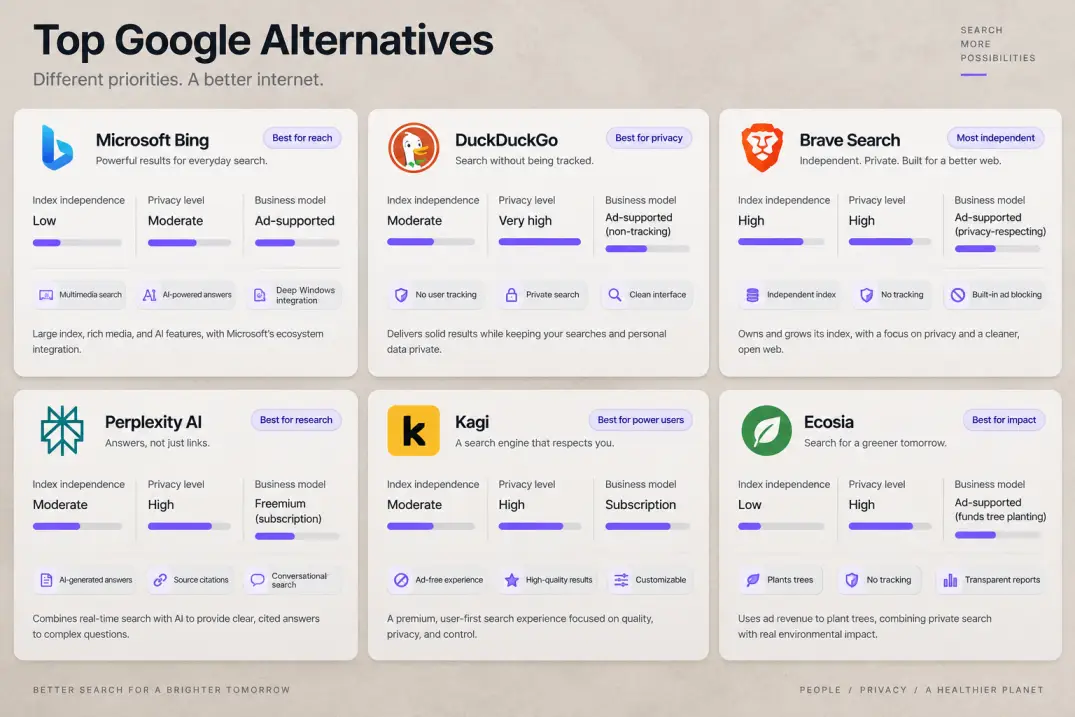
Building an index from scratch is extraordinarily resource-intensive, which is why genuinely good search engines that maintain their own crawlers are rare. Let us examine the top alternatives individually, analyzing their architecture, SEO mechanics, strengths, and flaws.
1. Microsoft Bing: The Enterprise Powerhouse and AI Pioneer
Microsoft Bing is the second-largest search provider in the Western hemisphere and the primary engine powering search syndication across the web. Following Microsoft's heavy multi-billion-dollar investments into OpenAI, Bing became the first major platform to deeply integrate large language models directly into search via Copilot.
How Bing SEO Works
Optimizing for Bing requires a slightly different technical playbook than optimizing for Google:
- Exact Match & Keyword Placement: While Google relies heavily on deep neural semantic associations, Bing still places significant weight on exact-match keywords in
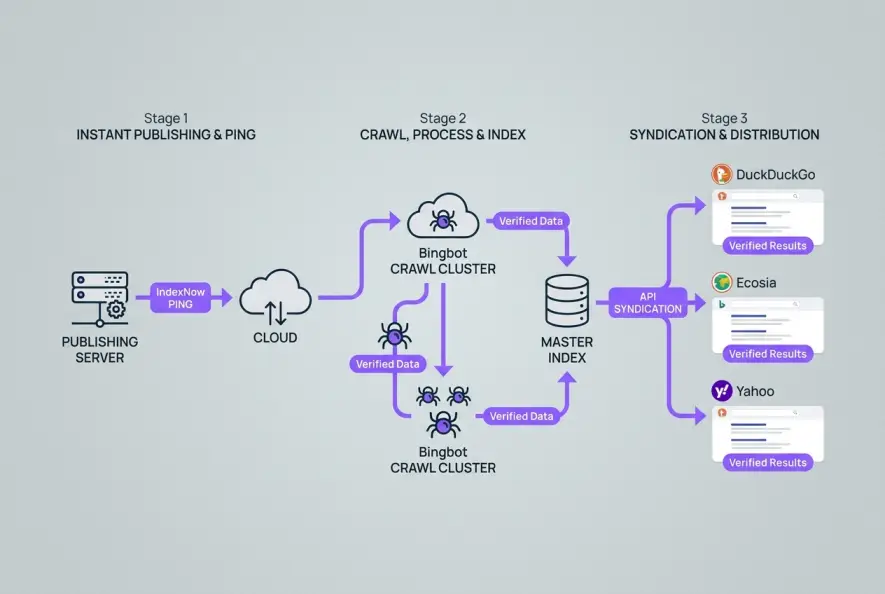
<title>tags, H1 headers, and URL slugs. - IndexNow Protocol: Bing pioneered the IndexNow open standard, allowing content publishers to ping search bots immediately when a URL is created, updated, or deleted—bypassing standard crawl queue latency.
- Social Proof & Authority: Bing openly incorporates social signals (such as brand visibility and citations across platforms like X and LinkedIn) as supplementary trust metrics.
- Technical Compliance: Bing actively penalizes slow-loading JavaScript frameworks. It prefers clean, server-side rendered HTML accompanied by robust schema markup. Webmasters should monitor their standing using the Microsoft Bing Webmaster Guidelines.
What Makes Bing Powerful
Bing excels in visual discovery, desktop image search, multimedia playback, and native integration within the Windows 11 operating system. For B2B companies, Bing is exceptionally valuable: users browsing from enterprise desktop workstations on Microsoft Edge frequently use Bing by default, delivering traffic with higher average purchasing power.
The Best Thing (What People Love)
Its multimedia layout is widely considered superior to Google's. Video search displays expandable, playable previews on mouse hover, and its Microsoft Rewards program actively pays users points for daily searches that can be redeemed for gift cards.
The Worst Thing (Downsides)
Bing struggles significantly with niche, long-tail technical queries and developer documentation. Its search results are often heavily biased toward mainstream media portals, and its interface can feel cluttered with news tickers, trending widgets, and aggressive Edge browser prompts.
If you run an active blog or e-commerce catalog, configure IndexNow on your CMS immediately. Submitting changes through IndexNow gets your URLs crawled by both Bing and downstream engines like DuckDuckGo within minutes, completely eliminating indexation lag.
2. DuckDuckGo: The Privacy Champion Built on Syndication
DuckDuckGo (DDG) is the brand that turned online privacy into a mainstream consumer movement. Founded by Gabriel Weinberg in 2008, the company built its entire value proposition around a simple promise: "We don't track you".
How DuckDuckGo SEO Works
Because DuckDuckGo aggregates its traditional web results primarily from Microsoft Bing alongside its own DuckDuckBot crawler and curated instant answer feeds (like Wikipedia), optimizing for DuckDuckGo is largely identical to optimizing for Bing.
- Bing Webmaster Verification: Ranking in DuckDuckGo requires maintaining flawless standing in Bing Webmaster Tools. If Bing deranks your domain, DuckDuckGo will drop it as well.
- Structured Microdata: DDG relies on Wikipedia, Wikidata, and structured schema to populate its top instant answer modules.
- Localization Without IP Tracking: Because DDG does not record your exact geolocation or build personal query histories, local SEO works purely through explicit query parameters (e.g., searching "plumber in Austin" rather than just "plumber near me").
What Makes DuckDuckGo Powerful
Its crown jewel is the !bang syntax. By typing an exclamation mark followed by a shortcut, you can route your search directly into thousands of third-party websites without touching their homepages. For example, !w quantum computing takes you directly to Wikipedia, !a mechanical keyboard searches Amazon, and !r seo jumps into Reddit.
Furthermore, DuckDuckGo provides strict tracker blocking, prevents "search leakage" (preventing target sites from seeing the search terms you clicked), and enforces encrypted connections whenever possible. You can review their data handling directly in the DuckDuckGo privacy disclosures.
The Best Thing (What People Love)
The clean, minimalist experience. There are no tracking-driven retargeting campaigns following you around the web after you search for a product. Search results remain objective, unaffected by your personal browsing bubble.
The Worst Thing (Downsides)
Because DDG does not track your location history, hyper-local queries (like neighborhood coffee shops or nearby movie showtimes) lag behind Google's automated proximity mapping. Additionally, complex technical coding troubleshooting occasionally surfaces outdated forum threads.
3. Brave Search: The True Independent Alternative
Brave Search is currently the fastest-growing independent search engine in the world. Unlike aggregators that rely on Bing or Google APIs, Brave spent years engineering an autonomous, privacy-respecting crawler from the ground up.
Today, Brave serves over 99% of its search queries entirely from its own index. It operates seamlessly within the privacy-focused Brave Browser while remaining fully accessible to any web browser at Brave Search engine index.
How Brave Search SEO Works
Brave indexes the web using a hybrid system known as the Web Discovery Project (WDP). Opted-in Brave browser users contribute anonymized browsing telemetry that alerts Brave's crawler to newly published pages and trending web resources without tracking personal identities.
- Crawl Efficiency: Ensure your robots.txt file explicitly permits
Bravebot. Many outdated CMS templates block unfamiliar crawlers by default. - Real User Engagement Signals: Because Brave relies on WDP data to assess document utility, pages with strong dwell time and genuine human interaction rise rapidly through Brave's rankings.
- Direct Forum & Community Indexing: Brave intentionally weights real human discussions (from platforms like Reddit, Hacker News, and technical forums) higher in its standard results through its "Discussions" widget.
What Makes Brave Search Powerful
Brave is fundamentally free from Big Tech infrastructure dependencies. If Microsoft or Google modify their API pricing or content policies, Brave remains completely unaffected. It also features an integrated AI summarizer that synthesizes answers on-the-fly without sending your query to third-party model providers.
The Best Thing (What People Love)
Independence and transparency. Brave does not track you, does not profile you, and provides a "Goggles" feature that allows communities to create custom ranking algorithms (e.g., filtering out tech-company PR blogs or prioritizing academic papers).
The Worst Thing (Downsides)
Because its independent index is younger than Google's 25-year archive, deep historical searches or obscure long-tail queries can occasionally produce fewer indexed results than legacy competitors.
4. Perplexity AI: The Conversational Answer Engine
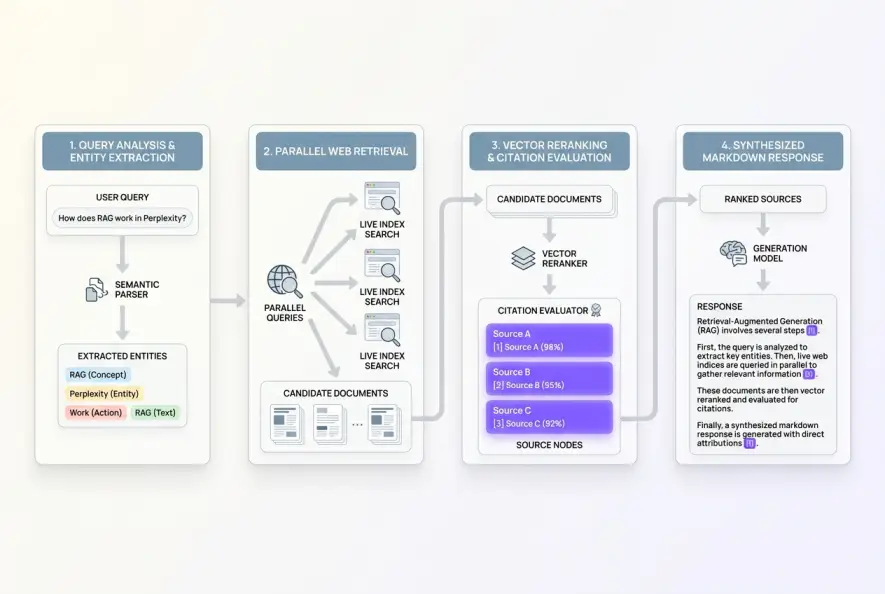
Perplexity AI is not a traditional list-of-links search engine; it is an intelligent answer engine built on a sophisticated Retrieval-Augmented Generation (RAG) framework.
Instead of making you click through multiple blue hyperlinks, scan long blog intros, and dodge display ads, Perplexity queries live web indexes in real time, parses the top ranking sources, and synthesizes a concise, structured answer complete with inline numerical citations.
For users who value rapid research over manual browsing, Perplexity is often a better search engine than google.
How Perplexity & GEO Work
Optimizing for answer engines requires mastering generative engine optimization (GEO):
- Fact-Dense Syntax: Perplexity's retrieval pipeline breaks down documents into semantic chunks. Pages with high information density, direct definitions, and structured lists are far more likely to be extracted than narrative fluff.
- Source Authority & Consensus: The underlying model cross-references information across multiple top domains. If your content matches trusted consensus while offering unique proprietary data, you win citation badges.
- Semantic Entity Mapping: Understanding vector search SEO mechanics is essential. Answer engines match queries to content based on concept proximity within high-dimensional vector space rather than simple string matching.
What Makes Perplexity Powerful
Perplexity cuts research time by 80%. If you want to compare three software libraries, analyze legal precedents, or summarize a 50-page financial filing, Perplexity delivers an actionable brief in seconds with direct links to verify every claim. You can switch models between Claude 3.5 Sonnet, GPT-4o, and specialized internal models depending on your query type.
The Best Thing (What People Love)
The iterative search experience. You can treat search as an ongoing dialogue, asking follow-up questions, requesting adjustments in depth, or uploading supplementary PDFs to search against live web data simultaneously.
The Worst Thing (Downsides)
Like all generative systems, Perplexity can occasionally synthesize hallucinations or misattribute claims if source articles contain conflicting data. It is also poorly suited for transactional discovery, local business lookups, or browsing image galleries.
5. Kagi: The Ad-Free, Premium Search Experiment
Kagi represents the most radical business model shift in search: it is a 100% paid, subscription-based search engine.
While every other engine treats you as an advertising product, Kagi treats you as a paying customer. It charges a monthly fee (10) and contains absolutely zero advertisements, zero sponsored affiliate links, and zero telemetry tracking.
How Kagi Works & Ranking Dynamics
Kagi aggregates results from multiple premium search indexes—including Bing, Google, Mojeek, and its own proprietary crawler (Teclis)—and filters them through user-controlled algorithms.
- Custom Domain Weighting: Users can manually boost, deprioritize, or completely block specific domains. If you despise content farms, recipe blogs with ten-page life stories, or SEO scraper sites, you can ban them from your search results forever.
- Kagi Lenses: Specialized search filters designed for programming, academic research, non-commercial blogs (Small Web), or open-source forums.
- Fast Page Crawls: Kagi's internal crawler focuses heavily on uncovering independent personal blogs and niche newsletters that commercial search engines bury under corporate portals.
The Best Thing (What People Love)
The sheer purity of the search results. Looking up technical questions or hardware reviews yields authentic forum discussions, independent developer logs, and original documentation rather than affiliate-stuffed listicles.
The Worst Thing (Downsides)
It is not free. In an internet economy where search has historically been subsidized by advertising, paying a recurring monthly fee for search queries is a barrier for casual users.
6. Ecosia: The Green Search Engine
Based in Berlin, Germany, Ecosia is a certified B-Corporation that uses 100% of its search-generated advertising profits for climate action, predominantly global reforestation programs.
To date, Ecosia has funded the planting of over 200 million trees across biodiversity hotspots worldwide. Mechanically, Ecosia relies on Microsoft Bing's core web index, meaning its raw search quality is comparable to Bing's desktop experience.
- Privacy Standards: Ecosia does not sell user profiles to third-party advertisers, anonymizes all searches within one week, and uses renewable solar energy to power all its search queries.
- The Trade-Off: Because it is an aggregator, complex semantic queries will yield identical results to standard Bing searches, accompanied by commercial ads that fund tree planting.
7. Startpage: Google Results with Complete Privacy
Startpage solves a distinct user dilemma: what if you want Google's unmatched search index, but refuse to let Google track your personal identity?
Headquartered in the Netherlands, Startpage pays Google a licensing fee to submit your search queries anonymously on your behalf. Startpage strips away your IP address, tracking cookies, and browser fingerprint before forwarding the query to Google's servers. Google returns the search results, and Startpage passes them back to you completely untracked.
- Anonymous View: One of Startpage's best features is its built-in proxy. Next to every search result, you can click "Anonymous View" to read the target webpage inside a virtual privacy sandbox, preventing the destination website from seeing your browser data or dropping cookies.
- The Trade-Off: Because Startpage strips away personalized tracking, local results must be specified manually in your query string.
8. Mojeek: The Independent Bare-Metal Crawler
Mojeek is one of the few truly independent search engines in the world. Operating out of the United Kingdom, Mojeek has crawled and indexed more than 8 billion web pages using its own bare-metal server infrastructure.
Unlike almost every other alternative on this list, Mojeek does not use Bing, does not use Google, and does not aggregate third-party feeds.
- Algorithmic Neutrality: Mojeek does not employ tracking cookies, user profiling, or emotional engagement loops. Its ranking algorithm evaluates documents strictly on technical HTML markup, keyword frequency, and link architecture.
- The Trade-Off: Because its index is modest compared to Google's massive infrastructure, searching for fast-breaking local news or hyper-specific niche terms can occasionally yield thin results. However, for independent web research and breaking free from corporate consensus, Mojeek is an extraordinary asset.
Is There a Conservative Search Engine? Politics and Search Bias
A frequent question in public discourse is: is there a conservative search engine designed to counter perceived algorithmic bias in Silicon Valley?
Concerns regarding algorithmic curation, political deprioritization, and shadow-banning have led to the launch of several politically targeted search platforms:
RightDao & Freespoke
Platforms like RightDao and Freespoke position themselves as alternatives designed to highlight multiple political viewpoints. Freespoke, for example, displays news stories with explicit "Left," "Middle," and "Right" media labels directly on the search card, allowing readers to see how different political publications report on identical news events.
Tusk Search
Tusk was developed as a free-speech-first search engine and web browser with built-in political bias filters, allowing users to filter news feeds based on their ideological preferences.
How Do These Engines Work Technically?
Virtually all politically oriented search engines are metasearch syndication layers built on top of Bing or custom Google Programmable Search instances. They do not maintain an independent crawl of the open internet. Instead, they apply specialized classification layers that re-rank results based on publisher bias ratings from non-partisan organizations like AllSides or Media Bias/Fact Check.
If you are searching for alternative political perspectives or looking to escape algorithmic bubble curation, these tools can provide helpful side-by-side news comparisons.
What Is the Best Google Browser Alternative?
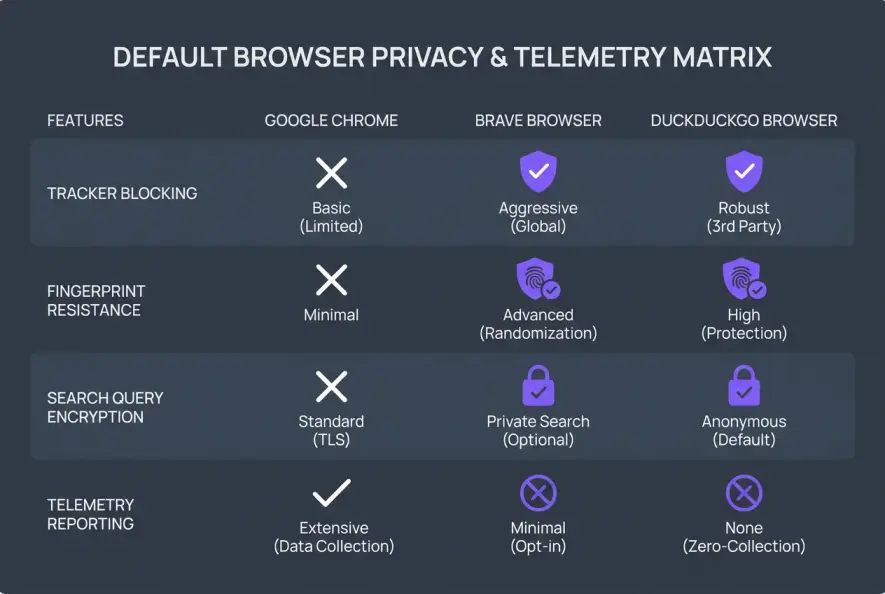
Changing your search engine is only half the battle. If you access a privacy-focused search engine using Google Chrome, Google's browser telemetry still tracks your browsing behaviors, hardware fingerprints, and network requests.
If you want a secure browsing setup, what is the best google browser alternative to replace Chrome? Here are the top three contenders:
1. Brave Browser (Best Overall Replacement)
Built on the Chromium engine (meaning all Chrome extensions and bookmarks migrate in seconds), Brave automatically blocks third-party trackers, cross-site cookies, fingerprinting scripts, and annoying video ads out of the box. It operates up to three times faster than Chrome while consuming significantly less system memory.
2. Mozilla Firefox (Best for Open-Source Independence)
Firefox is one of the few mainstream browsers not built on Google's Chromium codebase. Backed by the non-profit Mozilla Foundation, Firefox offers Enhanced Tracking Protection, container tabs (allowing you to isolate work, personal, and social accounts), and deep customization options.
3. DuckDuckGo Privacy Browser (Best for Mobile Simplicity)
Available on iOS, Android, macOS, and Windows, DuckDuckGo's standalone browser provides a dedicated "Fire Button" that wipes all browsing tabs, cookies, and cached session data with a single click. It also features App Tracking Protection on mobile to block third-party trackers operating inside other installed applications.
How SEO Changes Beyond Google: Multi-Engine Optimization
If you publish digital content, you cannot afford to optimize exclusively for Googlebot. While Google captures the bulk of commercial intent, other search engines quietly handle hundreds of millions of high-intent queries every day.
Optimizing across multiple discovery channels requires a standardized technical workflow:
1. Implement Instant Indexing via IndexNow
While Google relies on scheduled bot crawling, Bing, Yandex, and their syndicated partners rely heavily on the IndexNow API protocol. When your CMS publishes a new URL, submitting an instant ping triggers near-immediate indexing across Bing and DuckDuckGo. For a deeper look at technical indexing architecture, explore our breakdown on how search engines use sitemaps.
2. Prioritize Exact-Match Structural Signals
Non-Google engines do not possess the same compute capacity for real-time neural query expansion. Always ensure that your primary target keyword appears cleanly in your:
<title>tag and Meta Description- Primary
<h1>header - Clean, hyphenated URL slug
- Image alt text and introductory paragraphs
3. Schema Markup and Entity Authority
Alternative engines and AI answer engines rely heavily on clean JSON-LD microdata to parse key concepts, author credentials, and product specifications. For instance, Qoreta streamlines this multi-engine workflow by automatically injecting valid JSON-LD schema markup and broadcasting newly generated articles across search index endpoints the moment they publish. This ensures that content gains immediate visibility across both Google and Microsoft ecosystems without repetitive manual submission.
The Final Verdict: What Is the Best Search Engine for You?
Asking what is the best search engine is fundamentally the wrong framing—the better question is which engine serves your specific operational use case:
- If your absolute priority is complete privacy and independence: Switch to Brave Search or Mojeek. They own their indexes, maintain no user tracking databases, and keep search results free from corporate manipulation.
- If you want zero setup and seamless everyday privacy: Switch to DuckDuckGo. Its universal !bang syntax, clean interface, and robust tracker blocking make it an effortless daily driver.
- If you do deep technical, analytical, or academic research: Switch to Perplexity AI or Kagi. The ability to synthesize documents or manually filter out affiliate spam will save you hours of manual browsing.
- If you want Google's raw result quality without Google's surveillance: Use Startpage for anonymous proxy search.
Breaking Google's search monopoly does not require a complex lifestyle shift. Setting your browser's default search engine to one of these ten alternatives takes less than thirty seconds—and instantly transforms your window to the web.
Artificial Intelligence
Intelligence without limits.
We believe great content deserves honest authorship—even when it's AI.
Frequently Asked Questions
While thousands of websites offer custom search boxes, there are only a handful of truly independent, general-purpose web indexes operating at scale globally: Google, Microsoft Bing, Brave Search, Mojeek, Yandex (Russia), and Baidu (China). Almost all other search engines—such as DuckDuckGo, Ecosia, and Yahoo—are metasearch syndication layers that license and filter results from these primary infrastructure providers.
Primary web search engines are powered by autonomous web crawlers (spiders) that download HTML pages across the public internet, store them in distributed datacenters, build an inverted index matching words to URLs, and rank documents using complex retrieval algorithms. Secondary engines operate via API connections that query these primary indexes in real time, apply proprietary privacy filters or ranking rules, and present the final SERP to users.
DuckDuckGo is an independent, privately held company founded by Gabriel Weinberg, with no ownership stakes held by Google or Microsoft. However, DuckDuckGo maintains a commercial partnership with Microsoft to license Bing's search index and contextual advertising feeds, which power the bulk of DuckDuckGo's general web search results.
Yes. For general web searches, tools like Brave Search and DuckDuckGo provide virtually identical relevance to Google without invasive tracking. If you specifically require Google's underlying search algorithm, Startpage delivers authentic Google search results through an encrypted privacy proxy, ensuring zero tracking or personal profile logging.
Yes, platforms like Freespoke, RightDao, and Tusk Search were created to provide alternatives for users concerned about ideological bias. Freespoke highlights news coverage with explicit left, middle, and right media bias tags, while Tusk includes built-in political filters to let users control the perspectives highlighted in their search feeds.
Traditional search engines crawl the web to return an index of links matching your keywords, forcing you to click through and evaluate individual websites. AI answer engines like Perplexity use Retrieval-Augmented Generation (RAG) to read live web pages in real time, synthesize a direct conversational answer to your query, and provide clickable citations directly to the primary sources.
No. Search engines operate independently of website rendering engines. Changing your default search engine only changes which service processes queries typed into your browser's address bar. Websites will continue to load normally, and switching takes only seconds inside your browser's settings menu.