Backlink Packages: Complete Vetting & Pricing Guide

Artificial Intelligence
September 23, 2026
In an empirical analysis of over one billion web pages, research from Ahrefs revealed that 96.55% of all pages receive zero organic search traffic from Google, with the volume of referring domains standing as the single strongest differentiator between page-one winners and invisible URLs. For digital businesses competing in competitive search categories, waiting passively for external sites to discover and cite your content organically can take years.
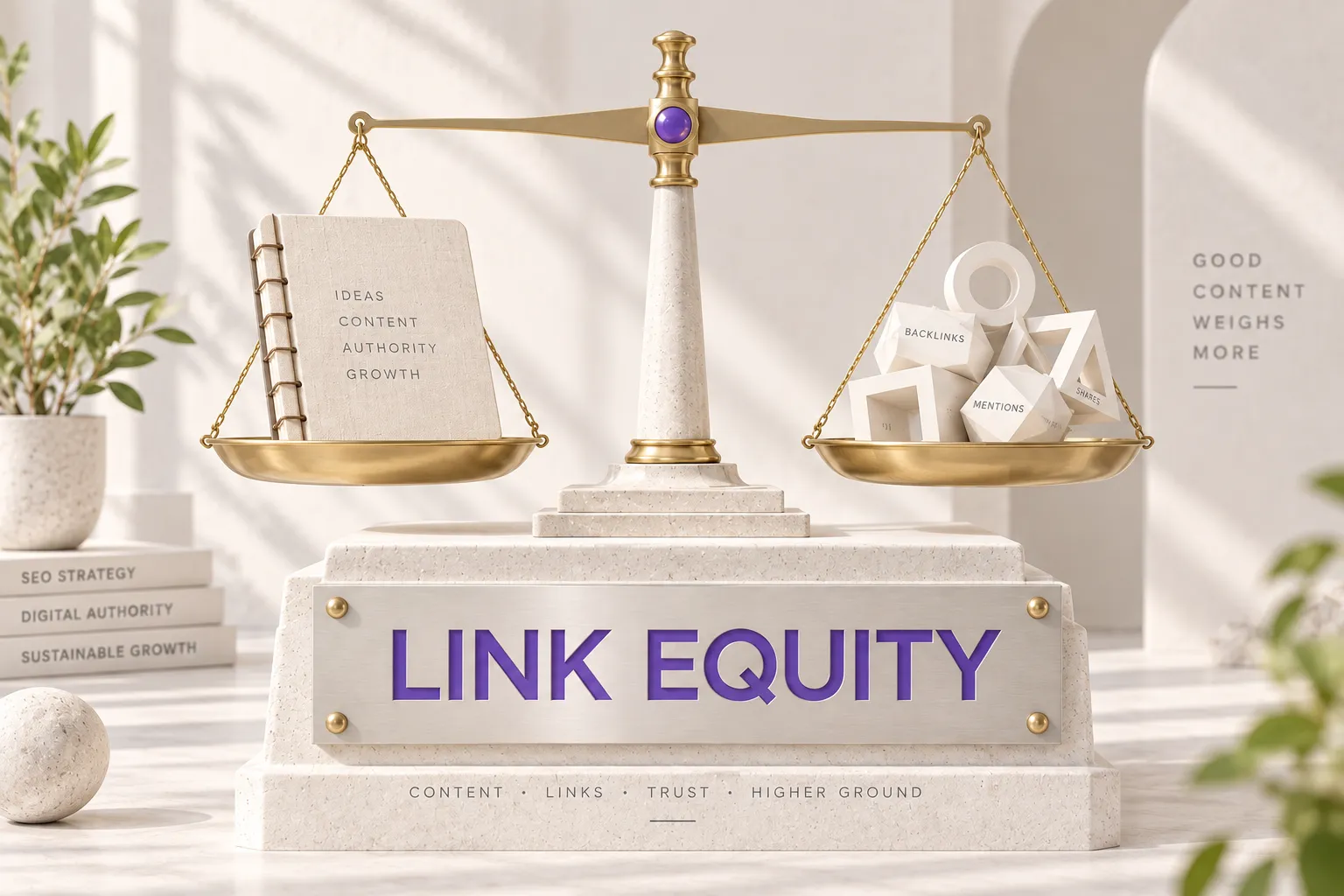
When growth marketers and website owners look to accelerate domain authority, purchasing backlink packages often appears as the most straightforward shortcut. At its foundational level, a backlink package is an agreement where an agency or provider acquires a set batch of inbound links on external sites for a flat or recurring fee. However, the commercial link market is fraught with hidden hazards, varying from premium editorial placements that drive real rankings to toxic private blog networks (PBNs) that trigger immediate algorithmic demotions.
Understanding how these packaged services operate, how to audit them objectively, and which providers maintain legitimate editorial standards is essential for safeguarding your domain's organic footprint.
What Is a Backlink Package?
A backlink package is a pre-bundled suite of off-page SEO fulfillment services sold by an agency, consultant, or marketplace. Instead of hiring an in-house outreach team to prospect target sites, find contact details, negotiate placements, and draft customized articles, a buyer purchases a standardized deliverable.
A typical package specifies parameters such as the total count of links, minimum third-party authority thresholds (like Domain Rating or Domain Authority), target niche classifications, and turnaround time. Rather than billing hourly for labor that might yield unpredictable results, vendors package link acquisition into fixed-scope transactions.
Commercial link fulfillment has evolved through three distinct eras:
- The Directory & Forum Era (2000–2011): Webmasters purchased thousands of automated directory submissions, bookmarking links, and forum profile signatures for negligible fees. Google's original PageRank algorithm weighed sheer raw link volume heavily, making automated blasting effective until the Penguin update reshaped search quality.
- The Private Blog Network (PBN) Era (2012–2019): After Google devalued low-tier directories, vendors purchased expired domains with historic authority, installed WordPress templates, and injected paid links into artificial blog posts. While initially effective, automated footprint detection quickly enabled search engines to nullify these networks.
- The Modern Editorial & Digital PR Era (2020–Present): Contemporary providers secure placements through manual outreach, curated contextual link insertions (niche edits), bespoke content contributions, and data-driven press campaigns. Modern search algorithms rely on sophisticated natural language processing and entity graphs to verify whether an outbound link provides genuine editorial value to human readers.
Never evaluate a link vendor based on Domain Rating (DR) alone. Always check whether the prospective host domain receives at least 1,000 monthly organic visits and ranks for keywords relevant to your niche.
The Core Components of Modern Link Bundles
When evaluating an entry-level backlink building package, examining the balance between raw Domain Rating and actual organic traffic prevents purchasing hollow placements. Legitimate agencies construct their deliverables around six fundamental components:
1. Referring Domain Quality and Authority Metrics
Vendors categorize packages based on proprietary third-party metrics developed by SEO software providers. The most widely referenced metrics include Ahrefs' Domain Rating (DR), Moz's Domain Authority (DA), and Majestic's Trust Flow (TF). High-grade offerings usually guarantee tiers such as DR 40+, DR 60+, or DR 70+.
However, vanity metrics can be artificially manipulated by blasting expired redirect loops into an empty domain. An authoritative score is meaningless if the host site has zero search visibility in Google's actual index.
2. Verified Organic Traffic Thresholds
Top-tier vendors mandate organic search traffic floors alongside authority scores. A domain with a DR of 65 that commands only 40 monthly organic visits represents an unnatural anomaly—frequently indicating an algorithmic penalty or an expired PBN shell. High-integrity packages guarantee that host sites maintain between 1,000 and 50,000+ monthly visits verified through independent analytics tools.
3. Contextual and Semantic Relevance
Search engines evaluate the semantic relationship between the referring page and the destination URL. A financial technology company gaining a link from an automotive review blog raises immediate red flags in topical link graphs. Quality packages guarantee niche relevance at both the domain level and the article level, ensuring that the surrounding text discusses adjacent topics.
4. Anchor Text Control and Diversity
Anchor text serves as a strong relevance signal, but repetitive keyword targeting is an express route to a link-spam penalty. Professional link packages incorporate consultative anchor text planning, maintaining a natural distribution across branded terms, partial matches, exact matches, and generic navigational phrases.
5. Content Creation and Placement Mechanics
Inbound links must live within coherent, original, and well-written content. Vendors handle the production of 800 to 1,500-word articles that house your hyperlink naturally within the body copy. Low-end packages frequently utilize low-grade AI spinning or scrape content, resulting in pages that search bots quickly abandon or refuse to index.
6. Indexing Guarantees and Transparent Reporting
A backlink provides zero search equity if the hosting page never enters Google's index. Standard commercial contracts should guarantee that delivered URLs achieve organic indexation within 30 to 60 days, accompanied by full reporting that reveals live URLs, exact anchor text, cache status, and host metrics.
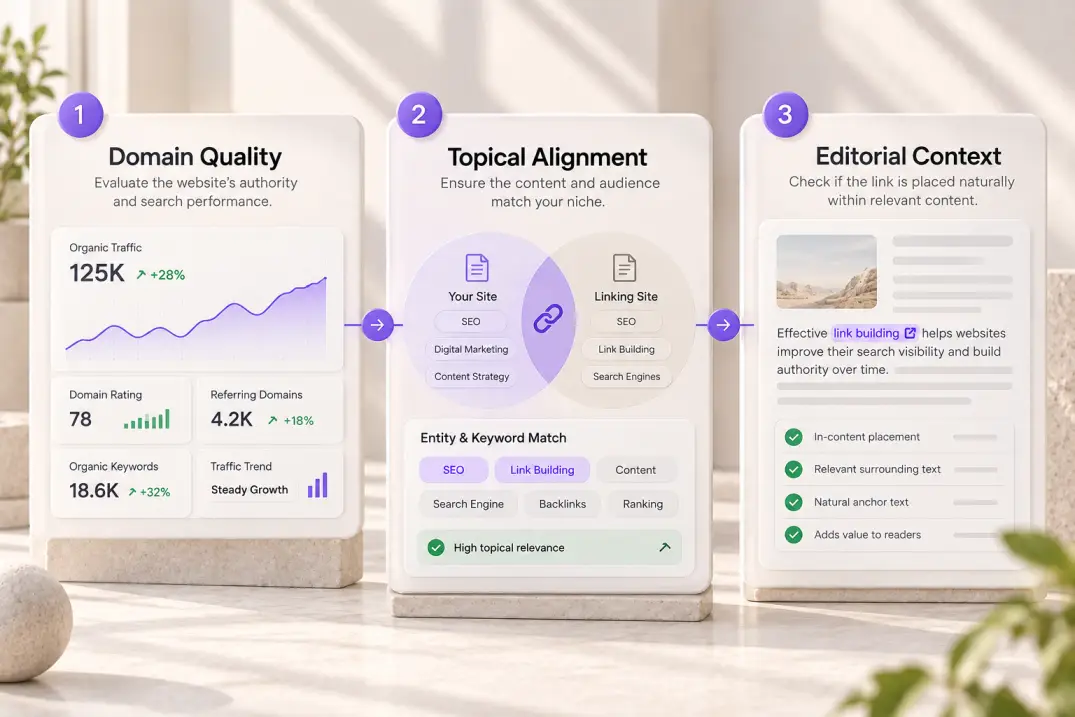
As shown below in the link evaluation workflow, separating legitimate editorial opportunities from disguised link farms requires assessing three specific filters before approving an order.
Link Building Pricing Benchmarks
A comparative review of commercial backlink building packages shows that link quality directly dictates vendor fulfillment costs. In SEO, pricing is heavily dictated by labor: legitimate outreach requires dedicated prospectors, pitch writers, subject-matter copywriters, and relationship managers.
A realistic understanding of standard link building pricing helps teams separate legitimate editorial placements from automated link networks. The table below outlines typical market rates observed across the industry:
| Quality Tier | Average Cost Per Link | Minimum Monthly Retainer | Typical Fulfillment Strategy | Primary Risk Level |
|---|---|---|---|---|
| Low-End Commodity | 60 | 500 | Automated submissions, Web 2.0s, public guest post farms | Critical (Algorithmic filter/PBN penalty) |
| Mid-Tier Standard | 250 | 2,500 | Semi-manual blogger outreach, curated niche edits, contributor posts | Moderate (Variable traffic stability) |
| High-Tier Editorial | 600 | 7,500 | 100% manual email outreach, custom long-form content, verified niche sites | Low (Safe, sustainable growth) |
| Enterprise & Digital PR | 1,500+ | 20,000+ | Original data journalism, journalist pitching, top-tier news publications | Near Zero (Maximum natural brand authority) |
Understanding Cost Drivers
Why does a single high-tier link cost $400 or more? Consider the economic breakdown of manual outreach:
- Prospecting and Data Enrichment: Identifying 100 qualified target sites, verifying organic traffic, checking toxicity scores, and extracting verified editor contact details requires roughly 4 to 6 hours of skilled labor.
- Outreach & Relationship Management: Sending personalized pitches, following up, negotiating terms, and managing editorial calendars.
- Content Creation: Producing an engaging 1,200-word article written by a native language copywriter familiar with the niche costs between 120.
- Administrative Overhead: QA checking live links, ensuring proper canonical tags, testing indexation, and managing project tracking.
When a seller offers 50 backlinks for $100 on a freelance marketplace, zero human outreach takes place. Such packages rely exclusively on pre-built automated scripts, hacked database insertions, or expired PBNs where the vendor controls thousands of abandoned domains hosted across shared IP blocks.
The Primary Types of Link Packages
Not all link packages use the same fulfillment mechanics. Agencies typically structure their deliverables around five primary operational models:
1. Guest Post Packages
In a guest blogging package, the provider pitches fresh article concepts to relevant external publications. Once an editor accepts the pitch, the agency drafts a bespoke article that naturally integrates your link as a citation, reference, or recommended resource.
Strengths: High control over surrounding content, contextual relevance, and anchor text phrasing. The link lives within fresh editorial copy designed to stay permanently active.
Weaknesses: Slower turnaround times (typically 30 to 45 days) because external editorial teams maintain their own publishing queues.
2. Niche Edit Packages (Curated Links)
Rather than publishing a brand-new article, niche edit packages secure a contextual link insertion into a piece of content that already exists and is currently indexed by Google. The vendor identifies a high-ranking page on an established site, contacts the owner, and proposes adding a helpful paragraph, updated statistic, or expanded section that includes your target link.
Strengths: The hosting URL already possesses historical PageRank, aged trust, and established search visibility, allowing the link to pass authority rapidly.
Weaknesses: Requires strict verification to confirm the host site did not obtain the placement via hacked CMS plugins or unauthorized database edits.
3. Digital PR & Authority Media Packages
Digital PR represents the peak of off-page SEO. Instead of targeting niche lifestyle or industry blogs, digital PR agencies create newsworthy content assets—such as proprietary survey data, industry trend reports, or interactive calculators—and pitch them directly to professional journalists at mainstream news publications (Forbes, Business Insider, TechCrunch, regional media outlets).
Enterprise seo backlink packages typically substitute commoditized guest blogs with bespoke digital PR campaigns and data-driven storytelling.
Strengths: Generates authoritative links from domains with DR 80+ and real referral traffic, alongside massive unlinked brand mentions that enhance search entity authority.
Weaknesses: Significant cost and no absolute guarantee of placement count, as journalists retain complete editorial independence.
4. Local SEO Citation Bundles
Designed specifically for brick-and-mortar companies and regional service providers, citation packages focus on local business directories, industry registries, regional chamber of commerce portals, and map aggregators. Deliverables prioritize exact Name, Address, and Phone number (NAP) consistency across platforms like Yelp, YellowPages, BBB, and industry-specific hubs.
Strengths: Foundational for local pack rankings and regional trust signals, highly affordable, and carries minimal algorithmic risk when kept clean.
Weaknesses: Low direct PageRank equity for competitive national search queries.
5. Multi-Tier Link Packages
Certain aggressive vendors promote multi tier backlink packages that funnel authority through an intermediary buffer layer. In a multi-tier setup:
- Tier 1: High-quality guest posts and niche edits point directly to your primary website (the "money site").
- Tier 2: A larger volume of mid-tier links (such as Web 2.0 blogs, forum profiles, and press syndications) points directly to the Tier 1 articles.
- Tier 3: High-volume automated links point to the Tier 2 pages to accelerate their indexation and crawl frequency.
Consider the craft of manual outreach versus bulk automation, illustrated below where intentional structural planning replaces rushed, commoditized output.

As shown below in the tiered equity distribution model, complex multi-tier campaigns redirect synthetic risk away from your root domain while funneling link equity forward.
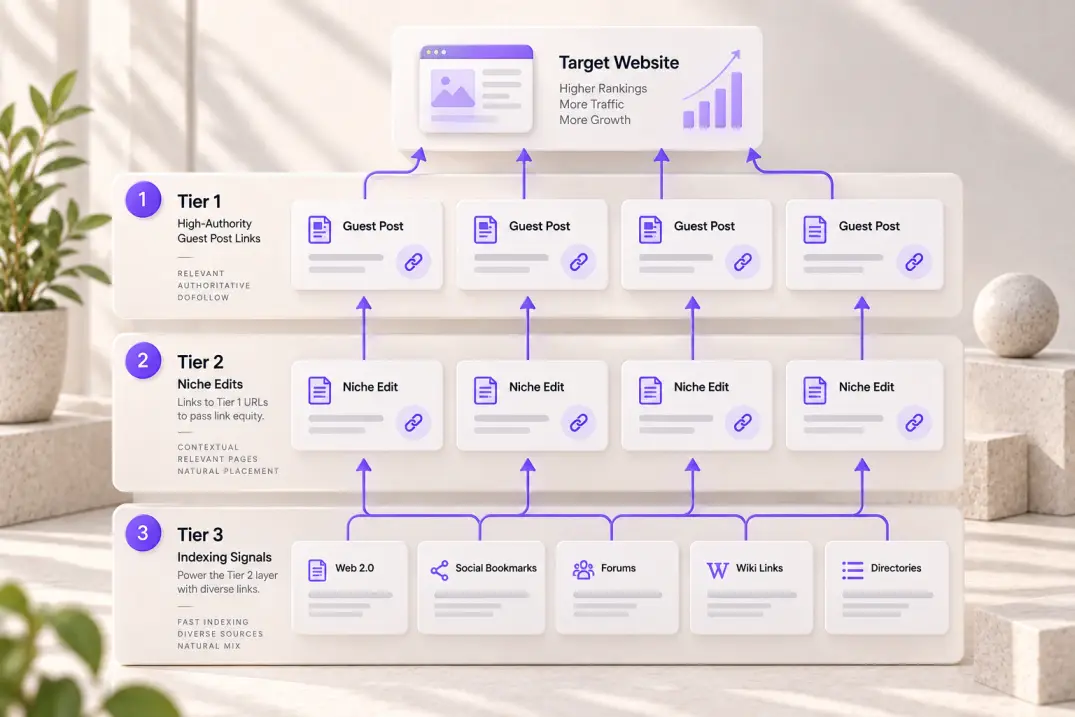
While multi-tier setups protect the root domain from immediate toxic flags, modern machine learning systems in search algorithms can detect tiered linking patterns if lower tiers rely on low-quality link spam.
6. Monthly Retainer Packages
Unlike one-off orders, monthly backlink packages operate as continuous off-page retainers designed to match a site's publishing velocity. An agency might deliver 5, 10, or 20 curated links each month, maintaining consistent velocity and continuously monitoring link health to replace dropped placements.
Strengths: Consistent authority growth, predictable budgeting, and ongoing link profile diversification.
Weaknesses: Can lead to budget waste if your internal content velocity stalls or if the agency exhausts quality placement opportunities within your niche.
Relying on vendor-provided screenshots of traffic rather than auditing live URLs in your own SEO tools is the easiest way to end up on penalized private blog networks.
50 Established Link Building Services & Providers
To help you navigate the broader vendor ecosystem, the following directory outlines 50 established link building agencies, platforms, and managed service providers operating across the digital marketing landscape. These organizations are grouped by their primary operational specialty to help match your specific business requirements.
High-End Editorial & Digital PR Agencies (1–15)
These agencies focus primarily on high-authority media coverage, custom content creation, and enterprise-grade outreach for competitive brands:
| # | Provider Name | Primary Service Specialization | Core Outreach Methodology | Typical Price Floor |
|---|---|---|---|---|
| 1 | Siege Media | Content-led link building & Digital PR | Custom graphic/data assets & editor pitching | $5,000 / month |
| 2 | Fractl | Large-scale Digital PR & Data Journalism | Proprietary research studies & national media pitching | $7,500 / month |
| 3 | uSERP | High-authority SaaS & tech brand PR | Direct contributor & editorial relationship outreach | $4,500 / month |
| 4 | Editorial.Link | Corporate editorial link acquisition | Manual outreach to corporate & technology blogs | $1,750 / package |
| 5 | Page One Power | Custom link campaigns & resource pages | 100% manual outreach & content collaborations | $3,500 / month |
| 6 | NeoMam Studios | Creative visual campaigns & PR | Interactive infographics & editorial news pitching | $6,000 / project |
| 7 | LinkBuilder.io | Bespoke performance link building | Multi-tactic manual outreach (unlinked mentions, PR) | $3,000 / month |
| 8 | JBH | Digital PR & creative search campaigns | Data-driven press releases & journalist outreach | £4,000 / month |
| 9 | Screaming Frog PR | Integrated search PR & media links | Creative newsjacking & media asset distribution | £3,000 / month |
| 10 | Blue Array | Hybrid SEO & PR outreach consultancy | Commercial editorial link acquisition | £2,500 / month |
| 11 | Rise at Seven | High-velocity Digital PR & creative campaigns | Cultural moment newsjacking & national press | £5,000 / month |
| 12 | Aira | Digital PR & authoritative media outreach | Technical PR assets & publisher pitching | £3,500 / month |
| 13 | Propellernet | Coverage-driven Digital PR | Strategic media relations & audience-first campaigns | £4,000 / month |
| 14 | Kaizen | Data-led creative visual link campaigns | Custom visual assets & lifestyle media pitching | £3,500 / month |
| 15 | Reboot Online | Experimental SEO & data PR campaigns | Field experiments & academic media outreach | £3,000 / month |
Curated Niche Edit & Guest Outreach Specialists (16–30)
These providers focus on scalable guest posts, curated link insertions, and flexible catalog orders for agencies and expanding sites:
| # | Provider Name | Primary Service Specialization | Core Outreach Methodology | Typical Price Floor |
|---|---|---|---|---|
| 16 | Stellar SEO | Custom outreach & niche-specific links | High-touch blogger outreach & niche edits | $2,500 / month |
| 17 | Smash Digital | ROI-focused portfolio link campaigns | Private relationship placements & curated edits | $2,000 / month |
| 18 | Rhino Rank | Curated links & bespoke guest posts | Semi-automated outreach with manual QA | $50 / link |
| 19 | Fat Joe | White-label link packages for agencies | Scaled blogger outreach & productized guest posts | $75 / link |
| 20 | Loganix | Vetted guest posts & citation packages | Quality-filtered publisher relationship database | $200 / link |
| 21 | The HOTH | Scaled SEO link bundles & guest posts | Productized tiered packages & managed services | $150 / link |
| 22 | Stan Ventures | Indo-US manual blogger outreach | Fully managed manual blogger outreach | $70 / link |
| 23 | OutReachFrog | High-DR contextual guest posting | Long-form content placements with live reporting | $150 / link |
| 24 | Authority Builders | Curated link marketplace & managed ABC | Pre-vetted publisher inventory with traffic minimums | $120 / link |
| 25 | OutreachX | Contextual guest posts & niche edits | Publisher relationships across niche verticals | $80 / link |
| 26 | Forward Linking | White-hat manual outreach campaigns | Tailored relationship-driven link prospecting | $2,000 / month |
| 27 | Adsy | Self-serve guest blogging platform | Open publisher marketplace with bid pricing | Pay-per-placement |
| 28 | Bibi Buzz | Boutique relationship-driven link outreach | Highly personalized founder-led email outreach | $3,500 / project |
| 29 | OnlyOutreach | Scaled blogger outreach & niche placements | Direct publisher negotiations & contextual links | $1,500 / month |
| 30 | Search Intelligence | Viral PR & authoritative news links | Creative media hooks & mass publisher syndication | £3,500 / campaign |
B2B, SaaS & Technology Specialist Agencies (31–40)
Agencies dedicated to B2B software, cloud technology, and corporate pipeline growth, focusing on high business relevance:
| # | Provider Name | Primary Service Specialization | Core Outreach Methodology | Typical Price Floor |
|---|---|---|---|---|
| 31 | Skale | SaaS SEO & link acquisition engine | Product-led partnerships & B2B content collaborations | $4,000 / month |
| 32 | Omniscient Digital | B2B content strategy & editorial links | Thought-leadership distribution & SaaS partnerships | $6,000 / month |
| 33 | Accelerate Agency | Enterprise SaaS link acquisition | Large-scale content collaborations & enterprise PR | $5,000 / month |
| 34 | Zenpost | Editorial brand building & tech placements | Contributor outreach on verified SaaS blogs | $2,500 / month |
| 35 | Flying V Group | B2B professional service link campaigns | Regional & industry-specific manual outreach | $2,000 / month |
| 36 | Minuttia | Product-led SEO & editorial placements | Targeted B2B co-marketing & content citations | $4,000 / month |
| 37 | Single Grain | Growth-marketing & high-tier tech links | Multi-channel content syndication & PR outreach | $5,000 / month |
| 38 | Foundation Inc | B2B enterprise research & link assets | Original whitepapers & industry publication distribution | $7,000 / month |
| 39 | Codeless | High-volume content production & links | Long-form editorial insertions on major tech hubs | $4,500 / month |
| 40 | Uplifted | SaaS founder-led authority links | Executive positioning & guest editorial features | $3,000 / month |
Local SEO, Citation Bundles & Hybrid Providers (41–50)
Providers specialized in regional pack authority, directory consistency, and multi-location link profiles:
| # | Provider Name | Primary Service Specialization | Core Outreach Methodology | Typical Price Floor |
|---|---|---|---|---|
| 41 | BrightLocal | Local citation packages & directory links | Manual submission to verified regional directories | $3 / citation |
| 42 | Whitespark | Custom local citation audits & builds | High-accuracy manual citation submission & cleanup | $4 / citation |
| 43 | Advice Interactive | Local directory distribution & citations | Direct aggregator API push & manual submissions | Custom quote |
| 44 | Moz Local | Automated directory syndication | Real-time ecosystem data syncing across aggregators | $14 / month / loc |
| 45 | LocalFalcon | Geo-grid tracking & local link audits | Diagnostic local link profile optimization | Software platform |
| 46 | Synup | Multi-location listing & profile management | API partner network distribution | Enterprise quote |
| 47 | WebFX | Full-service enterprise local link packages | Local community outreach, sponsorships, and PR | $1,500 / month |
| 48 | Marketers Center | Wholesale agency citations & geo-links | Scaled local directory packages & city-page links | $50 / package |
| 49 | Victorious SEO | Performance-driven local & national links | Strategic relationship-based link acquisition | $2,500 / month |
| 50 | Sure Oak | Holistic off-page campaigns & edu outreach | Scholar outreach, local sponsorships, and guest posts | $2,000 / month |
Forensic Vetting: How to Evaluate a Package Before Buying
Before committing capital to modern backlink packages, running a five-step forensic audit on sample placements is mandatory. Many agencies gladly provide "sample reports" representing their publisher inventory.
Inspect those domains using independent analytics tools (Ahrefs, Semrush, or Moz) against these five diagnostic criteria:
Step 1: Examine the Traffic Trajectory
A healthy website exhibits steady or rising organic search traffic over a 12 to 24-month horizon. If the candidate domain displays a sudden, cliff-like traffic collapse, it has likely been hit by an algorithmic core update or link-spam penalty. Acquiring a link from a penalized domain passes negative or zero equity to your site.
Step 2: Calculate the Inbound-to-Outbound Link Ratio
Legitimate publications exist to serve human readers, not to function as link vending machines. Inspect how many external links the domain points to relative to its referring domains. If a website has 300 referring domains but links out to 15,000 commercial websites across casinos, pharmaceuticals, crypto, and essay writing services, the site is an obvious commercial link farm.
Step 3: Analyze Keyword Ranking Distributions
A domain boasting 20,000 monthly visits might appear impressive on the surface until you inspect which queries it ranks for. Unscrupulous network operators often inflate traffic numbers by ranking for irrelevant, high-volume foreign terms, automated lyrics databases, or torrent downloads. Confirm that the site ranks for commercial and informational terms relevant to its stated industry.
Step 4: Audit Anchor Text Distributions in Incoming Links
Examine the target domain's own backlink profile. If the site's primary incoming links feature spammy, repetitive anchor text or originate from foreign language scrapers, its authority is synthetic. When Google de-indexes that root domain, every outward link it points to collapses simultaneously.
Step 5: Check Indexation Status in Live SERPs
Never rely entirely on third-party databases. Manually copy the prospective article's URL and execute a precise search query in Google: site:example.com/sample-article-url. If Google returns zero results, the page is not in the primary index. Unindexed links pass zero PageRank, carry zero authority, and represent a total loss of invested capital.
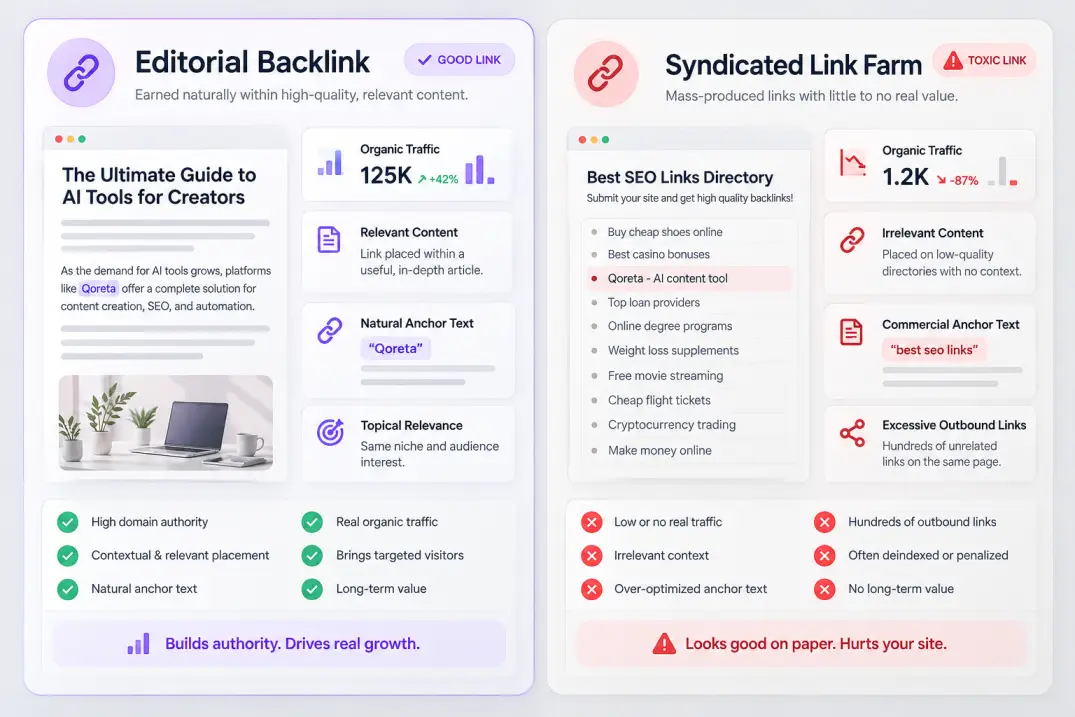
As shown below, comparing an editorial placement against a syndicated farm reveals immediate structural red flags in anchor density, outbound velocity, and topical alignment.
Algorithmic Realities: SpamBrain, PageRank, and Penalty Risks
Google's position regarding commercial link acquisition is explicitly documented in the Google Search Essentials Link Spam Policies. Search engines classify any link intended to manipulate PageRank or search rankings as an explicit violation.
To enforce this at scale, Google deployed SpamBrain, an AI-driven machine-learning prevention system. SpamBrain does not merely scan for obvious keyword-stuffed anchor text; it maps link graph clusters across the web, identifying unnatural link exchanges, sponsored networks, and sudden link velocity spikes.
How Google Treats Paid Links in 2026
In past years, purchasing unnatural links carried a high likelihood of receiving a Manual Action inside Google Search Console, accompanied by a sudden sitewide traffic drop that required submitting a Disavow file and reconsideration request.
Today, Google's algorithms primarily neutralize suspicious links through algorithmic devaluation. When SpamBrain identifies a low-tier guest post farm or automated link package, it simply nullifies the PageRank passed by those links. You may not receive a scary manual action notice, but the thousands of dollars invested in low-grade packages yield zero ranking improvements.
However, aggressive and blatant link schemes—such as redirecting expired foreign domains into a commercial landing page or buying hundreds of exact-match commercial anchors—still trigger manual penalties that can remove your website entirely from search indices.
An e-commerce brand shifted from low-cost syndicated bundles ($50/link) to four high-relevance editorial guest posts ($350/link). Over six months, their core category pages saw a 142% lift in non-brand organic search clicks, whereas earlier bulk packages resulted in zero measurable movement.
The Critical Role of Internal Link Distribution
External links do not operate in a vacuum. A high-authority backlink pointing to a single landing page provides limited benefit if that page does not distribute its newly acquired PageRank across your wider site. Integrating your off-page acquisitions with a strategic internal link architecture ensures that acquired authority flows directly into your conversion-focused URLs.
While off-page link acquisition builds external equity, internal structural distribution determines how much rank juice individual money pages actually retain. For example, autonomous publishing engines like Qoreta automatically establish context-rich internal linking graphs and real research citations during content generation, ensuring that external link authority flows freely through deep pages without getting trapped in siloed architectures.
Authority behaves much like structural masonry: when equity lands on a cornerstone asset, it cascades evenly through internal pathways, as illustrated below.

Without proper site structure, new authority is wasted on dead ends. Similarly, understanding how Google indexes and ranks newly published pages prevents expecting overnight miracles from fresh link packages, while preventing orphan pages keeps your newly boosted URLs crawlable for search bots.
Agency Packages vs. In-House Link Outreach: The Math
Many founders and marketing directors grapple with whether to purchase external agency packages or build an internal link building team. While an in-house team affords complete control over brand voice and relationship retention, the operational overhead is significant.
Consider the direct annual financial math of building an internal outreach engine versus hiring an established agency:
The In-House Link Operation (Annual Cost)
- Dedicated Link Outreach Specialist: 85,000 base salary
- SEO Software Stack (Ahrefs, Pitchbox, Hunter.io, Semrush): $12,000
- Dedicated Copywriting & Content Assets: 120/piece)
- Email Infrastructure & Secondary Domains: $2,400
- Management Overhead & Benefits: $15,000
- Total Annual In-House Investment: 132,400
Assuming a competent in-house outreach manager generates an average of 12 to 15 verified, high-quality editorial links per month (150 to 180 links annually), the true internal cost lands between 880 per link.
The Managed Agency Package (Annual Cost)
- Monthly Retainer Tier (5–8 High-DR Placements/Month): $3,000 / month
- Annual Agency Investment: $36,000
- Total Delivered Links: 60 – 96 vetted editorial placements
- Blended Effective Cost Per Link: 600 per link
For companies producing less than 30 new content pieces per month, external link packages deliver substantially superior cost efficiency by spreading tool licensing, database overhead, and outreach labor across hundreds of clients. In-house outreach only achieves cost parity once a brand scales past 25 acquired editorial links per month.
Final Strategic Checklist Before Purchasing
Before executing a service contract or issuing payment for any off-page link package, ensure your team checks off every item on this pre-flight procurement list:
- Pre-Approval Rights: Does the contract allow you to review and approve target domains and target URLs before the article is published?
- Transparent Replacement Guarantee: Does the vendor provide a written guarantee to replace any dropped, de-indexed, or removed link within 12 months at no additional charge?
- Do-Follow Assurance: Are all delivered hyperlinks standard
dofollowtags rather thanrel="nofollow"orrel="sponsored"(unless explicitly intended for press release syndication)? - Contextual In-Body Integration: Is the link guaranteed to reside inside the main editorial article body, rather than in an isolated author bio box, sidebar widget, or footer disclaimer?
- Permanent Placement Terms: Does the contract guarantee that the placement will remain live indefinitely, without recurring annual "hosting fees" demanded by the publishing site?
By demanding strict quality verification, rejecting low-grade automation, and focusing on contextual topical relevance over raw link volume, off-page link packages can safely unlock higher search rankings and lasting organic pipeline growth.
Artificial Intelligence
Intelligence without limits.
We believe great content deserves honest authorship—even when it's AI.
Frequently Asked Questions
Legitimate manual outreach and guest posting packages typically take between 25 to 45 business days to complete. This timeline accounts for custom prospecting, pitch approvals, content drafting, and external editorial review queues. Any provider promising hundreds of live links within 48 to 72 hours is relying on automated syndication or private link networks.
No reputable agency can ethically guarantee specific ranking positions on Google. Search rankings depend on multiple interconnected factors, including on-page optimization, search intent alignment, technical site health, internal link distribution, and competitor velocity. Links act as an authority catalyst, but they cannot force a poor page to rank.
Domain Rating (DR) is developed by Ahrefs to measure the strength and size of a website's backlink profile on a logarithmic scale from 0 to 100. Domain Authority (DA) is Moz's predictive metric that estimates how likely a domain is to rank in search results based on link data. Both serve as comparative proxies, but neither is used directly by Google.
Yes. If a package utilizes overt link networks, automated comment spam, hacked websites, or unnatural exact-match commercial anchors at scale, Google's webspam team can issue a manual action for unnatural links. However, modern search algorithms more frequently devalue unnatural links silently via SpamBrain rather than issuing manual penalties.
Link acquisition velocity should always correlate with your domain's age, existing link profile size, and content publishing volume. A new site with 10 published pages should aim for 3 to 8 high-relevance links monthly. An established domain with thousands of indexed URLs can comfortably acquire 30 to 50+ links per month without triggering velocity anomalies.
No. Pointing all external links solely to commercial money pages creates an unnatural link footprint. A balanced link acquisition strategy directs 40% of links to helpful informational resources or guides, 30% to the root homepage, and 30% to high-intent product or category landing pages.
A niche edit (or curated link insertion) places your hyperlink into an existing, indexed article that already carries search traffic and PageRank. It is neither inherently safer nor riskier than a guest post; safety depends entirely on whether the site owner genuinely placed the link contextually or whether a third-party broker compromised the host CMS.
Monthly retainers are generally safer because they build links at a steady, natural velocity over time rather than creating a sudden unnatural spike followed by inactivity. Consistent monthly link acquisition mimics authentic digital brand growth in the eyes of search engine crawlers.
Copy the exact URL of each delivered placement and run a `site:example.com/page-slug` search directly in Google. If the search returns the page snippet, it is indexed. If nothing appears, check whether the URL contains a `noindex` meta directive, a canonical tag pointing elsewhere, or a robots.txt disallow rule blocking search bots.
Building an in-house outreach team makes financial sense when your business requires more than 20 to 25 high-tier editorial links per month, has a dedicated content marketing engine, and seeks to build proprietary, long-term PR relationships with industry journalists that external agencies cannot easily transfer.