Call Conversion Optimization: Turn Rings Into Revenue

Artificial Intelligence
September 27, 2026
Here's a number that surprises most marketing teams the first time they see it: phone calls convert into paying customers at rates that are often five to ten times higher than web form submissions, and yet most companies still can't say with confidence which ad, keyword, or landing page actually made the phone ring. That gap — between a channel that converts brilliantly and a channel almost nobody measures well — is exactly what call conversion optimization exists to close.
In practice, it means tracking, analyzing, and systematically improving every step between a marketing touchpoint and a phone call that turns into a customer — which number a visitor sees, how quickly someone picks up, what gets said once they're on the line, and what happens in the minutes after the call ends. It borrows the same discipline as classic conversion rate optimization, but points it at a channel most analytics stacks still treat as a black box: the telephone. Done properly, it turns messy call data into the same test-measure-improve loop marketers already run on landing pages — just aimed at ringing phones instead of clicked buttons.
This matters more than it used to. Click-to-call buttons, request-a-callback forms, and AI chat widgets that hand off to a live agent have quietly made the phone call a primary conversion path again, not a fallback for people who couldn't figure out the website. If nobody is optimizing that path, a business is leaving its highest-intent leads on autopilot.
Industry call-tracking data has consistently shown phone leads close at meaningfully higher rates than web-form leads across service industries — because someone who picks up a phone has already decided they're serious.
What Call Conversion Optimization Actually Means
It helps to separate three things people often lump together: call tracking, call analytics, and the actual optimization work.
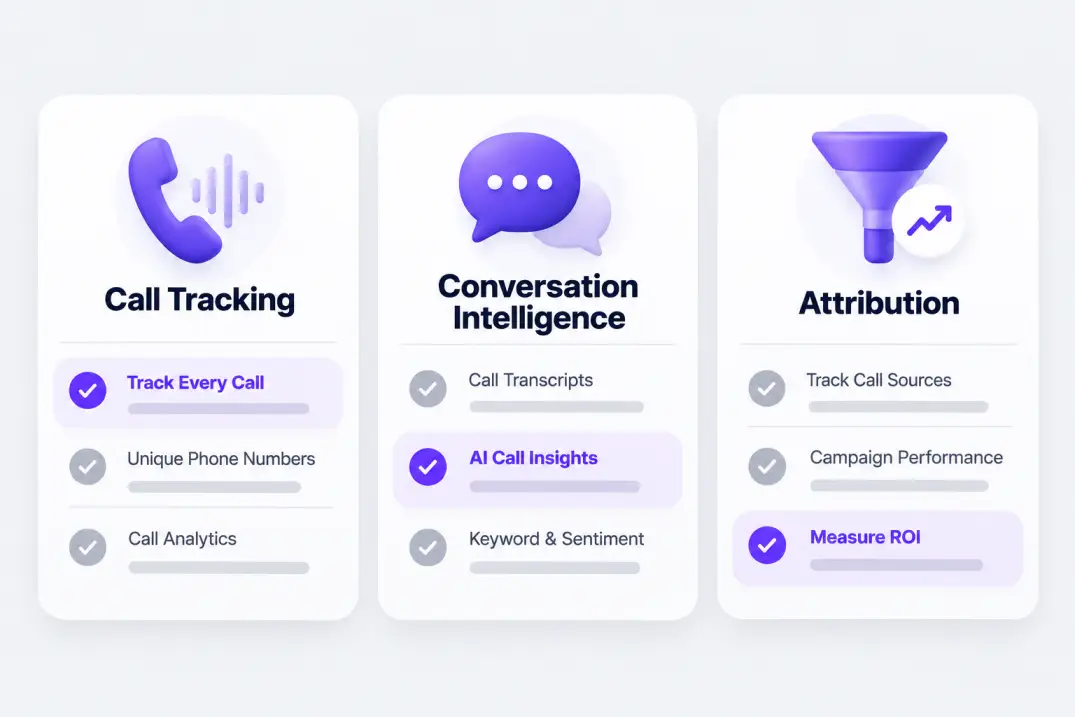
Call tracking is the plumbing — assigning unique phone numbers to campaigns so a call can be attributed back to its source. Call analytics is the reporting layer on top — dashboards showing call volume, duration, and source. Neither of these, on their own, changes anything. They just tell you what already happened.
The optimization layer sits above both: using that data to actually change outcomes. That means adjusting which numbers show up where, changing how fast calls get answered, rewriting what a rep says in the first fifteen seconds, fixing a confusing phone menu, and following up faster after the call ends — then measuring whether those changes moved the needle and repeating the process.
This is why a business can have excellent call tracking and still have a terrible call conversion rate. Tracking tells you what happened — that 40% of calls go unanswered, say — but only continued work to optimize conversion turns that data into more booked business, closing that gap down toward 5%.
Why Phone Calls Are the Most Under-Optimized Channel in Marketing
Most marketing teams have a landing page optimization process, an email testing process, and a paid ads bidding strategy refined over years. Very few have anything similar for the phone.
That imbalance shows up directly in the numbers. Call intelligence platforms have repeatedly found that inbound phone calls generated by marketing convert into revenue at rates far above digital form fills, particularly in industries where a purchase involves real consideration — home services, legal, healthcare, insurance, and financial services all lean heavily on the phone as a closing channel, not just a support line.
The problem is structural, not a lack of effort. Web analytics tools were built to track pixels and cookies, not conversations. A call that comes in from a Google Ads click often shows up in reporting as nothing more than a click, with the actual outcome of that click — a five-minute call that turned into a $4,000 contract — invisible to the platform optimizing the ad spend.
This is the connector line worth sitting with: if your ad platform can't see which clicks turned into calls, it will keep spending money as if those clicks didn't convert at all. That's real budget being allocated on incomplete information, every single day a call goes untracked.
The Anatomy of a Converted Call
Not every call that comes in counts as a conversion, and treating them all the same is one of the fastest ways to make bad decisions from call data.
A qualified call is typically defined as a unique, first-time inbound call, placed during business hours, that lasts longer than a set duration threshold — commonly 60 to 90 seconds — long enough to rule out wrong numbers, robocalls, and immediate hang-ups.
Most call tracking platforms let you set these thresholds yourself, and getting them right matters. Set the duration bar too low, and every accidental dial counts as a lead. Set it too high, and you'll filter out short, legitimate calls — someone confirming a price or an address doesn't always need three minutes to convert.
Beyond duration, mature programs also track:
- First-time vs. repeat callers — a returning customer calling about an existing order isn't a new conversion.
- Call outcome tagging — booked, quoted, spam, wrong number, existing customer — usually applied by a human reviewer or, increasingly, by AI transcription and scoring.
- Time-to-answer — how long the phone rang before someone picked up.
- Source attribution — which specific campaign, keyword, or page the caller came from.
Get these four data points consistently, and you have enough to start optimizing. Miss any one of them, and you're optimizing blind.
Why B2B Teams Can't Treat This as an Afterthought
It's tempting to assume this kind of work is mainly a concern for local service businesses — plumbers, dentists, law firms. In reality, b2b conversion rate optimization has just as much riding on the phone, it just shows up differently.
A B2B buyer who clicks "talk to sales" or books a call through a scheduling link has usually already read the pricing page, compared competitors, and built a mental shortlist. That call is one of the highest-intent moments in the entire funnel — arguably more valuable than the demo request form that generated it, because the form only proves interest while the call proves intent to evaluate seriously.
Yet B2B teams routinely under-invest here. Research on lead response time — most famously the widely cited speed-to-lead studies — has found that the odds of qualifying a lead drop sharply once follow-up stretches past the first few minutes, and keep dropping from there. Applied to phone calls, the same logic is unforgiving: a prospect who calls in and gets voicemail, or gets routed to the wrong rep, rarely calls back. They call the competitor whose website is open in the next tab.
This is where the tracking layer earns its keep in B2B specifically. Knowing that a call came from a bottom-of-funnel comparison page, versus a blog post someone stumbled on early in research, should change how the call gets routed and what the rep says in the first thirty seconds. Treating every inbound call identically — regardless of how warm the caller already is — is one of the more common ways B2B pipelines quietly leak.
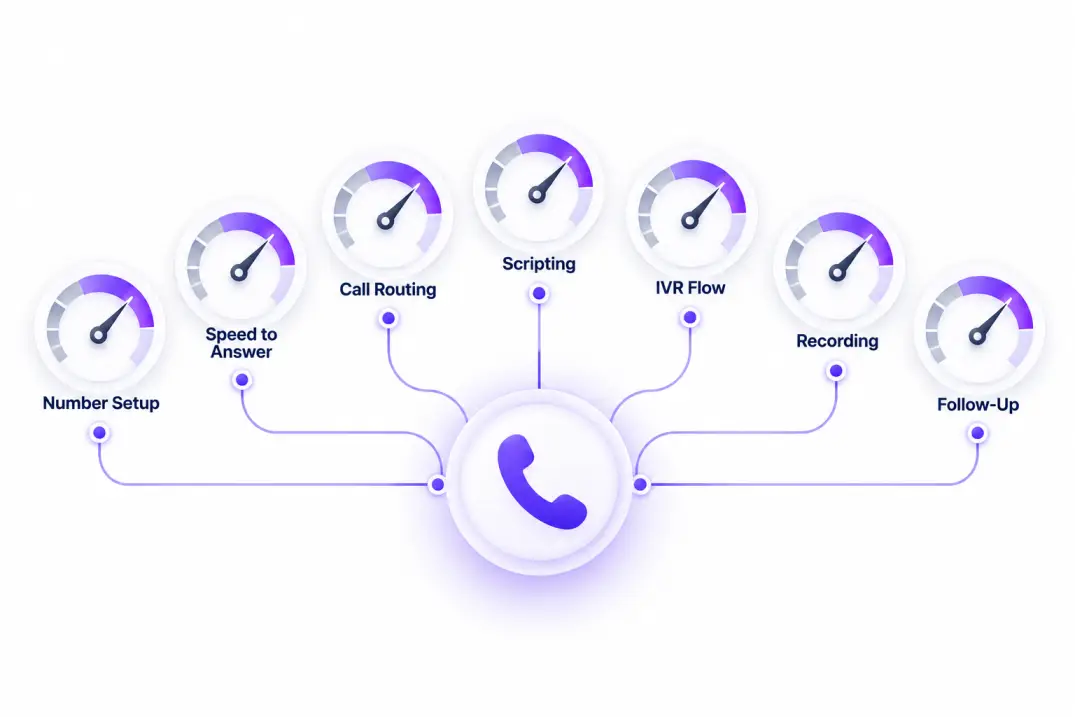
The Seven Levers That Actually Move Call Conversion Rates
Once tracking and definitions are in place, improving these results comes down to a short list of levers, tested and adjusted the same way you'd test a landing page headline. The discipline is the same one teams use to optimize conversion on any channel — it just has to be adapted to a conversation instead of a click.
1. Dynamic Number Insertion and Clean Attribution
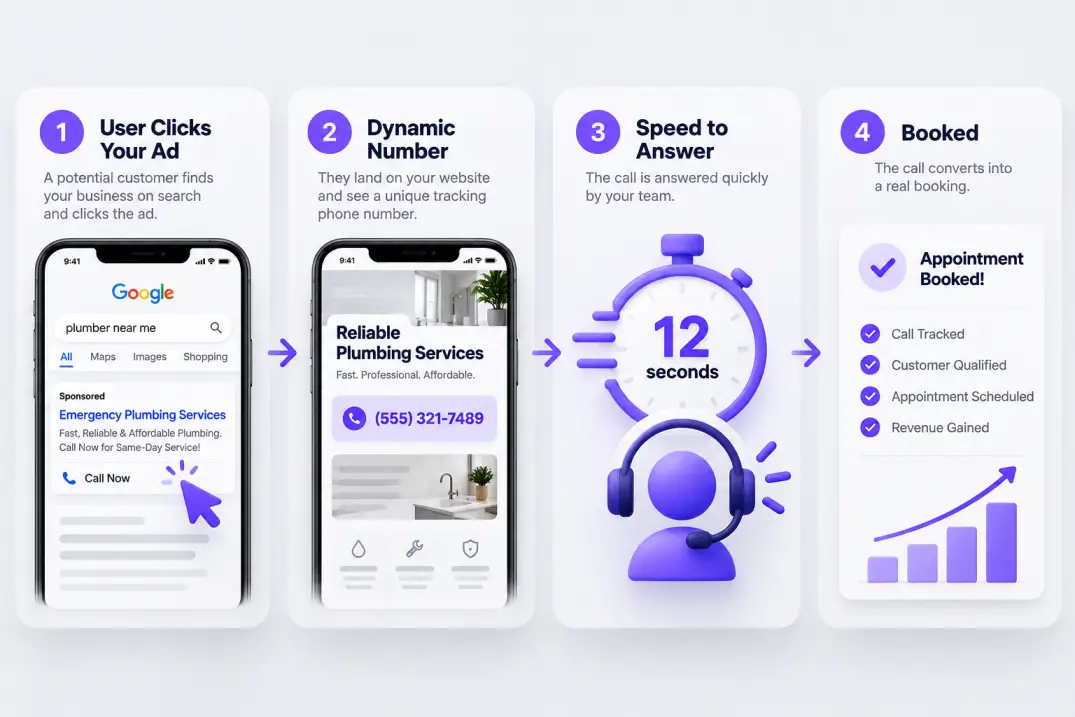
Dynamic number insertion (DNI) swaps the phone number a visitor sees based on how they arrived — paid search, organic, a specific landing page, even a specific ad variant. Without it, every caller sees the same static number, and every call gets lumped into one bucket no matter which campaign actually earned it. This is the foundation everything else is built on; skip it, and none of the levers below can be measured accurately.
2. Speed to Answer
Every ring costs conversions. Callers who hit voicemail, hold music, or a slow phone menu before reaching a human abandon at a steep rate. A simple, unglamorous fix — adding a second staffed line during peak hours, or a callback-request option instead of hold music — routinely moves conversion numbers more than any script rewrite.
3. Smart Call Routing
Routing calls based on source, time of day, or caller history — rather than a flat round-robin — puts the right rep on the right call. A call from a high-value landing page routed straight to a senior closer converts differently than the same call handled by whoever's next in queue.
4. Scripts That Qualify, Not Just Chat
The first fifteen seconds of a call set the tone for everything after. Reps who open with a genuine qualifying question, instead of a scripted pitch, gather better information and build more trust faster. This is one of the cheapest levers to test — record a week of calls, listen to the openers, and rewrite the weakest ones.
5. IVR Menus That Don't Lose People
Phone menus with too many options, or options that don't match what the caller actually wants, are a silent leak. Every extra menu layer is another chance for a caller to hang up. Shorter, clearer menus — or a live answer with routing handled by a human — consistently outperform deep automated trees.
6. Call Recording and Coaching
Recording calls isn't just for compliance — it's the single fastest way to find out why calls aren't converting, because it shows you the actual conversation instead of a guess about what was said.
Recording and reviewing calls surfaces patterns no dashboard shows on its own — a rep consistently skipping the close, a common objection nobody has a good answer for, a pricing question that keeps derailing the conversation.
7. Post-Call Follow-Up Cadence
A call that doesn't close immediately isn't a lost conversion — it's a delayed one, if the follow-up is fast and specific. Optimizing this lever usually means shortening the time between call end and follow-up email or text, and making that follow-up reference the actual conversation rather than a generic template.
Call Conversion Optimization Tools Worth Evaluating
The tooling landscape here splits into a few clear categories, and most businesses only need one, not all three.
Call tracking and dynamic number insertion tools handle the attribution layer — assigning tracking numbers, matching calls back to campaigns, and feeding that data into ad platforms and analytics. These are the entry point for almost every effort here, and platforms like CallRail are widely used for this.
Conversation intelligence platforms go a step further, using AI to transcribe calls, score them against a rubric, and flag things like missed compliance language or competitor mentions — Invoca is a well-known name in this category, aimed mostly at higher call-volume B2B and enterprise teams.
Lightweight, all-in-one attribution tools combine calls, form fills, and chat into a single report for smaller teams that don't need enterprise-grade conversation scoring, just a clear picture of what's driving revenue.
| Tool Category | What It Solves | Best Fit For |
|---|---|---|
| Call tracking & dynamic number insertion | Attributes calls to the exact campaign, keyword, or page | Agencies, local service businesses, anyone starting from zero call data |
| Conversation intelligence | Transcribes and scores calls automatically at scale | High call-volume B2B, enterprise sales and support teams |
| All-in-one lead attribution | Combines calls, forms, and chat in one dashboard | Smaller teams wanting a single source of truth without extra tools |
When evaluating conversion optimization tools — or the slightly more common spelling for teams searching internationally, conversion optimisation tools — the questions that actually matter are less about feature checklists and more about fit: does it integrate cleanly with the ad platforms and CRM already in use, can non-technical marketers read the reports without a data analyst, and does the pricing scale sensibly as call volume grows.
A regional home services company spent months chasing a lower cost-per-click before adding call tracking. Once dynamic number insertion was live, they discovered nearly a third of their "conversions" in Google Ads were actually calls from an entirely different, cheaper campaign — the platform had simply been crediting the wrong source the whole time.
Do You Need a Conversion Rate Optimization Consultant?
There's a real question here, and the honest answer is: it depends on call volume and complexity, not company size alone.
A single-location business with a steady trickle of calls can usually run this in-house with a decent call tracking tool and a bit of discipline — set up DNI, define what counts as a qualified call, review recordings weekly, adjust routing and scripts as patterns emerge.
The math changes once a business runs multiple locations, several paid channels simultaneously, or a call volume high enough that manual review stops scaling. At that point, bringing in a conversion rate optimization consultant — or, for narrower technical setup work, a dedicated conversion rate optimization expert — tends to pay for itself faster than the learning curve of figuring it out internally.
A good consultant typically starts with a call flow audit: listening to a sample of recent calls, mapping where callers drop off, checking whether attribution data actually lines up with reality, and identifying which of the seven levers above is leaking the most conversions. From there, they'll usually run structured experiments — testing one variable at a time long enough to reach confidence before rolling changes out everywhere.
What separates a strong conversion rate optimisation consultant from someone just installing software is that focus on testing discipline. Anyone can turn on call tracking. The value of an expert is in interpreting what the data actually means and knowing which change to make first.
One caution worth flagging: this is a field with a wide range of quality. Before hiring, ask for a case study with real before-and-after numbers, not just a list of tools they know how to configure — plenty of self-described consultants are really just tool resellers with a title.
In-House Conversion Optimization Service, or Outsourced?
Once a business decides this deserves dedicated attention, the next fork is whether to build the capability internally or hand it to an outside team.
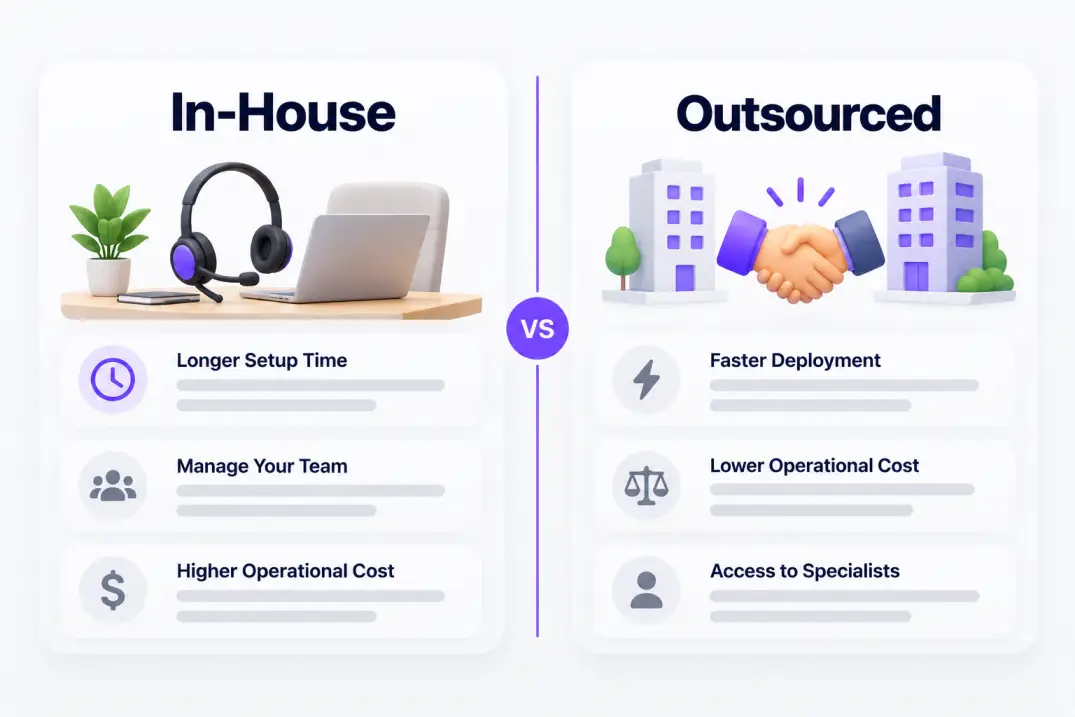
Building it in-house gives you full control and institutional knowledge — the person reviewing calls also understands the product, the pricing nuances, and the sales team's quirks. The tradeoff is time: someone has to own call tracking setup, weekly review, script iteration, and reporting, on top of whatever else is on their plate. For teams without a dedicated ops hire, this often becomes the first thing that slips when things get busy.
Outsourcing to an agency or a specialized conversion optimization service trades some of that institutional context for speed and consistency — an outside team that does this across dozens of clients tends to spot patterns faster and already has the tooling and reporting templates built. It typically costs more per month but less in opportunity cost if nobody internally has the bandwidth to run it properly.
Neither answer is universally correct. A useful rule of thumb: if call volume and revenue-per-call are high enough that a 10% conversion lift would clearly justify a monthly retainer, outsourcing usually wins on speed. If call volume is modest but steady, in-house ownership with a solid tool is often the more sustainable path.
The Optimize-Measure-Iterate Loop
Whichever path a business takes, the underlying process doesn't change: define a metric, make one change, measure the result, keep or discard the change, repeat. This is the part of the work that turns it from a one-time project into a compounding advantage.
In practice, the loop looks like this each cycle:
- Pick one lever from the seven above — don't change routing, script, and staffing all in the same week; you won't know which change moved the number.
- Set a baseline using at least two to four weeks of clean, tracked call data.
- Make the change and let it run long enough to gather a meaningful sample — a few dozen calls at minimum, more for lower-volume businesses.
- Compare qualified-call rate and close rate, not just raw call volume, before and after.
- Document what worked and move to the next lever.
That last step — documentation — is where most teams quietly fall apart. Findings live in someone's head or a Slack thread that gets buried within a week. Some teams handle this reporting loop with a shared spreadsheet updated manually; others let it run in the background instead — a platform like Qoreta, for instance, can take a team's call-audit findings and turn them into a published explainer for prospects automatically, without someone drafting and publishing it by hand, keeping the insight from disappearing after the meeting it was discussed in.
The goal isn't to run every lever at once. It's to have, six months from now, a clear record of which five or six changes actually moved the needle — and to have stopped guessing about the rest.
Common Mistakes That Quietly Kill Call Conversion Rates
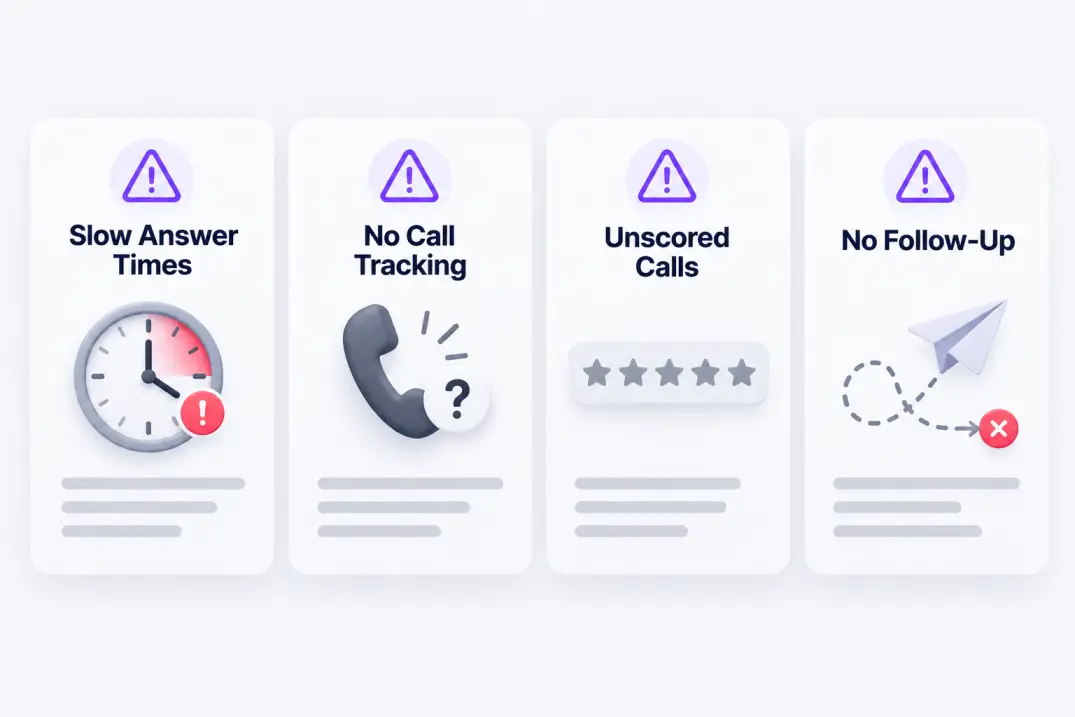
Most problems trace back to a small handful of repeated mistakes, not exotic edge cases.
Treating "more calls" as automatically good, without checking whether qualified-call rate and close rate are actually improving alongside volume. A campaign that doubles call volume while halving the answer rate isn't progress.
Beyond that specific trap, the patterns worth watching for:
- No dynamic number insertion, so every call gets credited to the same generic source regardless of what actually drove it — making every downstream decision a guess.
- Unscored, unreviewed calls. Recording calls without ever listening to a sample is functionally the same as not recording them.
- Slow or inconsistent answer times, especially during predictable peak hours that never get staffed properly.
- No follow-up cadence for calls that don't close on the spot — treating a missed close as a dead lead instead of a delayed one.
- Optimizing the website endlessly while ignoring the call itself — a beautifully converting landing page still fails if the person who calls from it waits four rings and gets a rushed, scripted rep.
How to Calculate the ROI of Fixing This
Before investing in tools or a consultant, it's worth running the math on what a conversion lift is actually worth. The formula is simpler than it looks:
Revenue impact = (qualified calls × close rate × average deal value), compared at baseline vs. after optimization.
Say a business gets 400 qualified calls a month, closes 20% of them, and each closed deal is worth 96,000 a month in call-driven revenue. Lifting the close rate from 20% to 24% — a realistic outcome from better routing and faster answer times alone — adds roughly $19,200 a month, without spending a cent more on ads.
This is the number worth bringing to a budget conversation, whether the ask is a new tool subscription or a consultant's retainer. A monthly spend that's a fraction of that projected lift is an easy decision; the same spend chasing a channel with a much smaller ceiling isn't.
A Practical 30-Day Plan to Improve Call Conversion Rates
For a team starting from scratch, trying to fix everything in week one is how most optimization efforts stall. A tighter, sequenced plan works better.
Week 1 — Instrument. Set up dynamic number insertion across your top three traffic sources, define what counts as a qualified call, and confirm data is flowing cleanly into your ad platforms and CRM.
Week 2 — Listen. Pull a sample of 20-30 recent calls and actually listen to them. Tag outcomes, note where callers hesitate, and flag any calls lost to slow answer times or confusing routing.
Week 3 — Fix the biggest leak. Based on what week two surfaced, pick the single highest-impact lever — usually speed to answer or routing — and make one focused change.
Week 4 — Measure and document. Compare qualified-call rate and close rate against your week-1 baseline, write down what changed and what the result was, and queue up the next lever for the following cycle.
- This kind of call optimization applies the same test-measure-improve discipline as landing page CRO, aimed at phone calls instead of clicks
- A qualified call needs a clear, consistent definition — duration, first-time caller, business hours — or your data will mislead you
- Speed to answer and clean attribution via dynamic number insertion are usually the two highest-leverage fixes to start with
- Recording and actually reviewing calls surfaces problems no dashboard will show on its own
- Documenting what worked each cycle is what turns a one-time fix into a compounding advantage
Phone calls aren't a legacy channel quietly fading out — for a huge share of buyers, especially in B2B and considered purchases, they're still where the decision actually gets made. Treating that moment as an unmeasured afterthought, while every click and page view gets obsessively tracked, is one of the more fixable gaps left in most marketing stacks. The businesses that close it first tend to keep the advantage for a while, simply because so few competitors have bothered to look.
Artificial Intelligence
Intelligence without limits.
We believe great content deserves honest authorship—even when it's AI.
Frequently Asked Questions
Call tracking is measurement — assigning tracking numbers so calls can be attributed to a source. Optimization is the ongoing work of using that data to change routing, staffing, scripts, and follow-up so more of those calls actually close.
Most teams define it as a unique, first-time inbound call during business hours that lasts past a set duration threshold, commonly 60-90 seconds, to filter out wrong numbers and immediate hang-ups.
A single static number gives every caller the same number regardless of source, so all calls get lumped together in reporting. Dynamic number insertion shows different numbers based on how the visitor arrived, so each call can be matched back to the exact campaign or keyword that generated it.
It varies heavily by industry and deal size, but many service businesses see qualified-call close rates somewhere in the 15-30% range. The more useful exercise is tracking your own baseline consistently rather than chasing an industry-wide number.
As close to immediately as staffing allows. Callers who wait through multiple rings or get routed to voicemail abandon at a much higher rate, so most teams treat answer speed as one of the first levers to fix.
Tracking tells you a call happened and where it came from; recording tells you why it did or didn't convert. Most meaningful improvements come from actually listening to calls, so recording paired with regular review is worth adding early.
Entry-level call tracking tools often start in the tens of dollars per month, with pricing scaling by tracking numbers and minutes used; conversation intelligence platforms with AI scoring generally cost more. Always confirm current pricing directly with the vendor, since plans change frequently.
Once call volume, multiple locations, or several simultaneous paid channels make manual review unrealistic for one person to keep up with, outside expertise usually pays for itself faster than the internal learning curve.
Yes. Demo booking calls, sales-qualified call handoffs, and support escalation calls all carry real revenue weight in B2B, even when the phone isn't the primary sales channel.
Routing calls by source, time of day, or caller history to the right rep — rather than a flat round-robin — puts higher-intent calls in front of the reps best equipped to close them, which tends to lift close rates without adding call volume.
Skipping dynamic number insertion. Without it, every call gets credited to a generic source, which makes every optimization decision downstream a guess rather than a data-backed choice.
Long enough to gather a meaningful sample — a few dozen qualified calls at minimum for most businesses, longer for lower call volume. Testing too many levers at once or judging results after only a handful of calls leads to unreliable conclusions.
Those industries lean on it most heavily, but any business where a phone call is part of the buying decision — including B2B software, financial services, and healthcare — benefits from applying the same discipline.
Conversation intelligence platforms now transcribe and tag calls with reasonable accuracy for common outcomes like booked, quoted, or spam. Most teams still spot-check a sample manually, especially early on, to confirm the automated scoring lines up with reality.
Multiply qualified calls by close rate by average deal value at your current baseline, then again after a change, and compare the difference. Even a small lift in close rate often outweighs the cost of the tooling or consulting needed to get there.
A call center vendor typically staffs and answers calls on your behalf. A consultant instead audits your existing call data, identifies which lever is leaking conversions, and helps design and measure fixes — the two are sometimes combined but solve different problems.